





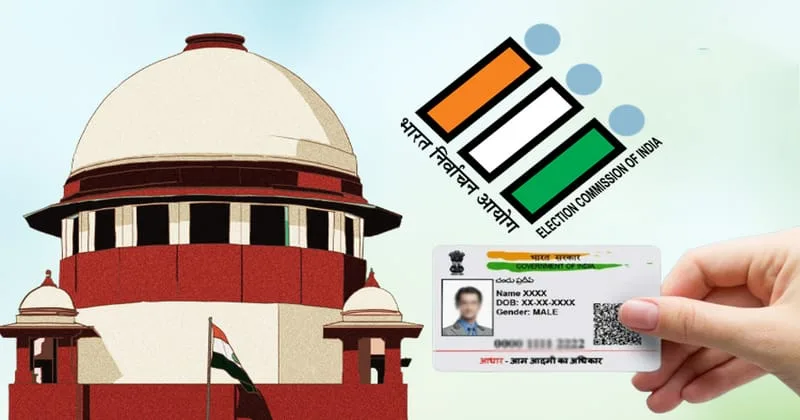
The Supreme Court on November 25 weighed in sharply on controversies surrounding the Special Intensive Revision (SIR) of electoral rolls, questioning whether possession of an Aadhaar card for welfare benefits should automatically translate into voting rights.
The bench, headed by Chief Justice of India Surya Kant and Justice Joymalya Bagchi, underscored that Aadhaar alone does not qualify as proof of citizenship, a point that could have major implications for political parties seeking to expand their vote banks.
During the hearing of petitions challenging the constitutional validity of the SIR exercise, the CJI noted, “An Aadhaar card is created under a statute and is valid to the extent that it confers the benefits or privileges associated with it. That is indisputable. After all, an Aadhaar card serves a specific purpose under a specific law.”
He added pointedly, “Suppose there are individuals who have entered India from other countries and are working here, perhaps as poor rickshaw pullers or laborers on construction sites. If they are issued an Aadhaar card to access subsidised rations or other welfare benefits, that aligns with our constitutional ethos and moral framework. But does receiving such benefits automatically entitle them to vote? That is a separate question.”
The Chief Justice’s remarks came in response to concerns raised by Senior Advocate Kapil Sibal, representing West Bengal and Kerala, who highlighted the risk of excluding bona fide voters. “There is a presumption at play, I make a self-declaration that I am a citizen, that I reside here. I possess an Aadhaar card, which reflects my residence. If you want to take that away, do it through a proper process, and that process must be established before Your Lordships,” Sibal said.
Referring to Bihar’s SIR exercise, the CJI observed that only a few objections had been reported. “If there are cases where a bona fide resident and citizen of India has been excluded, we have been eagerly and actively looking for such instances so that any procedural errors can be corrected,” he said.
Sibal also raised the question of what recourse a voter would have if, upon arriving at the polling booth on election day, they discovered their name was missing from the electoral roll. The Chief Justice responded that in Bihar, extensive media coverage and daily reporting ensured even voters in remote areas were aware of the revisions.
Justice Bagchi highlighted that while software tools can identify duplicate voters, they cannot detect deceased voters. “It all depends on the political gradient. A stronger political party may take advantage by using the votes of dead persons. We don’t judge in a vacuum, that is why these names must be weeded out. It is not about party A or party B; if the power gradient favors party A, then all the dead voters’ ballots effectively go to party A,” he explained.
The bench stressed that no survey is ever 100 per cent accurate, which is why draft electoral rolls are published for scrutiny. Publishing lists of deceased and shifted voters in public forums, including panchayats and official websites, was deemed critical for transparency and voter confidence.
Petitions challenging the SIR process in West Bengal, Tamil Nadu, and Kerala have cited logistical difficulties, with Kerala holding local body elections on December 9 and 11. Senior Advocate Rakesh Dwivedi, representing the Election Commission of India, countered that 99 per cent of voters had already received enumeration forms and that 50 per cent of these forms had been digitised. He said the SEC and ECI were facing no operational difficulties and that only a small number of Booth Level Officers (BLOs) were needed.
The Court directed the ECI to file counter-affidavits and scheduled hearings for the Tamil Nadu and West Bengal petitions on December 4 and 9, respectively. It also asked both the ECI and the Kerala State Election Commission to respond to challenges against the ongoing SIR exercise.
The SIR process, aimed at updating and verifying electoral rolls, has multiple uses: identifying duplicate or deceased voters, ensuring accurate voter records, and enhancing overall electoral integrity. Bihar’s implementation demonstrated how extensive media coverage, public participation, and careful scrutiny can produce largely inclusive and error-free electoral rolls, offering a model for other states.
By emphasising that Aadhaar does not confer voting rights, the Supreme Court has sent a clear message to political parties seeking to broaden vote banks through welfare-linked voter inclusion, implicitly cautioning against attempts to use social benefit schemes to influence electoral rolls.















Comments