





There is no dearth of the suppressed historical facts that are being unveiled by researchers in relation to the history of Indentured labour, or what we term as forced migration, or indeed human trafficking under British rule, from India. The propagandist colonial history that people willingly migrated from India, because of poverty and caste oppression, has now fallen to ground due to the concerted efforts of contemporary researchers, who look beyond the colonial spectacles, in order to unmask the concealed realities of colonial oppression and deceit.
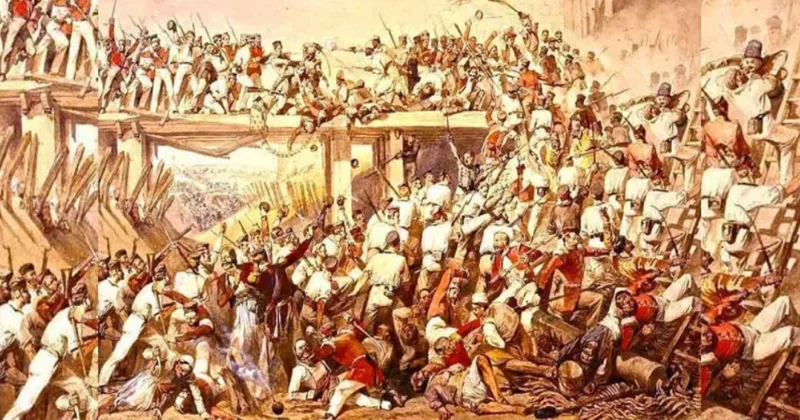
The British atrocities and brutalities like blasting freedom fighters with cannons; en masse hangings on trees; the burning of villages; loot and imprisonment are known facts of what the British termed as ‘punishment’ and ‘teaching a lesson’ to those who fought for freedom against the British King in 1857. However, another meted-out brutality was the deportation of Freedom Fighters thousands of miles away, chained aboard ships sometimes along with their families, which also served to replace the slave labour in the plantation colonies: a brutal punishment cleverly concealed by colonial historians.
In spite of the records on forced deportations of these freedom fighters and the ship records clearly mentioning the ‘castes’ of those who were forced on the ships to avoid the British jails and ruthless persecution in India, the colonial mindset insisted that it was the ‘low caste’and the poor who left India in search of a better life. But was this so-called life in the estates better/different from the earlier slaves in plantation colonies or the way British oppressed the poor in India? No! The working conditions were the same, restrictions were the same and the whip was the same towards the Indians as for the slaves. Britain’s desire to crush and exploit the Indians, remained the same, whether in India or overseas.
After the abolition of slavery, the British plantations were dying resulting in heavy economic loses to the planters who were mainly British aristocrats or wealthy merchants. They saw an opportunity to entrap labour for the colonies from India who were in British eyes ‘rebels’ for waging war against the British King. On one hand were the Indian Freedom Fighters sacrificing their lives for freedom and on the other hand were these planters conspiring with the British authorities to convert Indians of all ‘castes’ into labourers to fill the vacuum of slave loss.
British records themselves reveal that planters in Trinidad alone had asked for 70,000 out of the vast unknown numbers of the Indian Freedom Fighter soldiers from the First War of Indian Independence of 1857. This was British justice for their offence of treason and waging war as they had committed the crime for daring to free their own motherland.
Cunningly, the words used were migrant and emigration. The Geoghegan Report on Colonial Emigration mentions that between 1858 to 1862, the number of migrants to Mauritius, Guyana, Trinidad, Grenada, St. Lucia and Jamaica was 157,719. This report further mentions that most out of the 90,000 who had ‘migrated’ to Mauritius were sepoys/sipahis (soldiers). However, this brutal reality of human trafficking has not only been concealed in history books but was distorted to propagate that Indians had willingly migrated to avoid poverty and caste oppression. Even today, the colonial apologists carry forward this distortion under the garb of Migration studies or Mobility studies.
This loot of labour was concealed the same way it was concealed that Queen Victoria had a share in the looted treasure that the British had amassed describing it as “war booty” during 1857-58. However, historical realities and facts in spite of distortions and concealments can never be erased. These “indentured labourers” carried with them not only their religion, customs and traditions but also the memories of their struggle against the British. No doubt, these were not discussed overtly in the plantation colonies but there are several fascinating anthropological facts from southern Trinidad which bear testimony to these archival details.
Consider their township name of Penal. The word itself is related to, or used for, “…prescribing the punishment of offenders under the legal system”. Among the first such Penal settlements for the Indian Freedom Fighters of 1857, was the Andaman Penal settlement in the Bay of Bengal. However, there is no doubt that Penal town in Trinidad today, derives its name from where Indian Freedom Fighters were transported and kept under surveillance. Penal incarceration was well practiced by the British, who meted it out even to their own subjects, by transporting convicts including women and children, to far-off Australia. Unquestionably the Indian Freedom Fighters were considered both convicts and rebels, for many of them were convicted for deportation either just after arrest, or in some cases after a semblance of court trial for treason.
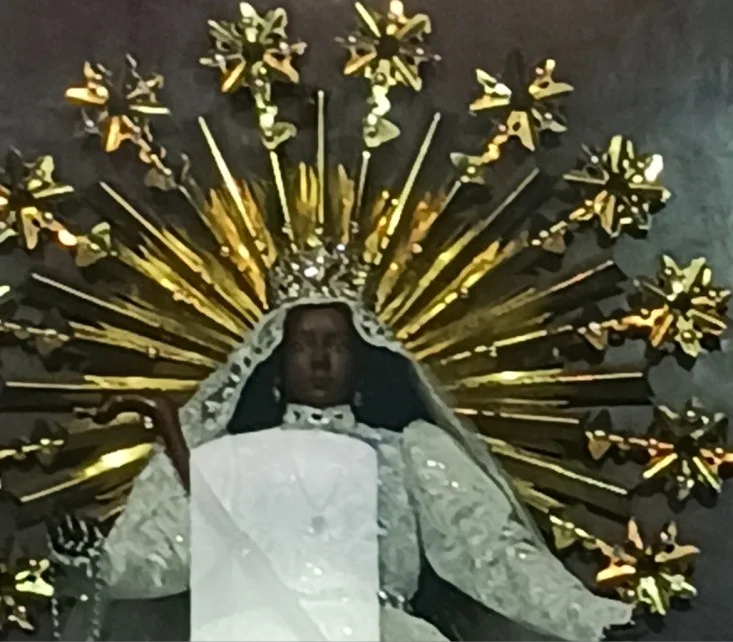
But there is another compelling piece of evidence regarding the presence of Indian soldiers in Trinidad. The name throughout most of northern India for soldier or warrior, is sepoy or sipahi. This also explains why the Indian community in Trinidad have long worshipped, ‘Siparia Maa’ also known as ‘Sipahiya Maa’ or ‘Sipahi Mai’: the Mother of sepoys/sipahis i.e. Mother Kali. She is known in Hinduism to be the Deity of War, particularly for soldiers, or sipahis. It is no coincidence therefore, that the place where Her form is worshipped, is in a town called Siparia, which is adjacent to Penal. She is dark in complexion, as are all forms of Mother Kali. It must be noted here that in every native, i.e. Indian regiment of the East India Company, there used to be a temple wherein the soldiers not only worshiped Kali Maa, but which were also centers for planning the independence battles against the British till 1947. In fact, the Indian revolutionaries sought the blessings of Kali Maa and Subhas Chandra Bose had also before secretly leaving Calcutta had got the blessings of Kali Maa from the Dakshineshwar Temple.
This practice had begun long before, as almost 90 years earlier, in 1770, Sadhus and Fakirs had fought against oppressive British rule for almost 30 years when 100 Sadhus had been shot in Bengal and Vande Mataram became the war cry for liberation in this ‘Sanyasi Rebellion’. Sadhus continued to play a major role not only in 1770, but in 1857, and tirelessly until the British were forced to leave India in 1947.
Returning to the ‘open secret’ of the relation between place names in Trinidad and Indian ancestral history, there are other striking examples. It was at Barrackpore in Bengal, a major British army cantonment, that Mangal Pandey fired the first shot against the British in 1857, and Fyzabad in Uttar Pradesh, (the ancestral state of a majority of West Indian PIOs), were the epicenters for this war for independence, for a year. Based on the memories of these battles, towns in Trinidad were likewise named: Barrackpore, Fyzabad, Calcutta Settlement, Delhi Settlement, Hindustan, Matura (Mathura), Patna Village or the street name Meerut: all centers of the battles fought against the British by the Freedom Fighters in India.
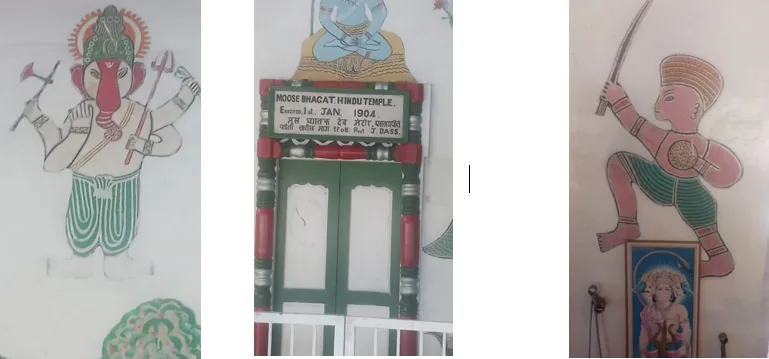
At the Moose Bhagat Temple (built in 1903 and consecrated in 1904), also known as the Kutiya, in Tableland, again in south Trinidad, one can easily see several paintings, including one of a soldier with a sword and shield in his hands and the other of Lord Ganesh with a Trishul (trident) and a Pharsa (Axe) in his hands. These paintings undoubtedly came from the memories of their Indian ancestors who were from among the soldiers who had fought the British in India, for it is a typical for a Ganesh temple to portray Him primarily as a warrior.
What British historians, Marina Carter and Crispin Bates describe as a policy of “wholesale transportation of every mutineer” along with their families, we would describe as the British psyche based on the desire for profit and punishment. “If the families protested…,” it was suggested by the Secretary of State for the Colonies, Hendry,“to…hang their dead bodies, headless, in chains, and plant the head in a conspicuous quarter, near the habitations of the living – the fashion will soon cease… Chains and fetters may be necessary in some of the islands… the hair should be cut in a particular fashion and the dress, of such a pattern, as to distinguish those under transportation from the free natives”. According to Philip Wodehouse, a British Colonial Administrator, these soldiers were “…liable to the heaviest punishment…if not for murder and robbery, at any rate for mutiny and desertion”.
Undoubtedly, many among those Freedom Fighters whom the British could not get hold of, went disguised labourers to the colonies to evade torture, imprisonment or the noose. Many were also those who had been imprisoned by the British for treason earlier, for daring to oppose British rule, and now had been liberated when compatriot Freedom Fighters broke open the jails: particularly in Uttar Pradesh and Bihar (the ancestral states for the majority of Indo-Trinidadians). The British could hardly catch them again, and it is acknowledged in the British records that many went to the sugar colonies.
One must also recall here, that most of these Freedom Fighter soldiers belonged to the peasant families connected to agriculture, and during the 1857 War, the villager too had become a soldier fighting the British even with a sickle or a stick. All castes were forced to depend on the land, as traditional professions were destroyed by the British in their desire for funding their Opium and Indigo trade, besides meeting the demands for their own Industrial Revolution at the cost of the prosperity of Indians. However, it does not mean that all Indians were therefore historically labourers. In fact, a British official commented that the, “…worst of the Hindustanees sepoys were not more dangerous than many of their village brothers”. Further evidence has been uncovered with respect to the warrior ancestry of the ‘migrant labourers.’ One Emigration Agent wrote to the Secretary of the Bengal Government in October 1859, that many of the higher castes Hindu people ‘employed’ as ‘migrant labourers’, had belonged to the armies of the Indian Princely states. These native armies had been disbanded under British coercion which created unemployment and more pressure on agricultural land forcing them to move out. No doubt, the impoverishment of a prosperous India was a direct result of British exploitation and oppression.
In 1862 for instance, there was trouble on the ship Clasmerden which was sailing from Calcutta to Demerara in Guyana. The West Indies Emigration Agent mentioned that, “…about 25 or 30 of these men, who possessed evidence of military training, may have probably belonged to mutinous Regiments or the rebel force”. This fact according to him “…was generally carefully concealed by them”. The majority of the Indians on this ship were from Eastern Uttar Pradesh and Oudh/Awadh/Ayodhya: again the land of origin of the Indian community in the West Indian plantation colonies. One can now understand that apart from slave era practices being habitual, whenever Indians protested in the colonies, not only were they fired upon, (as in Guyana and Trinidad) but suspicions were raised that they were instigated by the 1857 ‘ex-mutineers’ in the colony.
It also explains the persistent devotion for the Ramayana that this population maintains. Having their origins in the homeland of the Ramayana and perceiving their own parallels with the epic, as banished from home, fighting foreign rulers and longing for a return to their motherland, the enduring love of these West Indian, Indians for the Ramayana, remains unique.
Interestingly, whereas there had been a Society in Britain for the Abolition of Slavery, considering slavery inhumane, none had been formed for the prevention of cruelty towards Indians, though Indian ‘Indentureship’ followed closely on the heels of Slave Emancipation. Why? Because whereas the slaves had been seen as a source of labour for the British, the Indians besides labourers were also viewed as a threat to the British Empire.The British knew well that if India, the ‘Jewel in the British Crown’, fell, then the might of Britain itself would fall, and as such, Indians had to be treated with a harsh hand whether in India or abroad. No slave rebellion in the colonies threatened the stability of the Crown, but a war in India, certainly did.
Such was the fear as Carter and Bates point out, that the press reports claimed in 1873 that the ‘rioters’ were intending to recreate, “…on a small scale in British Guiana the part their countrymen played in the terrible drama at Cawnpore, [Kanpur, another centre of the 1857 War] sixteen years ago’’. The British, whether in Britain, India or the plantation colonies, remained in fear of an Indian uprising and recreating the events of 1857.This fear was so deep-seated that Auchinleck, the British Commander-in-Chief of India was terrified even almost a century later in 1946, when he wrote to the Viceroy that an 1857 type situation had emerged and if they were to remain in India he would need 1,00,000 European soldiers to re-conquer India. How then can Indians be seen as merely passive, weak and docile agricultural labourers in the colonies with the British being aware of their 1857 connections?
There are records which demonstrate that in Guyana, the planters were apprehensive about ‘high caste’ Indians and soldiers, who could have been present in disguise in the plantations, and hence instructions were issued to the Agent in Calcutta to ‘’…prevent Brahmins, Thakurs, Fakirs and other non-labouring castes from embarking for the colony”. Many pundits or Brahmins were also deported from Guyana on suspicion of instigating fellow Indians to strike: again proving there was a range of people who were sent to the West Indies and that they certainly did not all come from a solely agricultural background.
It is hardly likely however, that the British would have desired and paid for their return to India, from where they would easily oppose British rule again, armed this time with personal information regarding the conditions in the colonies. Nor could such Brahmins be killed in the colony itself, and again risk mass uprising of the Indian population. Further research may reveal the probability that they were killed at sea, (a method already practiced at Nelson Island in Trinidad), thus not allowing Indians either in India, nor the Caribbean region, to know their fate and rise in dissent. This probability gains credence for in Fiji many Indians who demanded fair treatment and food were transported in small boats on the pretext of taking them to other plantations and the boats were sunk: a mass murder again concealed by the British.
One cannot calculate the number of villages that were burnt, destroyed or leveled to the ground during 1857-59 as ruthless retaliation by the British. Nor can one ever calculate the number of those Freedom Fighters blasted, hanged, killed by bullets or butchered and thrown into wells. All this was done to set an example of brutal oppression directed towards the Freedom Fighters and the common people who fought along with them. This the British officers often subsequently sought to describe as the “…inhabitants were well punished”. Not only this, but where the whole village could not be burnt like at Shahbad, (in Bihar), the British Magistrate repented that the, “…burning was not so satisfactory as I could have wished”. Entire villages were blacklisted for punishment, forcing many villagers to flee their homes for safety. Is this the willing migration that colonial apologists propagate as one in which Indians fled British India due to Indian religious and social injustices, but were thankful for British rule in colonies like Trinidad? If so, then why have the majority of them remained Hindu even after almost 200 years away from India? Why was there no eager conversion away from the supposedly superstitious backward practices of Hindu India?
Though the policy of direct oppression and punishment for ‘rebels’ was suspended in 1859, it was done in the fear that continued brutality would simply trigger an even more intense and determined fight by Indians for independence. Yet, the indirect punishment had far more devastating results. The regions of Purvanchal in Eastern Uttar Pradesh and Bihar were pushed into backwards and poverty. For the dislocated of all castes, or those who had lost everything, there was no alternative left than to become labourers, which was a boon for the British planters whether in the tea plantations of Assam in India, or in the plantations abroad. In fact, thus started the Palayan (forced migrations or escaping from brutalities) from Bihar and Purvanchal in the absence of a livelihood even through traditional professions of artisans and soldiers.
Carter and Bates have given a descriptive account of how the West Indian planters lobbied in London over the prospects of getting the “mutineers” transported to the dying plantations which were in want of labour. Revealingly, it was also recommended that “…the Colonial Garrison should be adequately strengthened with white troops…”and “if the Indians misconduct themselves, they should be removed from the estates and made to work as convicts in penal gangs” in the colony. (Again, note the word Penal here.) In fact, the lobbyists for Trinidad in London, wanted 10,000 of them immediately, and by October 1857, the scheme had been given a green signal by the Chairman of the Standing Committee on Immigration.
Singapore, had already turned back a ship of such deportees and there were a few dissenting voices from other colonies also, for Carter and Bates have quoted a member of the St. Vincent Council who stated, “I have no hope that a cruel, infuriated and expatriated soldiery can be brought to become a peaceful industrious and contented peasantry – coerced into habits of labour they may be – but only by force of arms, or by converting the colony into a penal settlement.” However, these voices had no value in the overriding British desire for the permanent removal of Indian warriors from Indian soil, and the simultaneous economic survival of their failing plantation colonies.
At a time when the Indians in the West Indies are delving deep to uncover the reality of their ancestors, we continue to engage in this immense field of history spanning both India and the West Indies which the current Indian generation must also be aware of. For instance, there is still a family in Trinidad who evading the British, managed to bring a sword aboard a ship, nor can it be a coincidence that many Indian revolutionaries of the Gadar Party had toured the Caribbean countries during 1913-20. There are also accounts from British clergymen and historians of that era visiting Trinidad, such as Charles Kingsley, who wrote that being cautious, these Freedom Fighters sought to hide their identity from others, including from their children. After escaping British capture in India, would they risk exposure in a colony which was also under British rule? The experiences of 1857 formed a psyche for survival, keeping the future in mind and the then still oppressive conditions in plantations.
The history of Indians in the West Indies, is a part of our own collective global Indian history, these are our own shared ancestors who revolted against continued colonial rule in India and resisted conversion, thus retaining Indian heritage unabashedly. At a time when many NRIs renounce their heritage and allegiance, here are Indians who have shown more patriotism to India without any recognition or even appreciation. This explains why the recent visit of Indian Prime Minister Modi Ji in July 2025 to Trinidad, evoked such an enthusiastic response among the PIO’s that the slogans of “Bharat Mata Ki Jai” and “Jai Shree Ram” rented the skies of Trinidad welcoming him.










Comments