





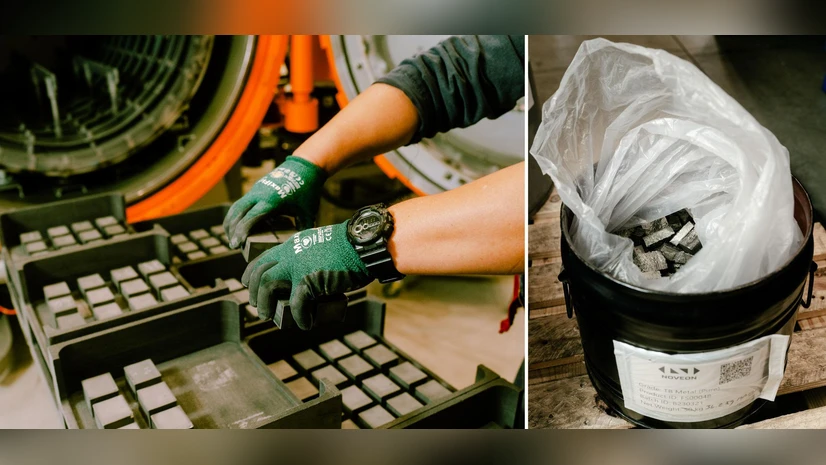
In one of the most strategically important industrial approvals of the decade, the Union Cabinet, chaired by Prime Minister Narendra Modi, has sanctioned a Rs 7,280 crore scheme to catalyse domestic manufacturing of sintered Rare Earth Permanent Magnets (REPM). These magnets, used in electric vehicle motors, wind turbines, missile guidance systems, drones, satellites, industrial automation, medical technology and high-performance electronics, are considered foundational to the technological and industrial competitiveness of a modern nation.
The decision of November 26 therefore, signals the Modi government’s intent to break India’s long-standing dependence on imported high-strength permanent magnets, particularly from China, which dominates over 85 percent of global REPM supply.
The scheme, formally titled the “Scheme to Promote Manufacturing of Sintered Rare Earth Permanent Magnets,” is the first national initiative to create an end-to-end domestic ecosystem, from rare earth oxide processing to metal and alloy production, and finally to high-grade sintered magnets. With the global supply chain for critical minerals facing increasing geopolitical disruption, the timing of India’s intervention is both economically prudent and strategically essential.
Building India’s first REPM Industry
The new scheme aims to establish a domestic capacity of 6,000 metric tonnes per annum (MTPA) of REPMs, a scale considered sufficient to meet India’s medium-term national requirements. The magnets in focus include neodymium-iron-boron (NdFeB) sintered magnets, the strongest and most sought-after magnets globally, powering everything from EV motors to next-generation weapon systems. Currently, India imports nearly the entire requirement of these magnets, despite being rich in rare earth mineral deposits. The Cabinet’s decision seeks to change this structural vulnerability by fostering India’s own REPM metallurgical and manufacturing expertise.
The scheme will provide a robust blend of sales-linked financial incentives and capital subsidies. Of the total Rs 7,280 crore outlay, Rs 6,450 crore has been earmarked as sales-linked incentives to be disbursed over five years, rewarding companies based on actual market performance and global competitiveness. Additionally, Rs 750 crore has been reserved as capital subsidy to help firms set up advanced manufacturing facilities capable of handling the complex metallurgical processes needed for REPM production.
India will select five companies through a global competitive bidding process, with each firm allotted up to 1,200 MTPA capacity. Officials said the structure ensures competition, avoids monopolistic control, and encourages technological innovation. The scheme will run for seven years, two years for setting up plants and five years for incentive disbursal, mirroring the proven design of earlier Production Linked Incentive (PLI) models.
Why the scheme is critical
India’s demand for Rare Earth Permanent Magnets is rising exponentially, driven by rapid expansion in electric mobility, renewable energy installations, defence modernisation, and consumer electronics manufacturing. Estimates show that national demand for REPMs will double by 2030 as India accelerates its transition to clean mobility, deploys larger wind energy farms, and expands high-tech production under Make in India. Since magnets form the technological core of EV motors and wind turbine generators, the lack of a domestic manufacturing ecosystem has long been seen as a serious supply chain risk.
Global supply chain disruptions, from pandemics to geopolitical tensions, have shown how vulnerable countries remain when dependent on a single region for critical materials. With China dominating both rare earth mining and magnet fabrication, India’s overreliance has carried strategic, economic and national security risks. The new scheme is therefore not merely an industrial stimulant but a structural risk-mitigation strategy.
Notably, REPMs are crucial for precision-guided weapons, satellite systems, UAVs, radar technology, submarine propulsion systems and aircraft avionics. Indigenous capacity is therefore essential to ensure uninterrupted defence production and strategic autonomy.
Permanent magnets are at the heart of clean-energy technology. EV traction motors and wind turbines, two pillars of India’s decarbonisation journey, depend heavily on NdFeB magnets. “Without secure access to REPMs, a long-term clean mobility ecosystem cannot be sustained,” a senior government official noted. By fostering domestic REPM production, India strengthens its Net Zero 2070 agenda and ensures a smoother expansion of renewable energy infrastructure in the decades to come.
Toward Atmanirbhar Bharat
The REPM manufacturing scheme aligns closely with the government’s broader push toward technological self-reliance. It complements ongoing national missions such as the Critical Minerals Strategy, the National Electric Mobility Mission, and PLI schemes in advanced chemistry cells, semiconductors, solar manufacturing and defence production.
Notably, the REPM initiative will create a new generation of metallurgical research, high-precision engineering jobs, and export potential, contributing directly to India’s long-term vision of becoming a global high-technology manufacturing hub.
For the first time, India will not merely assemble technologies dependent on magnets but will build an integrated supply chain capable of producing the magnets themselves, a leap that places India in the league of technologically advanced nations.
The scheme is expected to deliver widespread benefits across high-growth sectors. The electric vehicle ecosystem will gain a stable and affordable supply of magnets necessary for traction motors, enabling faster adoption and greater localisation. Wind energy manufacturers will no longer rely heavily on imported magnets, helping India scale its renewable energy targets. The defence and aerospace sectors, requiring the highest grade of magnetic materials will gain secure access to indigenous supplies, reducing vulnerabilities during geopolitical crises.
The electronics industry, which uses compact high-strength magnets in devices ranging from smartphones to robotics, will also benefit. Industrial automation and machinery, which rely on magnet-based motion control systems, are expected to see cost efficiencies and improved supply resilience.
Toward a Global Magnet Manufacturing Hub
Government officials emphasised that India’s approach integrates the entire rare earth value chain, from oxide to metal to alloy to sintered magnets, ensuring deep technological mastery. Five global-class companies will anchor the ecosystem, spurring the creation of ancillary industries, metallurgical research centers, and high-skill engineering jobs. By entering the global magnet market, India positions itself as a credible alternative in a sector currently dominated by a handful of nations.
The scheme is expected to attract significant private investment, strengthen India’s export competitiveness, and build supply chain resilience in sectors vital to economic and national security.
The Cabinet’s Rs 7,280 crore approval marks a watershed moment in India’s industrial and strategic trajectory. For the first time, the nation is laying the groundwork for an end-to-end Rare Earth Permanent Magnet ecosystem, an achievement that will shape India’s economic, technological and security landscape for decades.
At a time when the world is moving rapidly toward electric mobility, renewable energy and advanced weapon systems, rare earth magnets have emerged as the hidden backbone of modern industry. By choosing to manufacture them domestically, India has asserted its technological intent, strengthened its strategic autonomy, and positioned itself to lead in the industries of the future.
This is not just industrial policy. It is a declaration of capability, ambition and confidence, an essential step toward an Atmanirbhar, resilient and Viksit Bharat by 2047.
















Comments