





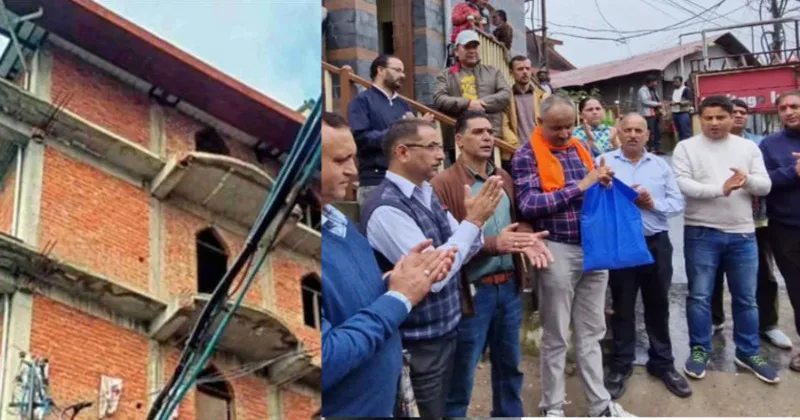
Shimla’s Sanjauli area is once again in the news due to a large, five-storey mosque that officials say was built illegally. The dispute surrounding the structure dates back nearly 30 years, with controversy beginning soon after its initial construction. The mosque, located in a predominantly Hindu neighbourhood, attracts a significant number of Muslim immigrants who come there to offer prayers.
According to reports, the Congress government in power at the time did not intervene as the structure gradually expanded, from an initial single room to a full five-storey building, despite concerns raised in the area. Municipal corporation records classify the mosque as an unauthorised construction. Although the state government later issued an order for its demolition, the directive was subsequently stayed.
Hindus in Sanjauli have grown increasingly frustrated due to the ongoing stay order and prolonged legal proceedings. In response, the Hindu Sangharsh Samiti has launched protests against what they claim is an illegal mosque. The Samiti had demanded that water and electricity supply to the mosque be cut off. Although the Municipal Corporation assured them that these measures would be implemented, no action has been taken so far.
A stage for the protesters has been set up near the Sanjauli police station. While daytime temperatures remain warm, nights drop to 3–4°C. Despite the cold and their disappointment with the Himachal Congress government and local administration, the Hindu protestors remain steadfast, refusing to back down.
According to Kamal Gautam, a member of the committee, the issue drew public attention on August 30, 2024, when a group of 5–6 individuals allegedly assaulted a local youth, causing a head injury. The accused were reportedly sheltered in a mosque before being taken into custody by the police. Incidents like this have tested the patience of local residents, who express concern over rising criminal activity in the area. The mosque in Sanjauli has been cited as a location where such incidents have occurred.
Vijay Sharma, a local participant in the ongoing protests, stated that the number of people coming to Himachal Pradesh from outside the state has risen rapidly. He noted that new faces appear in the area daily and expressed concerns about their activities, which he described as suspicious. Sharma also voiced worries about the safety of local women. According to him, the Muslim population in the area was previously around 3 per cent, but he claims it has increased significantly in a short period. He attributed this rise to the arrival of people from outside, including Bangladeshi nationals, Rohingyas, and Muslims from other states.
According to Vijay Sharma, Mohammed Salim, who built the mosque, played a central role in the ongoing controversy. Sharma stated that tensions escalated after an incident in which a local youth was allegedly attacked by some Muslim immigrants, leading to public anger and large-scale protests on September 5 and September 11, 2024. He added that these tensions had been building for several years.
Sharma said Mohammed Salim arrived in Sanjauli in 1990 and worked as a tailor. He reportedly occupied a piece of government land previously used for a school, which had been relocated. On this land, Salim initially constructed a single-story structure, which was gradually expanded into a multi-storey building and eventually developed into a mosque. According to Sharma, Salim received a No Objection Certificate (NOC) from the Waqf Board for political reasons.
The mosque received significant funding, allowing it to grow into a full-fledged five-story structure. As the building expanded, the number of people coming to offer Namaz also increased. Sharma claimed that most of the worshippers were outsiders, as there were no nearby Muslim settlements in the locality.
Despite its size, the mosque reportedly has only two toilets on the ground floor, which Sharma says is insufficient for the large number of worshippers. As a result, some Muslims perform ablution in open areas before prayers.
Sharma noted that the area has a predominantly Hindu population. In the afternoons, women walking their children home from school or attending daily chores sometimes encounter Muslim men performing ablution in open spaces. When some women objected, Sharma claims they were met with lewd comments. He added that local women typically do not report such matters to the police, as it is common in the region not to involve authorities in personal disputes.
















Comments