





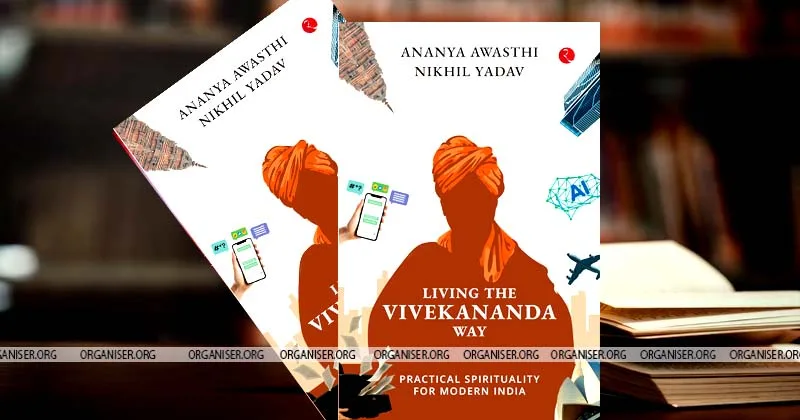
AUTHORS: Dr Ananya Awasthi and Dr Nikhil Yadav
PUBLISHER: Rupa Publications, India, PRICE: Rs 295
One of the most talked about works, Living the Vivekananda Way: Practical Spirituality for Modern India, authored by Dr. Ananya Awasthi and Dr. Nikhil Yadav, is a reflective work that reinterprets Swami Vivekananda’s teachings as an answer to the challenges of the modern world.
The preface of the book truly captures the authors’ central idea — can spirituality be practical, and can it offer solutions to the accelerated changes of the contemporary world? They argue that spirituality must not be confined to meditative solitude considering Vedanta to be intensely practical. The book beautifully conveys the timeless message of Swami Vivekananda structured in six insightful chapters of the book through a systematic flow of events, especially in the first two chapters.
The first chapter of the book traces the early life and journey of Swami Vivekananda. It mentions a very interesting fact, that during college days Swami Vivekananda actively engaged with the scholarship of Western philosophers like Hume, Kant, Fichte, Hegel, Schopenhauer, Comte, Darwin, Mill, Locke, and Plato. All this eventually led to a period of skepticism in his life. His quest for spiritual contentment peaked during his meeting with his guru, Sri Ramakrishna. The book sketches the grace of guru-shishya tradition, illuminating the transformative relationship between the two spiritual giants of Bharat.
Swamiji’s quest for spiritual contentment peaked during his meeting with his guru, Sri Ramakrishna. The book sketches the grace of guru-shishya tradition, illuminating the transformative relationship between the two spiritual giants of Bharat
The following chapter of the book dedicatedly covers Vivekananda’s efforts to spread the message of Vedanta in the West. It talks about the hardships he faced before the World Parliament of Religions, and the people who helped Swamiji in this journey.
The book interestingly captures the interaction between John D. Rockefeller, Josiah Goodwin, and Professor Max Müller with Swami Vivekananda. Later with the help of his Western disciples, he started the Vedanta Society of New York in November 1894 which is functional till date. For the social and spiritual upliftment of people in India, he founded the Ramakrishna Mission on 1 May 1897. The book soulfully captures Vivekananda’s vision for Indian women through the lens of his Irish disciple Margaret E. Noble in her notable work The Master as I Saw Him. Miss Noble, popularly called as Sister Nivedita in Bharatiya, clearly mentions that it was because of Swamiji’s continuous efforts that she swiftly adopted Bharatiya culture and started a girls’ school in Bosepara Lane, Calcutta. Nivedita of India worked immensely during the plague of 1899 in Bengal. She was working continuously to spread awareness regarding health and sanitation in masses.
A distinctive feature of this work is its complete chapter titles as “ The spiritual Teachings” by Swami Vivekananda through his lectures around the world. The book is trying to convey more than just mapping the life and lectures of Swami Vivekananda. This chapter talks about the contrasting world views of India and the West by taking into account the ancient Greeks and the Vedantic approach towards life. The chapter also discusses one of the most interesting episodes when Swami Vivekananda and Nikola Tesla met, including an excerpt of the letter exchange between the two. This has been artistically written as a meeting of science and spirituality. The authors succeed in capturing the essence of Practical Vedanta, that is, spirituality grounded in service, strength, and self-realisation. Both the authors approached Swami Vivekananda not as a distant sant, but as a modern-day guide whose thoughts and work shed light on the issues such as personal alienation, cultural confusion, and moral fragmentation in this age of change.
Taking the perspective of a general reader, the author’s exposition is lucid and accessible, yet it is rooted in the spirit of Bharatiya philosophical thought. Interestingly, the book engages in the discussions about the influence of Swami Vivekananda’s life and literature on leaders like Netaji Subhash Chandra Bose, Babasaheb Ambedkar, Gandhi, Jawaharlal Nehru, and Hansraj Rahbar who contributed significantly in Bharat’s freedom struggle. The book also gives a glance of the interaction between Swami Vivekananda and Jamshedji Tata, which laid the foundation of the premiere Research Institution in Bharat, the Indian Institute of Science. The book presents the response of Vedanta as a philosophy for the Western audience. It includes lesser-known episodes and mentions famous leaders who have drawn inspiration from Swami’s life and literature. It can serve as a bridge between the ancient and the modern, because it carries a powerful message for the youth.
The relevance of the book lies in its relevance for youth. It portrays spirituality not as withdrawal or escape from life, but as an active engagement with it, more fearlessly, more compassionately with a higher purpose. The text engages a generation seeking meaning beyond material success, offering Vivekananda’s ideals of fearlessness (abhaya), self-confidence, service (seva), and Oneness (Advaita) as key virtues for both individual and collective transformation. The authors have given thoughtful space in the book in discussions around Mental and Physical well-being, which is one of the most talked-about concerns of the Gen Z. They have taken into account Swamiji’s thoughts on a few socio-political issues like women’s rights, caste and social justice, education for the masses, and religious harmony and his active work in these areas.
Stylistically, the writing is crisp, balanced, and free from jargon like any other philosophical work. This makes the book easily readable. The fusion of critical reflection, historical insight, and moral clarity by the authors without sounding didactic in the text is commendable. The tone remains inspirational throughout the book, without lapsing into sentimentality. A tricky balance that both the authors maintain with maturity.











Comments