





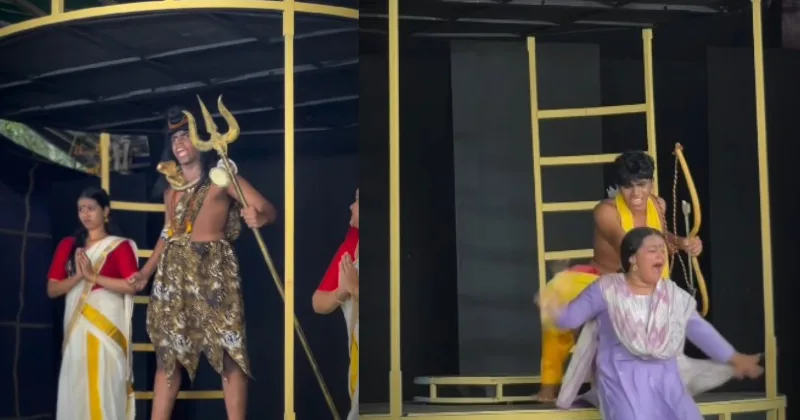
A fresh controversy has erupted in Kerala after a play staged at the Malappuram district school Youth Festival titled Veeranattyam was awarded the first prize despite its overt ridicule of Hindu history and culture. The script reportedly claims that the Ramayana and Mahabharata portray women as slaves and labels Lakshmana a “male chauvinist”, with characters using vulgar language throughout the performance.
Observers note that this is not an isolated incident but part of what they describe as a recurring pattern: in Kerala, “anything Hindu is always at the receiving end”. Several social activists argue that while one is free to insult or denounce Hindu, Hinduism, and Hindutva without consequence, the standards dramatically shift when the target involves minority communities particularly Muslims. What is dismissed as artistic freedom in one context is often reinterpreted as blasphemy and an attack on the secular fabric of the country in another.
The situation has escalated after confirmation that the same drama is now being considered for the state-level Youth Festival. Those following the developments fear it may again secure top honours, reinforcing the sentiment that “Hindus are always whipping boys” when it comes to cultural disputes in the state.
Only in Kerala…
A school play INSULTING Ramayana & Mahabharata gets FIRST PRIZE.At Malappuram District Kalolsavam, a play called “Veerannattyam” was awarded the top spot for mocking Hindu history and culture.
The script claims that Ramayana and Mahabharata portray women as… pic.twitter.com/qRu7rBJThv
— MAHARATHI (@MahaRathii) November 24, 2025
Critics argue that if a similar play had mocked the Bible or Quran, the consequences would have been markedly different.
The entire media establishment regional to national would have erupted in what critics describe as “secular anger”, accompanied by immediate denunciations from writers, actors, and self-styled cultural leaders claiming that secularism itself was under threat.
However, in the current case, Janam TV remains the only media outlet giving sustained coverage, while the rest maintain conspicuous silence.
Critics claim that Kerala’s cultural discourse is governed by a double standard: when art targets Hindu culture, it is celebrated as “freedom of expression”; but when minorities are portrayed negatively, the same voices label it fascism and a grave threat to secularism and the Constitution.
The ongoing debate has also revived memories of one of Kerala’s most shocking communal crimes, the hand-chopping of Prof. T. J. Joseph on 4 July 2010. The attack, carried out by cadres of the now-outlawed Popular Front of India (PFI), was justified by the organisation on the grounds that a question paper framed by the professor had allegedly insulted the Prophet.
To critics, this incident remains a stark example of how quickly outrage is mobilised when minority sentiments are perceived to be hurt, in contrast to the relative indifference when Hindu traditions are mocked.










Comments