





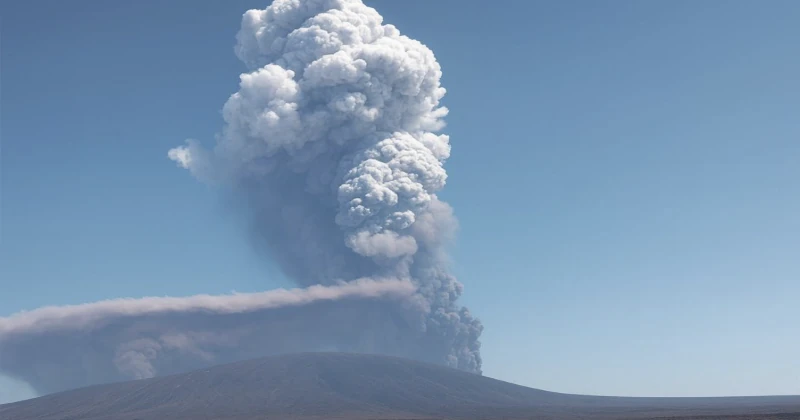
A massive volcanic eruption in Ethiopia has sent ash clouds drifting thousands of kilometres to India causing aviation turmoil, unusual sky conditions, and heightened anxiety in a region already battling its worst air pollution of the season.
The Hayli Gubbi volcano, a long-silent geological giant that last erupted nearly 12,000 years ago, awakened on Sunday with a force that stunned both scientists and residents of Ethiopia’s Afar region. The ash it spewed has since travelled across the Red Sea, Yemen and Oman, brushing past the Arabian Peninsula, and streaming into western India at jet-stream speeds.
❗️🌋🇪🇹 – Ethiopia's Hayli Gubbi Volcano Awakens After 10,000 Years
In a stunning geological event, Ethiopia's Hayli Gubbi volcano—long dormant in the remote Danakil Depression of the Afar Rift—erupted explosively for the first time in recorded history on November 23, 2025.
The… pic.twitter.com/bZby4sAuOC
— 🔥🗞The Informant (@theinformant_x) November 24, 2025
By November 24 night, the ash plume had reached Delhi. And by November 25 morning, the skies over northern India bore signs of an atmospheric intrusion unseen in decades.
In the early hours of November 23, residents of the Afar region in northern Ethiopia felt what one witness described as “a sudden bomb exploding underground.” A towering column of ash burst from the summit of Hayli Gubbi, a shield volcano normally associated with slow-moving lava flows rather than explosive eruptions.
This eruption, scientists say, is exceptionally rare for this region.
Juliet Biggs, Earth scientist at the University of Bristol, noted that large umbrella-shaped ash columns are uncommon in East Africa’s tectonic setting. “To see a big eruption column, like a big umbrella cloud, is really rare in this area,” she said, emphasising the geological significance of the event.
Within hours, the surrounding landscape including villages and grazing fields was coated in grey ash. While no casualties have been reported, the humanitarian impact is clear: livestock herders are struggling as ash-covered pastures provide little food, and several travellers were stranded in the Danakil desert after ash swallowed roads and visibility plummeted.
The ash cloud was immediately swept into high-altitude air currents and began a remarkable trek across continents. Its movement followed this trajectory:
- November 23 afternoon: Ash rises tens of thousands of feet into the atmosphere, caught by upper-level winds.
- November 23 night: The plume moves across the Red Sea, drifting over Yemen and Oman.
- November 24 morning: It reaches the Arabian Sea, spreading horizontally and climbing to altitudes of 25,000 to 45,000 feet.
- November 24 evening: The first bands of the plume enter India over the Jaisalmer–Jodhpur region of Rajasthan.
- November 24 night (11 pm): The ash reaches Delhi and NCR.
- Late November 24–November 25: The plume stretches over Rajasthan, Haryana, Delhi, Punjab and parts of Himachal Pradesh.
- Forecast: Western UP and northwest Maharashtra may see upper-air haze over the next 24 hours.
Satellite imagery from international volcanic ash advisory centres shows the plume clearly, appearing as a faint but expansive streak of particulate mass circling the region.
IndiaMetSky described the skies as likely to appear “weird and funny” an effect of sunlight scattering through layers of volcanic ash and sulphur dioxide. Early risers on November 25 indeed spotted pinkish, orange, and unusually muted dawn colours in Delhi, Gurugram and Jaipur.
Volcanic Ash warning ⚠️
Hayli Gubbi Volcano in Ethiopia, located in Afar rift region of African superplum erupted for first time in record history yesterday. This volcano has erupted for the very first time in +10,000 years of history. It has sent a thick and large Ash plume up… pic.twitter.com/VCIQjtpcFv— IndiaMetSky Weather (@indiametsky) November 24, 2025
Experts say ground-level ash deposition is unlikely since the plume is at cruising altitudes for commercial aircraft far above where humans live and breathe. The IMD and DGCA concur that the ash will not worsen Delhi’s already-poor AQI in a significant way, though it may create a thin upper-level haze and slightly nudge up temperatures due to heat entrapment.
But for people in northern India, battling a toxic smog wave for weeks, the psychological impact is undeniable. Delhi’s AQI on November 25 morning stood at 328 (Very Poor) with smog visibly pooling around India Gate, Kartavya Path and the airport region now compounded by a foreign atmospheric visitor.
Volcanic ash is a nightmare for aircraft. The tiny abrasive particles can melt inside engines, clog sensors, scratch cockpit windows, and cause sudden thrust loss. For this reason, global aviation protocols demand strict avoidance of any ash-affected airspace. As soon as volcanic ash advisories were issued for West Asia and parts of Indian airspace, the DGCA moved into high alert.
DGCA’s instructions to airlines included:
- Avoid all ash-affected routes and flight levels
- Reroute or delay flights as needed
- Recalculate fuel loads for longer detours
Report immediately if pilots detect unusual engine behaviour, cabin odour or visibility issues
Keep flight dispatch teams monitoring NOTAMs, ASHTAMs and satellite feeds continually
Airline disruptions escalated quickly:
- Kochi: Two international flights cancelled — IndiGo’s Cochin–Dubai and Akasa Air’s Cochin–Jeddah
- Akasa Air: Cancelled flights to/from Jeddah, Kuwait and Abu Dhabi
- KLM: Cancelled Amsterdam–Delhi and return flights (KL871/872)
- IndiGo: Diverted its Kannur–Abu Dhabi flight to Ahmedabad
- SpiceJet: Warned Dubai-bound passengers of likely delays
Sources indicated that more cancellations were expected through November 25 as the ash corridor over the Middle East shifted unpredictably. An aviation ministry official warned that if the plume settles over Delhi or Jaipur at lower altitudes, “Indian aviation is expected to be impacted severely.” For now, the plume remains high but the situation is fluid.
Volcanic ash is not like the soft ash from a bonfire. It is composed of:
- Microscopic glass shards
- Pulverized rock particles
- Crystallised mineral fragments
- Sulphur dioxide gas
At high altitudes, engines can inhale these particles, causing:
- Engine flame-outs
- Loss of thrust
- Electrical failures
- Pitot tube blockages
- Navigation system malfunctions
This is why even minor encounters with ash are considered high-risk across the aviation world.
With winter smog choking the plains, pollution levels in ‘severe’ or ‘very poor’ categories, and now a foreign volcanic haze drifting overhead, the atmosphere above India has become unusually complicated. While the volcanic ash may not worsen health risks on the ground, it has:
- Added atmospheric opacity
- Altered sky colours
- Created a thin, milky upper-level veil
- Triggered large-scale flight disruptions
- Heightened public alarm
Scientists expect the plume to pass over the western Himalayas within 24–48 hours before dispersing.
A volcanic eruption in one of the world’s hottest, driest desert regions has now influenced weather, aviation and public anxiety in a country more than 3,000 kilometres away. Hayli Gubbi’s awakening after thousands of years of silence shows that climate, geology, wind currents and civil aviation are all intertwined.














Comments