






During the 17th century, the legacy of Sunni orthodoxy reached its fruition in the form of Aurangzeb, who honoured himself with the title of Alamgir (conqueror of the world). Sunni orthodoxy and the conversion of non-Muslims expanded his empire territorially, making it spiritually and culturally impoverished and morally insolvent, leaving lasting scars that resonate from the history of the world.
Aurangzeb massacred Hindus over Jizya — the tax to be paid by non-Muslims to save them from Muslims for not being Muslims, forced conversions, temple desecrations. His antagonism did not end with Hindus alone but extended to sectarian Muslims. He executed Sufi mystic Sarmad; Qutb, the spiritual guide of the Ismaili; Saiyyid Shahji of the Khoja sect and targeted their communities, including Bohra & Shia Muslim sects.
Aurangzeb was a deeply political person, masquerading as a spiritual one, who knew best how to exploit religion for the supremacy of his empire; therefore, he misused Sunni orthodoxy to spread his rule and to vindicate himself for executing his brothers. His appointed Governor of Kashmir, Iftikhar Khan was enforcing strict Sunni rule torturing Hindu scholars and pandits in Kashmir. Persian chronicles (Baharistan-i-Shahi, Tarikh-i-Kashmir) confirm violence and that by 1675, an ultimatum was issued to convert to Islam or face death.
In fact, Aurangzeb’s State Official Policy, as confirmed by Persian chronicles (eg, Maāsir-i-Ālamgiri) was a predetermined campaign to destroy schools, temples, and religious practices of infidels throughout his empire with utmost urgency, thus, eliminating influential spiritual seats. In 1669, Aurangzeb attacked Kashi and desecrated the ancient Vishwanath Temple, and a year later in 1670, plundered Mathura and desecrated Bhagwan Shri Krishna Janmabhoomi Temple. From 1669 onwards, Kashi, Mathura, Ayodhya, Multan, Vidisha, Ujjain, Nashik, Vrindavan and other prominent cities were attacked and temples desecrated to demonstrate an imperial crusade to eradicate the spiritual legacy of the Hind.
Aurangzeb’s next obvious target was Kashmir — the land of philosophers and sants, and a well-known centre of rich spiritual heritage. A land that produced spiritual luminaries of Kashmir Shaivism and Lalleshwari (Lal Ded) embodied pluralism and spiritual courage. Aurangzeb aimed to obliterate the spiritual, intellectual and cultural life of Kashmir and likewise intensified pressure and issued the ultimatum to convert all Pandits, scholars and Hindus with a deadline for execution. This triggered the Third Exodus of Hindus from Kashmir, reported Baharistan-i-Shahi.
Led by Pandit Kripa Ram, a distinguished Sanskrit scholar, a large group of Kashmiri Pandits and scholars journeyed to Chak Nanki (now Sri Anandpur Sahib) and met Guru Tegh Bahadur in Sangat (Open Forum). Pandit Kripa Ram urged Guru Sahib that the emperor had given them some time to decide to convert to Islam or face execution, and the time for deciding had also expired. At this, Guru Sahib said that some well-known ‘Mahapurakh,’ religious person would have to make a sacrifice to stop this butchery, and we would have to find a supreme soul who would die to awaken the sleeping consciousness of the people of the Hind. At this, Guru Sahib’s son Gobind Rai (Guru Gobind Singh ji) said that Guru Sahib was the most spiritually aware person in the whole of Hind and he could make that sacrifice.
Guru Sahib was pleased to hear answer of young Gobind Rai and told Kripa Ram to go and tell Aurangzeb that if he could convert Guru Tegh Bahadur to Islam, they would all convert. Otherwise, he should leave them alone. On hearing the decision, Aurangzeb was delighted that by converting one person, he would be able to convert many thousands to Islam.
Aurangzeb was not aware of the fearlessness of Guru Sahib and that he was carrying the flame ignited by Sri Guru Nanak. The flame that did not accept divisions but delivered the message of ‘oneness of God’ and ‘oneness of humanity.’ In Japuji Sahib, Guru Sahib says (Pauri 28) –“Aai panthi sagal jamati man jeetai jag jeet” – Let all humanity be your only sect and community. If you conquer your mind, you conquer the world.
The Turning Point
By the 17th century, the faith of Sri Guru Nanak was two centuries old. In 1604, Sri Guru Granth Sahib was compiled by Guru Arjan and installed at Sri Harmandir Sahib, Amritsar. Guru Granth Sahib had works of Gurus and included works of spiritual currents, like it is said that it had rough-cut diamonds of Kabir, molten compositions blaze of Ravidas and untapped paths by Baba Farid and 12 other prominent Sants. Guru Arjan was the architect of the Adi Granth (later Sri Guru Granth Sahib).
But, Muslim tyrant Jahangir was demanding the removal of verses from Guru Granth Sahib that were considered critical of Islam. Guru Sahib refused to remove any verse or compromise the spiritual message of the Guru Granth Sahib. As recorded in ‘Tuzuk-i-Janhangiri,’ Jahangir desired to obliterate the influence of the Guru because he would not convert to Islam. In 1606, Guru Arjan was imprisoned in Lahore, tortured and forced to sit on a burning hot plate while hot sand was poured over his body — Guru Sahib continued to sing, Ik Onkar (God is One). For centuries, the martyrdom day of Guru Arjan is remembered by distributing sweetened rose and milk cold drinks to all in hot summers, symbolising the tortures endured by the Guru.
The Mahavakyas such as “Aham Brahmasmi” (I am Brahm) from the Brihadaranyaka Upanishad and “Tat Tvam Asi” (Thou art That) from the Chhandogya Upanishad, affirm the essential oneness of existence; that all distinctions are superficial and that, in reality, we all share an indivisible, universal self. The profound declaration of Sri Guru Nanak “ਇਕ ਓਅੰਕਾਰ” (Ik Onkar) tears down walls of all such fortresses built to divide humanity that, in fact, blocked humanity from its freedom to pray, right to worship and enjoy religious freedom. Sri Guru Nanak directly dissolves all boundaries constructed by religion, caste, ideology, ethnicity, and language. Religious freedom is not only a basic human right but an essential prerequisite for humanity because religion is a personal blossoming.
In fact, Aurangzeb intended to wreak a genocide based on religion, and at stake was — the native faiths like Hindu, Jain, Buddha, Sikh, and other pluralistic faiths, to render Hindustan into a monotheocratic monarchy governed by Sunni orthodox Islamic law — the very face and future of Hindustan. Aurangzeb wanted to wipe out the 10,000-year-old ancient sanskriti and its ancient faiths by enforcing total conversion. Aurangzeb posed existential threat to Bharat’s millennia-old spiritual and cultural forms. He intended to erase Bharat’s spiritual and philosophical capital and social diversity. Guru Sahib stepped into the centre of this crisis as the saviour, and stopped the tide of religious genocide. It was the turning point in Bharat’s history.
Guru Sahib’s Journey to Delhi
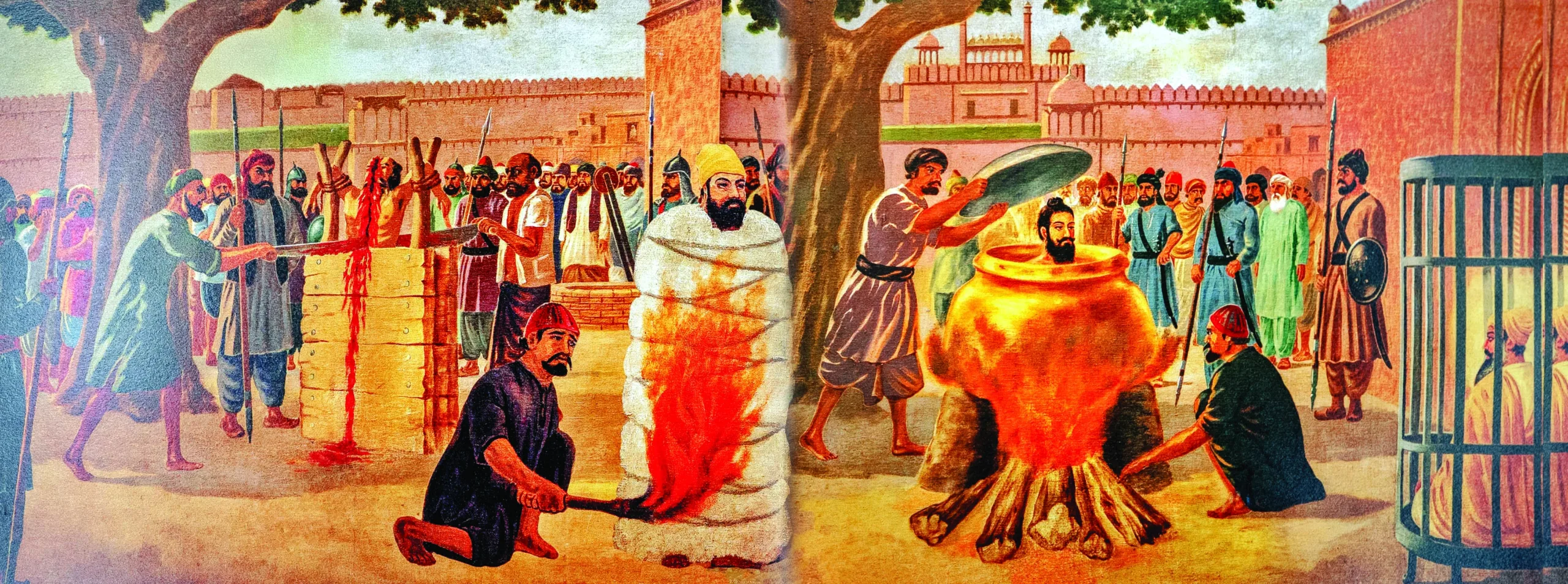
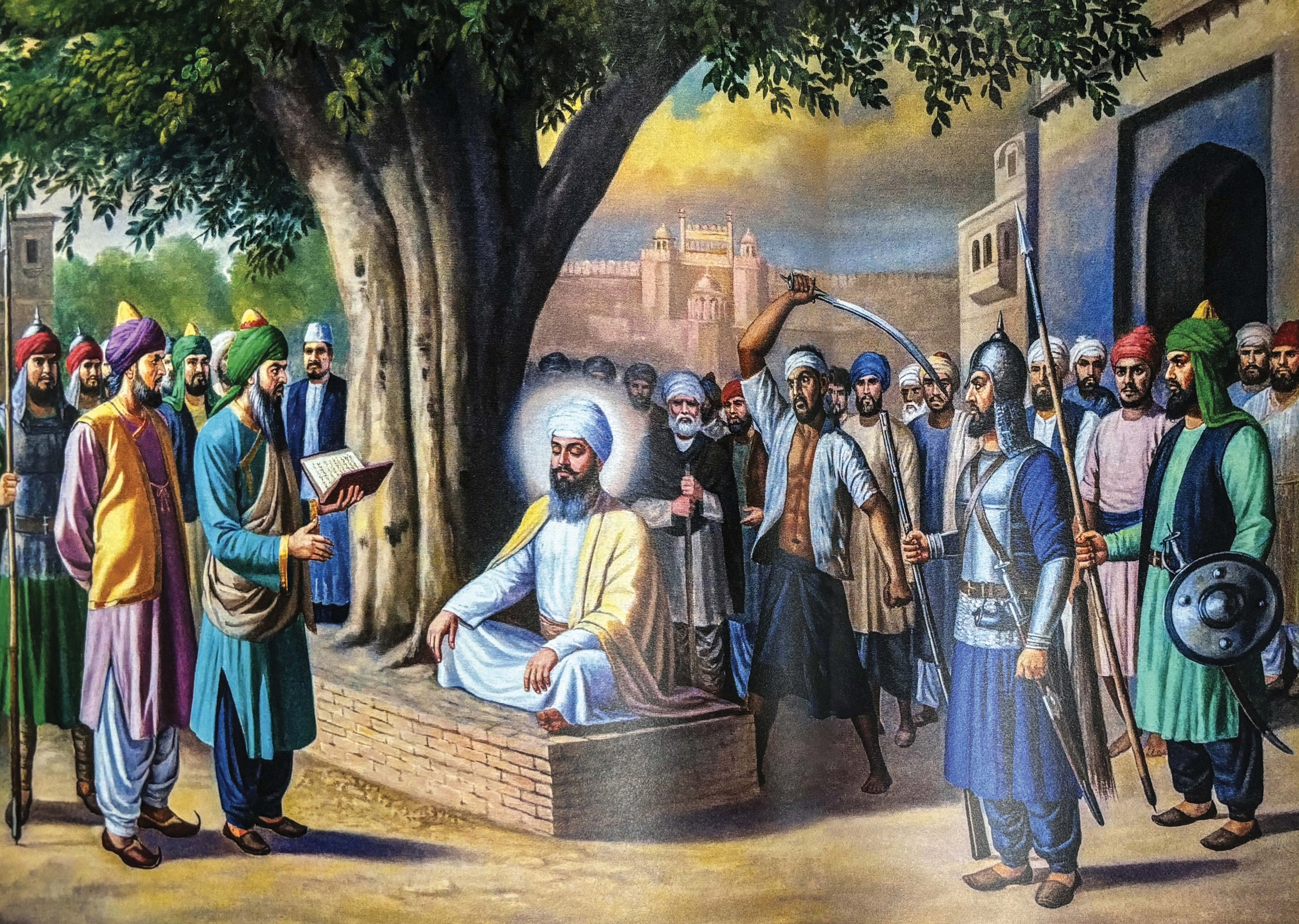
In July, Guru Sahib journeyed from Anandpur Sahib, with three companion disciples — Bhai Mati Das, Bhai Dayal Das, Bhai Sati Das to Delhi. Arrested enroute, kept under custody, Guru Sahib was subjected to repeated demands: “Accept Islam or die.” In November, Guru Sahib’s three companion disciples were martyred brutally. Bhai Mati Das was sawn in half, Bhai Dayal Das boiled alive, Bhai Sati Das burnt at the stake. Guru Tegh Bahadur saw all this in meditative silence. Finally, he refused all pleas to save himself through a miracle or submission. Dark clouds gathered up in sky, the executioner’s blade fell — it severed Guru Sahib’s head from his body, blood joined the sanctified earth. A massive thunderstorm followed the martyrdom as if Heaven was welcoming Guru Sahib.
Guru Tegh Bahadur’s martyrdom teaches many lessons like the need to defend human rights and freedom of conscience, exhibiting moral courage against oppression and speaking the truth
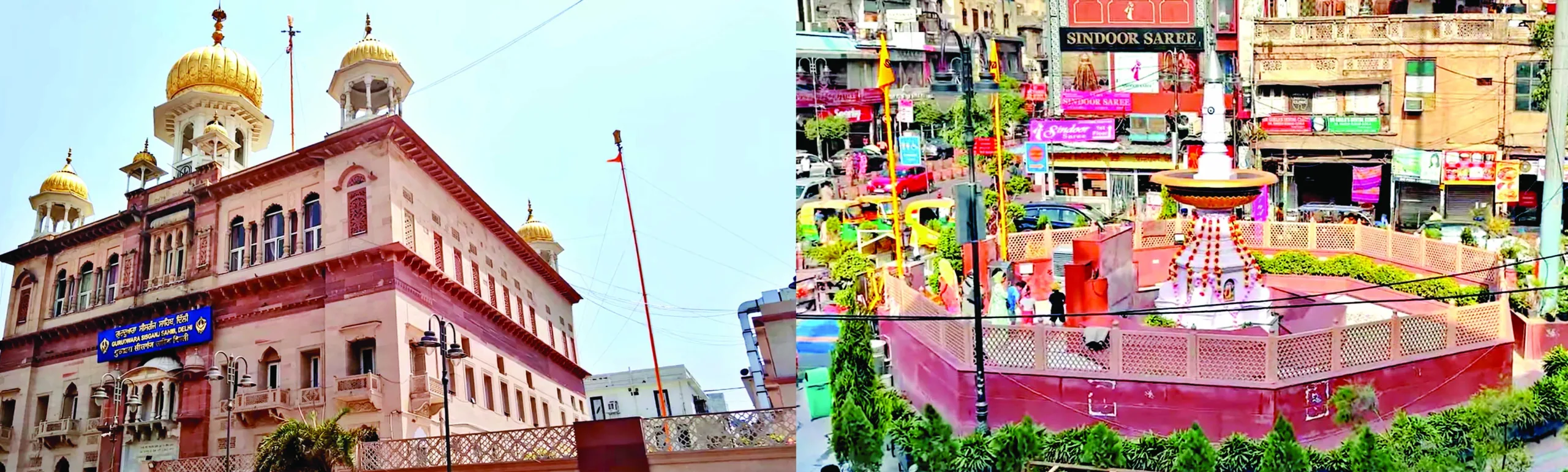
Through the blinding thunder and severe rain, Bhai Jaita, with profound reverence wrapped Guru’s severed head and dashed through the thunder all the way to Kiratpur Sahib. Embracing Bhai Jaita, Guru Gobind Rai declared him ‘Rangrete Guru Ke Bete’ honouring his devotion. Meanwhile, Bhai Lakhi Shah Vanjara in thunderous chaos retrieved Guru’s body concealed it beneath mounds of cotton in his cart and vanished through lanes, reaching his home at Raisina and set his own house ablaze to perform the cremation where Gurdwara Rakabganj Sahib stands today.
Bharat’s destiny thus changed. A martyrdom that not only shook Hindustan but the world. A martyrdom for the sake of another’s right to worship is the act of the soul’s utmost nobility, which is found nowhere in world history. Guru Tegh Bahadur’s martyrdom remains the lone such example in the history of the world, which was meant not only in defence of one’s own truth, but for the soul of humanity. It was an act for the conscience of all.
‘Ik Onkar Sat Naam’ was lived upon to prove the oneness of God and to defend spiritual pluralism, thus the dignity and freedom to seek truth in one’s own way was established. Guru Sahib did not merely preach this truth; he lived it fully, giving his own life to demonstrate that all are truly one. Not by sword or by diplomacy, but the fearless compassion of one immersed soul and unshakable resolve to protect others by dissolving the boundaries of divisions of faith turned the tide and the whole world became a single family of God. This changed the world forever. Guru Sahib’s martyrdom is an immortal lesson to establish ‘oneness’ – universalisation of the truth embracing all, proving that truth belongs to everyone, not just one faith, one sect or one community. Guru Tegh Bahadur’s martyrdom is called ‘supreme’, because it was for dissolving the chains of divisions that fracture the world in the name of religions, faiths, and sects establishing the Oneness of God. Guru Sahib stood for universalisation of the truth without prejudice and fear.
His supreme sacrifice planted the seeds of the Khalsa Path, and Sri Guru Gobind Singh in 1699 established Khalsa Panth, creating a unique army of sant-sipahi (sant-soldiers) who would defend the dignity and freedom of every soul, forever. Every time we refuse to bow down to fear, division or to cruelty masquerading as faith, a ‘Hind Di Chadar’ (The Shield of Hind) protects us all and Guru Tegh Bahadur’s martyrdom is remembered and followed anew.













Comments