





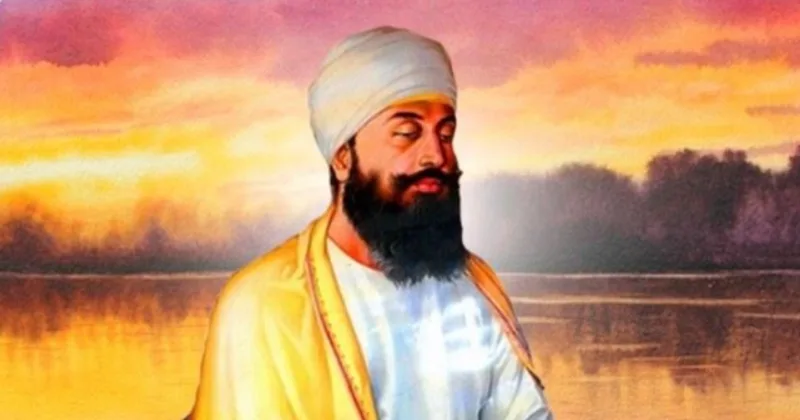
Tyag Mal learnt languages, social sciences, philosophy and martial skills like archery and horsemanship. It is said that Guru Hargobind personally taught swordsmanship to his son.
With such an illustrious upbringing and education young Tyag Mal grew into a wholesome personality with a brave and adventurous spirit. He got an opportunity to prove his military acumen when he was barely 13 years of age when he fought bravely against the Mughal forces in the Battle of Kartarpur in 1635. The Mughal forces led by Painde Khan were defeated. Guru Hargobind was very impressed by Tyag Mal’s bravery and humility in crediting the victory to his soldiers rather than to himself. It was due to this bravery that Tyag Mal was rechristened as Tegh Bahadur (brave sword wielder) by the Guru much to the delight of the warriors.
Tyag Mal was married to Mata Gujar in 1632. She was the daughter of a wealthy noble man, Lal Chand, and his wife, Bishan Kaur, residents of Kartarpur. It is notable here that their first child, Gobind, was born on Poh Sudi Saptmi Samvat 1723, which coincides with the western calendar as December 22, 1666, that is 34 years after their marriage.
Despite his proven ability as a soldier and military strategist, Tegh Bahadur exhibited a religious and meditative bent of mind. He remained immersed in the teachings of the Gurus and spent long hours in meditation. It is here that he lived up to his original name of Tyag (renunciation).
Guru Hargobind groomed his grandson, Har Rai, the son of Bhai Gurditta, to be the next master of the Sikhs. Tegh Bahadur rose above petty precedents and remained loyal to his father and the tenets of the Gurus despite being side lined from the seat. Bibi Nanki, questioned Guru Hargobind regarding his decision. The Guru is said to have told her that one day her son would also be a Guru and would with his extraordinary son fight for justice and the downtrodden. Once Guru Hargobind had decided upon his successor at Kiratpur Sahib, he called upon his son Tegh Bahadur to live with his mother, Bibi Nanki, at her ancestral house in Bakala near the River Beas.
Tegh Bahadur remained at Bakala for twenty years till he was anointed the ninth Guru in 1664. He was a recluse immersed in meditation while also attending to his family responsibilities. His fame as a sage and a man of wisdom spread far and wide and people came in large numbers to seek his blessings.
Anointment of Tegh Bahadur as Ninth Nanak
Guru Har Krishan, as he prepared to leave the world, did not specifically name the ninth master. He simply said two words – Baba Bakala implying that his successor would be found in Bakala. On hearing the news, many impostors set themselves up in Bakala. Amid all this activity, Tegh Bahadur remained aloof and immersed in meditation.
After Guru Har Krishan left his earthly body, five Sikh elders, Bhai Mati Das, Bhai Sati Das, Diwan Dargah Mal, Bhai Gurditta and Bhai Dayal Das, accompanied by Mata Krishan Kaur, went to Bakala in search of the ninth master, carrying with them the Thali (large plate), five copper coins and a coconut that Guru Har Krishan had blessed. When they reached Bakala they were totally confused and aghast at seeing so many impostors present there.
The identification of Tegh Bahadur as the next Guru was done by a wealthy trader and devout follower of the Guru Ghar, Makhan Shah Labana. It is said that earlier Labana had been in great danger when his ships got stuck in a storm in the high seas. At that stage, he had promised to donate 500 gold coins to the house of the Guru if his life was saved. On reaching the shores safely, Labana set forth to make good his promise and found that Guru Har Krishan had passed away. He then travelled to Bakala where he found many contenders for the seat. He tested each one of them by offering two gold coins for his safety which they accepted and thus proved that they were impostors. He was quite desperate when somebody told him that the ascetic Tegh Bahadur also lived in Bakala. He went to Tegh Bahadur and offered the two gold coins to which the master smiled, gave his blessings and told him that he had promised 500 gold coins. At this, Labana understood that he had found the true Guru and told all the people.
It was then that the elders realised who their next master was. Tegh Bahadur was approached and he accepted the will of his Guru with utmost humility. Then the anointment ceremony was performed in August 1664.
The Initial Days
From the outset, there was resistance to the anointment of Guru Tegh Bahadur. It is said that even an attempt was made on his life, but it failed. Guru Tegh Bahadur thought it appropriate to first visit Amritsar and pay his obeisance at the Harmandir Sahib. At that point in time, Harji, the grandson of Baba Prithi Chand, was the head of the Mina sect and was in control of the Harmandir Sahib. On reaching there, the Guru was denied entry by Harji and the Minas. The Sikhs were in favour of forcing their way through but the Guru refused. The Guru then paid obeisance at a place away from the Gurdwara but within the precincts that later got to be known as Thara Sahib (Pillar of patience).
Creation of Anandpur Sahib
With the intention of creating a seat for the Guru Ghar, the Guru purchased a site near Kiratpur Sahib, comprising land from three villages, for a sum of Rs 500. Here, he proposed the establishment of a township and called it Chak Nanki after his mother. The Guru left the construction of the new township in the hands of Dewan Dargah Mal and Bhai Gurditta while he set out on a tour to oversee the establishment of Sikh missions in the South and East of Bharat.
The Tours of Guru Tegh Bahadur
Guru Tegh Bahadur carried out his mission of reconnecting with Sikhs in far off places with great passion. He also took interest in improving the lives of those living under very poor circumstances. His efforts were successful in creating the required confidence and enthusiasm for the mission of Guru Nanak among the common people. He also kept in touch with his followers in Punjab by issuing Hukamnamas (instructions of the Guru) regularly.
His preaching attracted the ire of the Mughals and other detractors. While moving eastward through Delhi he was arrested by the Mughals, but his release was facilitated by Raja Ram Singh, the son of Raja Jai Singh.
The Guru passed through Agra, Allahabad, Benaras and Gaya. By that time his wife, Mata Gujar, was expecting a child and further travel was not recommended for her. Accordingly, in October 1666, Guru Tegh Bahadur proceeded towards the North-East and Dacca (now in Bangladesh) but left his family behind in Patna. His stay at Dacca is now marked with the Gurdwara Sangat Tola. It was here that he received the news of the birth of his son, Gobind, at Patna on the 23rd day of the month of Poh, Bikrami Samvat 1723.
Return to Punjab amid Aurangzeb’s religious Intolerance
For three years, the Guru stayed at Patna and had the pleasure of seeing his son Gobind grow. The Guru personally supervised the education of his son that was carried out in subjects of religion, social sciences and martial arts in equal measure as had become the norm in the Guru Ghar. He also told young Gobind about the lives and teachings of the Gurus. On the religious side, while at Patna, the Guru composed a major portion of his Bani that was later incorporated in the Sri Guru Granth Sahib by Guru Gobind Singh.
Sadly, this blissful existence was not to last long. This was the time when Aurangzeb started becoming increasingly intolerant towards Hindus, Sikhs and other communities. Temples were desecrated and forced conversions resorted to; the infamous religious tax, Jazia, was imposed again. The Mughals specifically targeted Hindus from the holy towns of the country like Kashi, Prayag, Kurukshetra, Haridwar and Kashmir.
Guru Tegh Bahadur, therefore, decided to get back to Punjab to be with his community at this time of religious crisis. On the way back, the Guru was arrested in Agra in July 1670 but was released. The Guru then toured Malwa and provided religious and economic succour to the poverty ridden people of the region. He finally reached Anandpur Sahib in February 1671 and for about two years he preached from there peacefully. By this time, Guru Tegh Bahadur had a very large following.
The Governor of Kashmir, Iftikhar Khan, was particularly energetic in the application of the Emperor’s will. He let loose a reign of terror on the Pandit community to get them to convert. A delegation of Kashmiri Pandits led by Pandit Kirpa Ram Dutt approached Guru Tegh Bahadur at Anandpur Sahib in May 1675 and requested his support to save them. Pandit Kirpa Ram’s family was associated with the Sikh community since the days of his great grandfather, Bhai Brahm Das, who was a devoted disciple of Guru Nanak.
Decision to Offer Martyrdom
Guru Tegh Bahadur, after due consultation and on motivation provided by his young son, Gobind, decided to peacefully present the case of the Kashmiri Pundits at New Delhi. The Pandits accordingly informed their Governor that if Guru Tegh Bahadur converts to Islam they all would also do so.
Aurangzeb who was quite prejudiced against the Guru. A case of creating public disorder and levying taxes in and around Anandpur Sahib was prepared against the Guru and accordingly he was summoned to Delhi. However, before the summons reached him, the Guru had already named his son, Gobind, as the tenth Guru and proceeded to Delhi with his close associates. This was in June 1675. Those accompanying him included Bhai Dayal Das, Bhai Sati Das, Bhai Mati Das, Bhai Jaita and a few more.
Intimidation and Torture
Attempts to intimidate the Guru into submission started much before the party reached Delhi. He was detained and tortured at Bassi Pathana in Ropar by Mirza Nur Mohammad Khan. The attempt did not succeed despite detaining him in Sirhind for four months. The Guru was locked up in an iron cage and his companions were chained and shackled on the outside of the cage. His followers were very agitated by his condition but he had earlier directed all not to offer any resistance, so none was offered. The Mughals were in awe of the patience shown by the Guru and his fellows.
On reaching Delhi, the Guru was brought to the Kotwali (police station) of Chandni Chowk and tortured further. He was given three options. One, show a miracle; two, embrace Islam; three, prepare to die. The Guru chose the third option. He was given many inducements, all of which were turned down.
The Kotwal (in-charge of a police station) and the Qazi (Islamic magistrate) of Chandni Chowk then decided to carry out the brutal murder of the Guru’s companions in front of his eyes with the intention of terrorising him into submission. The manner in which the executions were carried out was particularly savage even by Mughal standards.
Bhai Mati Das was called forward and asked to embrace Islam. He refused and was sentenced to death. He bowed before Guru, sought his blessing and offered himself for martyrdom. He was tied to a pole and sawn from head downwards into two parts, slowly and deliberately. The Guru remained unmoved and sat in his cage praying with God given tranquillity.
Next, Bhai Dayal Das and Bhai Sati Das were given the option to embrace Islam. They refused and sought the blessings of the Guru for their martyrdom. The Guru praised them for their lifelong devotion to him and his family and bade him to embrace the will of God. Bhai Dyal Das was thrown into a huge cauldron of boiling oil and Bhai Sati Das was tied to a pole wrapped in cotton and burnt alive.
These shocking events were observed and absorbed by the Guru in a calm manner. The Guru did not change his stand and the Mughals decided to execute him. It is said that early in the morning on November 11, 1675, the Qazi sentenced the Guru to death after asking him once more to either convert to Islam or perform a miracle. The executioner called Jalal-ud-Din Jallad swung his sword and the Guru was beheaded.
His body was retrieved by a disciple, Bhai Lakhi Shah Vanjara, a potter by profession; who carried the remains to his hut in a cart and cremated the same by burning the hut; the place is marked by Gurudwara Rakab Ganj in Delhi.
The head of the Guru was retrieved by Bhai Jaita and was taken to Anandpur Sahib where the nine-year-old Guru Gobind Singh carried out the cremation rituals. The jailer, Khwaja Abdulla, a pious man who tried to help the Guru as much as he could, resigned from his post after the execution and went to live in Anandpur Sahib.
Guru Gobind Singh, in the Dasam Granth, has written about the martyrdom of his father as, Tilak Janeau Rakha Parab Taka; Kine Bade Kul Mein Saka (He protected the forehead mark and sacred thread which marked them since ages.)
Teachings of Guru Tegh Bahadur
Guru Tegh Bahadur, the ninth Guru, a poet, philosopher, thinker, warrior and a mendicant unhesitatingly preserved the light and divinity of Guru Nanak. He was an ascetic by nature and spiritually inclined, preferring less involvement in worldly affairs.
His Bani is included in the Sri Guru Granth Sahib. These works are in the form of 116 Shabds and Shloks composed in 15 Ragas. One of the most significant compositions of Guru Tegh Bahadur is Shlok Mohalla 9. It constitutes the Samapati Path (culminating hymn) of the Sri Guru Granth Sahib. It gives a spiritual and worldly perspective on how a life should be lived, what values to be nurtured and what to expect from the same.
The Guru, through his compositions and especially the holy Shlok Mohall 9, enjoined upon mankind to seek oneness with the Almighty and strive to attain a state where there is no grief in bad times and no pleasure in good times; a state where a person becomes free from fear and attachment with complete immunity from greed and pride. The Guru enjoined upon all Sikhs to forsake ego in their quest to attain Mukti (liberation from the cycle of life and death). The Guru further attempted to guide humanity towards the realisation that the world is illusionary, transitory and perishable in nature and such a truth dawns upon a person only through meditation.
The Guru was firm in his belief that a person should remain ready to give up his head, but not forsake justice or those whom he or she has undertaken to protect. He considered the sacrifice of a life as insignificant against the need to maintain faith.
When one considers the aforementioned holy Bani of the Guru and the message contained therein one realises that he had a premonition of what was in store for him and how his destiny would be intertwined with the sacrifice and duty that remained in his thoughts at all times.
Guru Tegh Bahadur is remembered for his simplicity, piety and more so for his strong will that changed the course of history. He is known for the firm and principled stand that he took against forced conversions to Islam by Aurangzeb. He stood for justice and righteousness in the face of mindless and brutal oppression.










Comments