





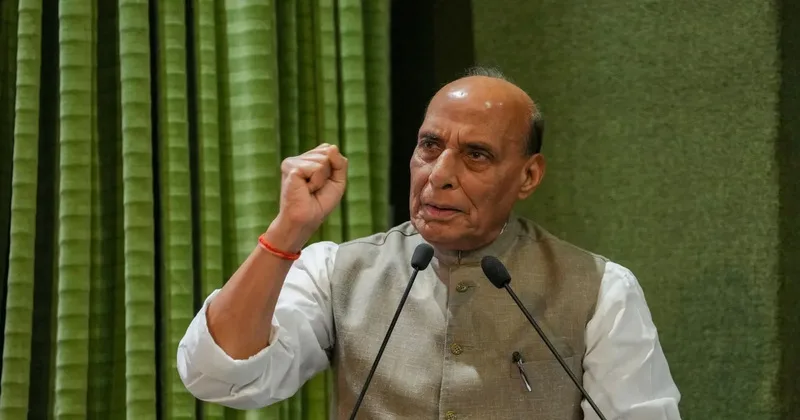
Defence Minister Rajnath Singh on Sunday (Nov 24) made one of his most direct civilisational references yet on India’s historical geography, saying that the region of Sindh, now a province of Pakistan, may return to India in the future. Speaking at a programme organised in honour of the Sindhi community in New Delhi, the minister said that Sindh may not be part of India’s current political map, but it remains an inseparable part of India’s cultural consciousness.
“Today, the land of Sindh may not be a part of India, but civilisationally, Sindh will always be a part of India,” Singh said, recalling the deep emotional ties shared by the Sindhi community with the Indus River and the land they were forced to leave behind during the traumatic Partition of 1947.
In a remark that has quickly gained national attention, Singh added: “As far as land is concerned, borders can change. Who knows, tomorrow Sindh may return to India again.”
His comment underscores a broader sentiment within sections of the Indian political spectrum that certain territories, bound by cultural and historical linkages, remain part of India beyond the realm of modern borders.
Sindh, located along the Indus River, was among the worst-affected regions during the violence of 1947. Home to a large number of Sindhi Hindus who considered the Indus sacred, the region was merged into Pakistan after Partition. The upheaval forced lakhs of Sindhis to migrate to India, where they rebuilt their lives from scratch.
Singh highlighted this legacy, noting the community’s contribution to modern India: “After the brutal Partition, Sindhis had to start from zero. But their courage, hard work and entrepreneurial spirit helped them establish new dimensions of success,” he told the gathering. He added that the community has become a driving force in India’s economic growth, business innovation and social service sectors.
The Defence Minister also cited former Deputy Prime Minister and veteran Sindhi leader LK Advani, recalling that Advani’s generation never came to terms with the separation of Sindh from India.
Quoting Advani, Singh said: “Many Muslims in Sindh also believed that the water of the Indus was no less sacred than the Aab-e-Zamzam of Mecca.”
Rajnath Singh’s comment that “borders can change” carries geopolitical significance. While he did not reference any diplomatic or military context, the statement hints at the belief that political boundaries are not immutable, especially when civilisational bonds transcend them.
The minister reiterated that the Sindhi community, dispersed across continents yet deeply rooted in India’s civilisational identity, will always be regarded as part of the nation.
“No matter where they are, they will always be ours,” he said, drawing applause from the audience.
His remarks also mirror sentiments expressed earlier by him regarding Pakistan-occupied Kashmir (PoK), another region that was part of the pre-Partition princely state of Jammu and Kashmir and continues to be a political and emotional flashpoint.
Singh’s latest statement comes just two months after his assertion in Morocco that PoK would eventually reunite with India without any military action. Addressing the Indian diaspora, he had said: “PoK will be ours on its own. Demands have started being made in PoK; you must have heard the sloganeering.”
He recalled a 5-year-old speech delivered in the Kashmir Valley, where he told soldiers that the day was not far when the people of PoK themselves would declare, “Main bhi Bharat Hoon,” signalling their desire to integrate with India.
The event in Delhi, where Singh addressed members of the Sindhi community, was a celebration of their heritage and contributions. He described the community as a symbol of India’s cultural identity and resilience, saying: “Sindhi society is a symbol of India’s cultural identity and self-respect.”
He praised Sindhi entrepreneurs, philanthropists and professionals who have excelled globally despite the adversity of forced displacement. Their success, Singh noted, is not just a story of survival but of unwavering determination and national commitment.
Rajnath Singh’s remarks come at a time when India-Pakistan relations remain strained, and debates on historical territories continue to shape the political discourse. While his statement may not indicate any immediate policy direction, it reinforces a narrative that India’s identity extends beyond present-day boundaries.
In recent years, conversations about Bharat’s ancient geography, from Gandhar to Sindhu to Kashi, have become central to public rhetoric. Singh’s emphasis that “civilisationally Sindh will always be a part of India” fits within this broader ideological trend.
It also echoes a long intellectual tradition that views the Indian subcontinent as a single cultural sphere, fragmented artificially by colonial borders. Many historians argue that regions like Sindh, Baluchistan and parts of Afghanistan were historically part of India’s cultural ambit, even if not always politically united.
Rajnath Singh’s statement that “Sindh may return to India again” is likely to spark conversations across political and public spaces. While the Defence Minister did not elaborate on the circumstances under which such a reunification might occur, the comment reinforces the idea that borders, especially those shaped by traumatic historical events, can evolve with time.
For now, the remark serves as a reminder of India’s shared civilisational history with Sindh and the unbroken emotional connection maintained by the Sindhi community worldwide.













Comments