





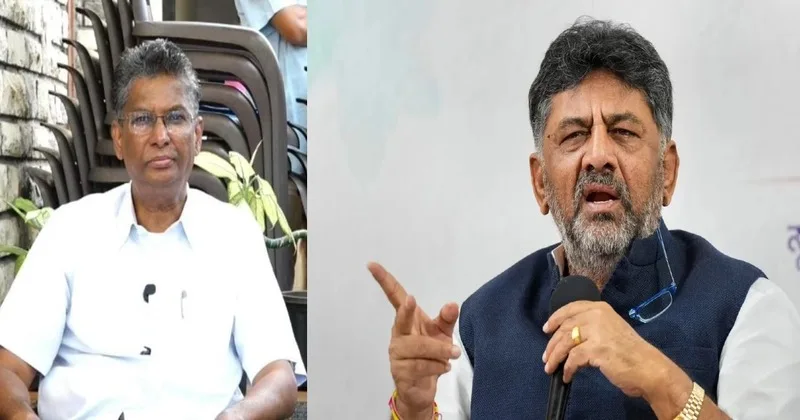
Bengaluru: As internal rifts within the Karnataka Congress deepen, the race for the Chief Minister’s post has sparked a fierce battle, with multiple party leaders now vying for the coveted position. The escalating power struggle has led to growing speculation over the party’s future leadership, as key figures engage in political maneuvering and lobbying to secure their place at the helm.
A major development in the ongoing turmoil came when All India Congress Committee (AICC) president Mallikarjun Kharge finally addressed the current crisis within the state Congress. Speaking to reporters at his residence in Sadashivanagar, Bengaluru, Kharge refrained from commenting on the internal developments, stating that the final decision would rest with the Congress High Command. He added that, despite the ongoing tensions, he would not comment on the situation, implying that the party leadership’s direction would ultimately guide the party through this turbulent period.
Kharge’s reluctance to directly engage with the leadership tussle has left many observers speculating about the nature of the decisions that may come from the Congress High Command. While the AICC president’s neutrality in the matter may be seen as an attempt to cool tempers, the situation within the state Congress seems far from settled.
In response to the leadership crisis, senior Congress leader and Public Works Minister Satish Jarkiholi made a strong statement about the need for equal recognition of all Congress leaders who have contributed to the party’s success. He emphasized that the party’s success was the collective effort of everyone—from grassroots workers to senior leaders. Speaking to the media on Sunday, Jarkiholi said, “We have 1.25 crore voters, and it is due to their support that we are elected as MLAs and ministers. No one can claim that the government was formed due to their individual effort.”
Jarkiholi also took an indirect swipe at Deputy Chief Minister D.K. Shivakumar, suggesting that credit for the party’s success should not be monopolized by a select few. “Everyone has contributed equally to bringing the party to power, and no one individual can claim credit for it,” Jarkiholi remarked. The statement reflects growing dissatisfaction within the party over the perceived concentration of power in the hands of a few leaders.
Jarkiholi further expressed his support for Congress leader Dr G Parameshwara, acknowledging his years of hard work as the Karnataka Pradesh Congress Committee (KPCC) president. He insisted that Parameshwara, who served for eight years as KPCC chief, should also be given equal opportunities within the party, pointing out that his efforts had played a pivotal role in strengthening the party during its challenging phases. “Parameshwara deserves equal recognition and opportunity, just like anyone else,” Jarkiholi said.
Amidst these power dynamics, Jarkiholi also made it clear that he too harbors ambitions for the Chief Minister’s post, a sentiment that was earlier echoed by Parameshwara himself. In an apparent nod to the growing competition within the party, Jarkiholi stated, “There’s nothing wrong in aspiring for the top post. I, too, am an aspirant. The Congress party’s core supporters, including backward classes and minorities, must have adequate representation.”
The jockeying for the CM position has intensified as party leaders debate over who is most suited to lead the state. Jarkiholi’s comments reflect the competitive nature of the internal politics within the party, especially after the Congress’ victory in the state assembly elections earlier this year.
Despite the intense lobbying, Jarkiholi was quick to add that the final decision on the Chief Minister’s appointment lies with the Congress High Command. “The decision on who will be Chief Minister, when they will assume office, and the timing of the power transfer will be decided by the High Command. There is no clarity on when the transition will happen, but I will go to Delhi if invited for discussions,” he stated.
In a veiled reference to Shivakumar’s recent claims, Jarkiholi suggested that power struggles and disagreements over leadership are not unusual in politics. He pointed out that some leaders may gain power quickly, while others may have to wait. “For some, power may come immediately, for others, it may take time. This is not the time for sacrifices, but for strategic political decisions,” Jarkiholi said.











Comments