





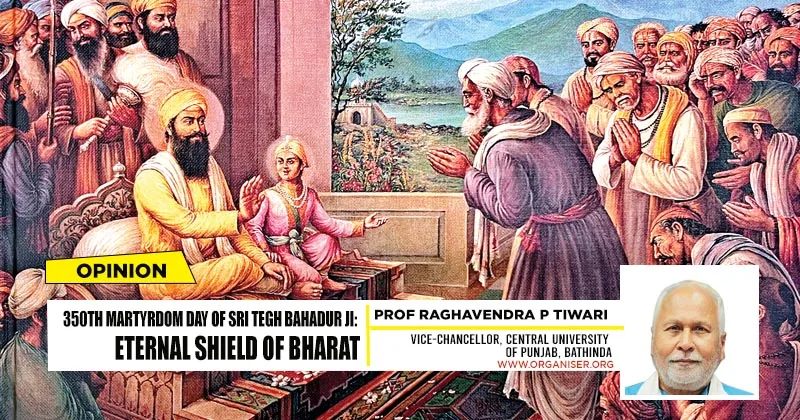
Sri Guru Tegh Bahadur Ji (1621–1675), the Ninth Guru, lived during one of the most turbulent periods in Bharatiya history. Under Aurangzeb’s oppressive rule, religious intolerance and forced conversions endangered Hindustan’s spiritual and cultural fabric. While conversion of Hindus was rampant across the Mughal Empire, the Mughal Governor of Kashmir, in a bid to seek favour from his Emperor, was particularly enthusiastic in implementing conversion policy. This resulted in severe persecution of the Kashmir Pandits, including forced conversion and the destruction of their places of worship. The Kashmir Pandits sought an audience with Guru Tegh Bahadur at Anandpur Sahib, and requested protection.
Out of profound courage, compassion, and as an exemplary mark of universal stand for freedom of conscience, Guru Sahib chose to defend their right to practice their faith freely. He assured the Pandits that he would seek debate with the Mughal Emperor in Delhi. He also told them to inform their Governor that if Guru Ji changes his religion to Islam, we too will, but if he resisted, their freedom would endure.
Perceiving Guru Ji’s growing influence as a challenge to imperial authority, the Mughal rulers arrested the Guru while he was on his way to Delhi, and subjected him and his followers to torture and humiliation all through the journey in a bid to break their will. During the sham of a court hearing conducted by a Qazi, they offered his life in exchange for conversion. Guru Sahib steadfastly refused to renounce his principles. His three devotes Bhai Mati Das, Bhai Sati Das, and Bhai Dayal Das, were executed before his eyes, yet he remained serene and absorbed in divine remembrance.
Choosing truth over life, Guru Tegh Bahadur Ji embraced martyrdom on November 24, 1675 at Chandni Chowk, Delhi, for the cause of religious liberty. His supreme sacrifice earned him the revered title ‘Hind di Chadar’, the Shield of Bharat. Through his unwavering determination and courage, he safeguarded the sovereignty of Hindustan’s soul and upheld the eternal ideals of dharma. Guru Sahib’s life exemplifies that true strength lies not in weapons, power, or cruelty, but in faith, sacrifice, and moral conviction. His supreme sacrifice safeguarded the right of all religions to freedom to worship and practice of dharma during a time of severe oppression. More broadly, it inspired generations to uphold conscience, courage, and moral duty over fear and personal safety. Guru Ji’s life stands as a testament to the ideal that real heroism lies in defending justice and the rights of others, leaving behind an enduring legacy of compassion, courage, and integrity.
Early Life
Guru Tegh Bahadur Ji was born in 1621 in the sacred city of Amritsar to the sixth Guru, Guru Hargobind Sahib Ji and Mata Nanki Ji. He was named Tyag Mal by his parents. From an early age, the young Tyag Mal was immersed in rigorous training, learning the arts of combat, the wisdom of the scriptures, and the practices of meditation and self-discipline. Yet, despite his martial training, his temperament was profoundly contemplative, reflecting a soul drawn towards spiritual depth and inner awakening. Guru Sahib married Mata Gujri Ji in 1633 who remained devoted to him even during long periods of meditation.
Guru Tegh Bahadur Ji emphasised true spirituality lies not in ritual or renunciation but in fearlessness, humility, and the remembrance of the Divine amidst worldly challenges
Guru Sahib was fully capable of warfare and in fact, participated in a few battles during his early life, primarily under the leadership of his father, Guru Hargobind Sahib Ji, who had militarised the Sikh community to defend dharma and justice. However, he is more known for his spiritual depth, moral courage, and sacrifice for freedom of conscience than for military conquests. His later life embodied the ideal balance between bhakti (devotion) and shakti (power). Guru Sahib journeyed east, retracing Guru Nanak Dev Ji’s Udasi path, to inspire those oppressed by the Mughal rule.
The title Tegh Bahadur, meaning “Brave of the Sword,” was conferred upon him by his father after he displayed extraordinary valour in the Battle of Kartarpur at the tender age of 13 years. But the sword he wielded was not merely for worldly defence. Guru Sahib championed a higher form of moral courage, born of detachment, meditation, and steadfast adherence to righteousness. His life exemplified the principle that true bravery resides not only in the battlefield alone, but also in standing fearlessly for truth and justice.
The Eternal Defender of Human Rights and Equality
Sri Guru Ji’s martyrdom represents one of the earliest and most profound sacrifices in human history for the cause of freedom of conscience. This supreme sacrifice was not driven by personal ambition, political power, or sectarian identity; rather, it was a selfless stand for the universal right of human to live, believe, and worship freely. He chose to protect the right to practice one’s religion without fear, demonstrating that the defence of others’ freedom is the highest form of spiritual duty. His act of resistance against tyranny was an assertion that moral conviction transcends the authority of empires.
Centuries before the emergence of Bill of Rights, or the Universal Declaration of Human Rights, Guru Tegh Bahadur Ji proclaimed through his life and sacrifice that freedom, equality, and human dignity are sacred, inherent, and non-negotiable. His martyrdom became a moral milestone in the global history of human rights, inspiring generations to uphold justice and liberty for all. He remains an eternal symbol of human rights, equality, and the triumph of moral courage over tyranny. He rejected all forms of discrimination based on caste, creed, or wealth, emphasising that the divine light exists in everyone. He also promoted peace, tolerance, and moral courage, teaching that true strength lies in patience, compassion, and the defence of the oppressed.
Transformer of Civilisational Discourse
Guru Tegh Bahadur Ji occupies a seminal position in history for redefining the civilisational and moral ethos of faith. He reinforced the martyrdom of Guru Arjan Dev Ji as a living example and defender of universal conscience, thereby elevating the faith to a civilisational paradigm of moral courage and human rights.
Guru Tegh Bahadur’s spiritual contributions are reflected in his religious songs. For instance, he says, “Fear none, frighten none; thus shall you know wisdom” (Guru Granth Sahib, Ang 1427) where he articulates the synthesis of spiritual discipline with moral valour, establishing the framework for the Sant-Sipahi ideal, and work for the welfare of all (Sarbat da Bhala). Additionally, the founding of Anandpur Sahib in 1665 under his guidance provided a structured centre for spiritual, social, and civilisational consolidation, later serving as the cradle of the Khalsa Panth under Guru Gobind Singh Ji. His life’s message is simple yet eternal: “Defend others’ freedom as you defend your own; in that lies the true path to God.”
Spiritual Evolution of Sikhism
Guru Tegh Bahadur Ji emphasised that true spirituality lies not in ritual or renunciation but in fearlessness, humility, and the remembrance of the Divine amidst worldly challenges.
Guru Sahib’s spiritual compositions (bani), enshrined in the Guru Granth Sahib in 15 Ragas with 59 Shabads and 57 Shloks, offer timeless guidance for the human spirit. They emphasise the impermanence of worldly attachments, urging humanity to rise above ego, greed, and fleeting pleasures. Through these, he teaches the cultivation of equanimity amidst the dualities of joy and suffering, success and adversity, and life and death. His vision of spirituality is both profound and practical, blending deep meditation (simran) with selfless action (seva), showing that devotion to the Divine must manifest in compassionate service to humanity.
Eternal Legacy: Lessons for Humanity
Sri Guru Tegh Bahadur Ji’s life and martyrdom are not only defining milestones in history but also timeless lessons for humanity. His teachings continue to guide civilisational discourse towards harmony and peaceful coexistence – values that hold immense relevance in our increasingly divided and conflict-ridden world. Equally significant are his spiritual insights into inner strength and detachment. He favoured conquering fear, cultivating humility, and attaining peace through self-discipline and surrender to the divine will. He taught that true happiness lies not in material possessions or transient pleasures, but in living a life of truth, selflessness, and service to humanity. His life serves as a radiant example of how one can remain steadfast in righteousness while being deeply compassionate towards all beings, a message that continues to inspire generations across time and cultures.
In essence, the life of Guru Tegh
Bahadur Ji teaches us to be brave in adversity, compassionate in strength, and selfless in service. His example reminds humanity that defending truth and human dignity is the highest form of devotion. His legacy continues to inspire people across the world to live for the ideals of freedom, equality, justice, and the well-being of all.
Thus, Guru Tegh Bahadur Ji’s life was shaped by one of the most testing circumstances in Bharatiya history. Yet he faced them with fearlessness, compassion, and unwavering faith. His martyrdom remains a timeless beacon of valour and a symbol of Bharat’s spiritual sovereignty. The title Hind di Chadar is not merely an honorific, it signifies that he was the living shield of Bharat’s spirit and conscience, protecting freedom of faith, human dignity, and the nation’s pluralistic ethos. His courage and selflessness continue to inspire humanity, reminding all that true strength lies in upholding truth and righteousness – a universal message of justice and compassion that transcends time.
(Views are personal)










Comments