





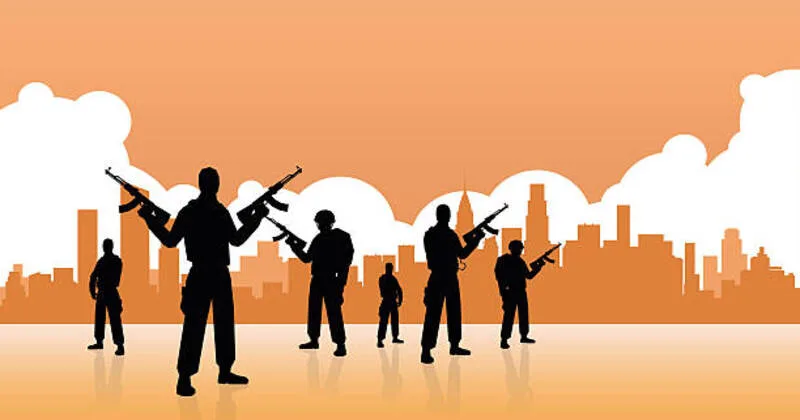
The new face of terror. “The forest was shrinking, but the trees kept voting for the axe-for the axe was clever and convinced the trees that because his handle was made of wood, he was one of them”. This Turkish proverb returned to my mind the moment I saw the undated video of terrorist Dr Umar Nabi. Dressed neatly in a T-shirt, sitting calmly on a rolling chair, speaking in fluent English, he justified suicide attacks as ‘martyrdom’.
This was not the face of deprivation. It was the face of an educated, articulate mind hijacked by ideology. And that is precisely what makes the recent Delhi terror plot so alarming. When Delhi Police uncovered a network linked to the banned Jaish-e-Mohammad (JeM), what shocked investigators was not only the explosives or the methods- it was the profiles. One of the key accused, Dr Muzammil Ahmad Ganaie, was a 32-year-old junior doctor at Al-Falah University, part of a group of well-educated medical professionals planning terror attacks. This incident brutally shatters the old assumption that terrorism thrives only where education is absent and poverty is present. It does not.
I am not surprised, because I have witnessed up close. It reminded me, uncomfortable as it is to admit, of my 15-year-old self. I grew up in Odisha in a family of activists and journalists-my father from ABVP, my mother from SFI. I grew up reading everything from Guruji Golwalkar to Karl Marx. Questioning was the default mode of life. When our family faced atricious pressure from the previous government- our press was shutdowns, home raids and my father’s detention- it pushed me deeper into activism. My first police detention came in Class 12. My college years were spent around protests, seminars and ideological debates at Delhi University. Odisha, at that time, was the epicentre of Maoist unrest and many mates
drifted into Naxal ideology. It was a normalised phenomenon.
Back then, literature that praised armed resistance felt heroic and justified. In Class 10, my Facebook cover photo even declared: “Resistance to existence is my valentine”. That was the mood of the time- rebellion felt like identity and anger felt like purpose. It took years of unlearning and discovering what India truly meant to me for that sentiment to transform into what I now write proudly on my platforms: “India is my valentine”.
Perhaps that is why I understand how easily educated minds can be radicalised. It rarely announces itself as evil-instead, it arrives disguised as meaning, belonging or community identity. Over the past few months, we have been working extensively in the mental-health domain in Kashmir. And it is not surprising to find that the youth most vulnerable to radical narratives are not the poorest, but the most educated, articulate and socially mobile. Many come from well-to-do families, speak multiple languages and have relatives well placed abroad. Yet they carry deep anti-establishment sentiments- sometimes out of conviction, but often as a social fashion meant to fit in. During my time at Delhi University- certain classrooms were dominated by extreme ideological currents. I recall professors subtly justifying the Pulwama attack as a “response to state atrocities”. Such narratives, especially when delivered through the authority of academia, can emotionally condition young minds.
Walk through Dal gate, step into the cafés, observe the conversations- they do not reflect poverty or unemployment that is often portrayed as victimhood. They reflect identity conflict, ideological confusion and emotional vulnerability. And this is not an Indian anomaly.
The world’s deadliest terrorists were not uneducated or deprived. Osama bin Laden was born into a billionaire family, received elite schooling, attended an English course in Oxford, read military history, wrote poetry and played football. ISIS recruited engineers and doctors. Al-Qaeda relied on Western-educated operatives. Education builds skills, not wisdom. Degrees can build expertise, not emotional resilience. Literacy can teach logic, but not loyalty. Radicalisation is not an intellectual process- it is an emotional hijack. It convinces a young individual that they are oppressed when they are not, victimised when they are not, noble when they are actually being used as pawns.
What matters is not “Are they educated?” but “What are they reading? Who are they listening to? Who do they think they are fighting for? Today’s radicalisation ecosystem thrives on encrypted Telegram groups, anonymous sermons, influencer-driven propaganda, algorithmic echo chambers, political myths, generational trauma narratives and friend-circle conformity. This is not poverty-driven extremism. It is identity-driven extremism customised for the GenZ to get absorbed.
At the same time, it is paramount to understand that labelling all Kashmiris as “terrorists” is not just inaccurate-it is dangerous. It is exactly the narrative that Pakistan and separatist groups want India to fall for. The more alienated Kashmiris feel, the easier it becomes for radical handlers to position themselves as their only ‘protectors’. India cannot allow such psychological manipulation to succeed. Kashmiris must believe and must experience that Delhi stands with them against terror modules. This fight shouldn’t be seen as “India versus Kashmir” it must be Kashmir versus radicalisation, with Delhi as the partner, ally and
protector. Only then can the emotional space in which terror groups breed be truly dismantled.
To counter this new reality, India must adopt a layered and psychologically informed strategy. First, we need to audit madrassa curricula nationwide- not to interfere with religion, but to ensure that no extremist literature, ideological indoctrination or anti-state narratives seep into young minds disguised as ‘faith’.
Second, there must be periodic review of religious sermons across all faiths, because clerics hold extraordinary influence. India needs more religious leaders who preach peace, pluralism, dignity and constitutional values. We need a cadre of clerics who openly articulate pro-India narratives- who teach that national loyalty is not separate from spiritual life but a part of it.
Third, we need stronger on-ground intelligence. Young people often show emotional or behavioural changes long before they act. Our intelligence teams should be trained to notice early signs- like shifting beliefs, emotional instability, new friend circles or sudden exposure to radical content.
Fourth, the Ministry of Higher Education must deploy psychological and emotional intervention units- trained school counsellors who can identify ideological grooming, community mentors who can guide youth and digital de-radicalisation teams who counter online propaganda with facts, empathy and compelling narratives. Terrorism runs on stories of victimhood, injustice, revenge. India must learn to tell better stories. Stories of opportunity, belonging, dignity and success within India. Censorship alone will not work- in fact, it often reinforces victimhood narratives. The solution lies in narrative disruption,
psychological engagement and emotional rebuilding.
Kashmir’s reality is delicate: A terrorist is seen as an enemy of India. But a dead terrorist is often turned into a story, a symbol a grievance. Don’t forget how Burhan Wani was made a hero.
The Delhi plot is a warning that the battlefield has shifted. Terrorists no longer emerge from distant jungles or impoverished neighbourhoods. They emerge from classrooms, hospitals, university hostels and encrypted chat rooms. The most dangerous terrorist today is not the uneducated youth with nothing to lose.
I won’t be shocked if this piece earns me the familiar label of “agent”. In Kashmir, that word is tossed around with ease at anyone who speaks up for India or questions the machinery of radicalisation. With time, I have realised that this reaction isn’t always a personal target, it’s a shield, a survival tactic in a place where even neutrality can be misread as danger. So I no longer take it to heart.
But I do hope for the day when Kashmir doesn’t need these shields anymore. A day when talking about peace isn’t an act of bravery, when condemning terrorism isn’t seen as betrayal and when young people are not forced into a choice between silence or suspicion. Even Osama bin Laden’s own son once pleaded with his father: “Try to find another way to help or find your goal. This bomb, this weapon- it’s not good to use it for anybody”. If a child raised in the heart of extremism could see the futility of violence, surely Kashmir deserves a future where its youth can see it too.













Comments