





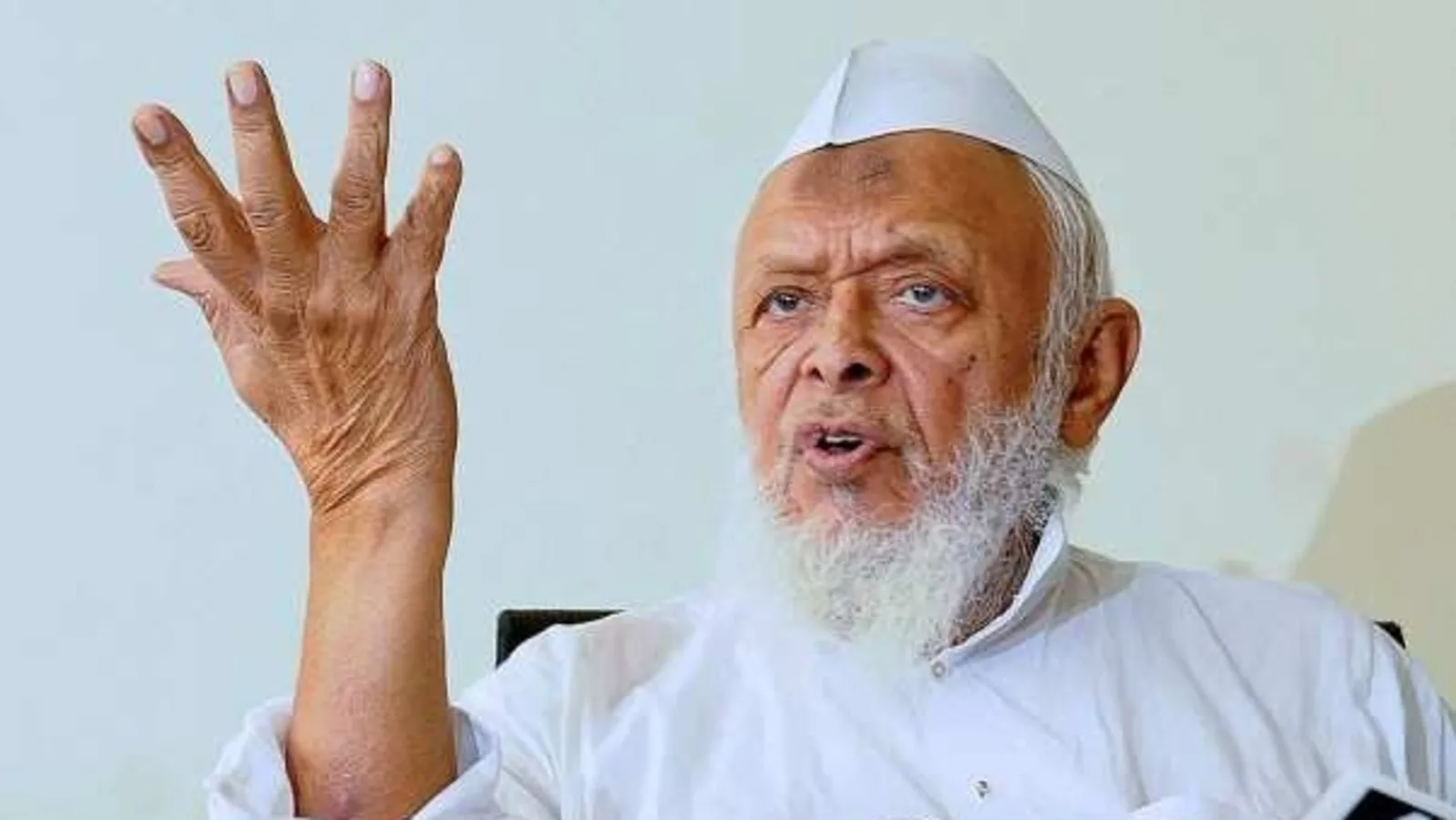
Bharatiya Janata Party on Sunday strongly criticised Jamiat Ulema-e-Hind president Maulana Arshad Madani for alleging that the Indian government was systematically ensuring Muslims remain marginalised. The party said such statements were “confusing,” “misleading,” and “dangerous,” particularly at a time when the Delhi blast probe is underway and security agencies are on alert.
BJP spokesperson Yaser Jilani dismissed Madani’s public address as an attempt to create unnecessary fear within the Muslim community. According to him, the cleric ignored the inclusive policies of the Central government and instead chose to “spread confusion for political gains.”
“There cannot be a better place for Muslims than India, nor a better big brother than the Hindus,” Jilani said, adding that Madani’s remarks misrepresented the social reality of India’s pluralistic structure.
Jilani Points to Contradictions in Madani’s Statements
The BJP also highlighted what it termed “inherent contradictions” in Madani’s speech. Jilani noted that the cleric simultaneously referred to global challenges faced by Muslims and celebrated the rise of leaders like Zohran Mamdani, the Mayor-elect of New York, and London Mayor Sadiq Khan.
“He cannot claim that Muslims are helpless globally and in the same breath cite Muslim leaders rising abroad. And in India, he links every legal case with discrimination,” Jilani said, referring specifically to Madani’s mention of Uttar Pradesh leader Azam Khan and developments at Al-Falah University.
Jilani reiterated that both cases involved “clear legal violations” and were not examples of targeting. “The owner of Al-Falah University is a perpetrator, and Azam Khan is also involved in various offences. The Central government is taking everyone along. Madani should not create confusion among people,” he added.
Maulana Arshad Madani, in his earlier statement, claimed that Muslims were being unfairly targeted in India. He argued that while Muslims abroad could rise to top positions in public life, their counterparts in India were pushed down by political machineries.
“The world thinks Muslims have become helpless and barren. But I don’t believe so,” Madani said. “A Muslim Mamdani can become mayor of New York, a Khan can become mayor of London, but in India, even if someone becomes a vice-chancellor, they will be sent to jail. Look at Azam Khan. Look at Al-Falah. The government is working to ensure that Muslims never raise their heads.”
His remarks stirred immediate political responses across party lines, with the BJP accusing him of inflaming sentiments and attempting to deepen communal divides.
Former Uttar Pradesh Minister and BJP leader Mohsin Raza launched a scathing attack, accusing Madani and his family of decades-long exploitation of the Muslim community.
“This has been their dual character for a very long time. Madani and his family kept receiving grants in the name of Muslim minorities but did nothing for their upliftment,” Raza said. He alleged that the cleric’s comments were driven by a political agenda rather than genuine concern.
In a contrasting political stance, the Congress extended full support to Maulana Madani. Party leader Udit Raj endorsed the cleric’s remarks and accused the government of discriminatory practices.
“I support his statement. Yes, someone may have done terrorist activity in Al-Falah University, but why should the university be targeted? Why are homes of Muslims being bulldozed?” he asked, alleging differential treatment by authorities. Raj also compared India unfavourably with the United States, saying, “America is great as there is no discrimination there.”
The political clash once again brings to the fore long-standing arguments over discrimination, legal accountability, and political rhetoric around minority rights. While the BJP asserts that legal action against individuals like Azam Khan or institutions like Al-Falah University has no religious angle, the opposition maintains that selective targeting and bulldozer actions reflect structural bias.
With the Delhi blast probe underway and national security dominating discourse, Madani’s remarks have sharpened fault lines within the political landscape. As multiple parties present conflicting narratives, the debate over Muslim representation, political accountability, and social justice is expected to escalate further in the coming days.















Comments