





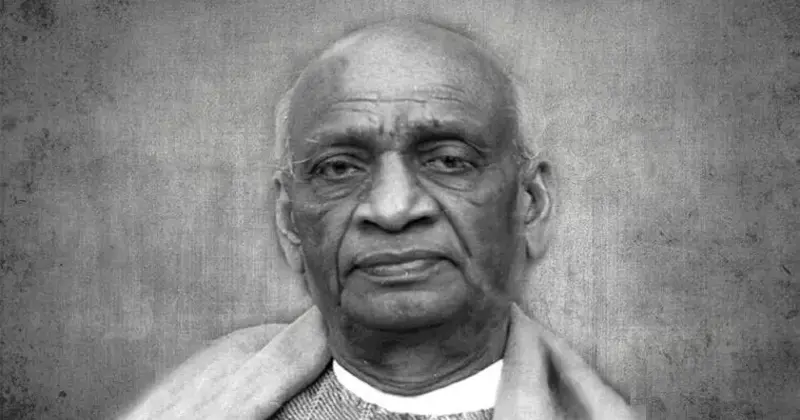
Sardar Vallabhbhai Patel, fondly remembered as the “Iron Man of India,” was one of the most remarkable leaders of India’s freedom struggle and the chief architect of national integration.
Early life and education
Sardar Vallabhbhai Patel was born on October 31, 1875 in the Karamsad village in the historic district of Kheda in the present-day Gujarat State. He came from a humble agrarian family of the Leuva Patel community. When he was about five years old his mother, Ladbhai Patel died and he was brought up by his maternal grandmother. His father Jhaverbhai Patel was a farmer by occupation and had also served as a soldier in the army of Gaekwad ruler of Baroda State. He was known for his sturdy character and patriotic spirit. Despite limited means, young Vallabhbhai showed exceptional determination and self-discipline. When he died in 1950, he had left no property in favour of his progeny namely, Dahyabhai Patel and Maniben. Thus, he has attained the stature of a Raj Guru in Bharat.
Sardar Vallabhbhai Patel completed his early education in the school of his village. Later, he studied law in England at the Middle Temple Inn, London, where he excelled and qualified as a barrister in 1913. He lived a very frugal lifestyle by cooking his own vegetarian meals while living in a small rented room and covering a distance of about 10 miles every day. Upon returning to India, he began a successful law practice in District and Sessions Court of Ahmedabad under the jurisdiction of Bombay High Court of the then larger Bombay State. However, the call of the nation soon drew him away from his legal career towards public life.
Entry into public life
Inspired by Mahatma Gandhi, Patel joined the freedom movement and became a leading public figure in the Kheda Satyagraha (1918) and Bardoli Satyagraha (1928) — both non-violent movements that protested against the oppressive British taxation policies. His effective leadership during the Bardoli movement earned him the title “Sardar”, meaning leader or chief, from the grateful farmers.
Role in India’s Unity
When India gained independence, the country was not a single, unified entity as it is today. The British had directly ruled certain regions (British India), while 562 princely states were semi-autonomous kingdoms under British suzerainty. With the lapse of British paramountcy, these princely states technically became independent. This situation posed a grave threat to India’s unity and stability.
It was at this critical juncture that Sardar Vallabhbhai Patel, the Deputy Prime Minister and Home Minister of India, took on the monumental task of integrating these states into the Indian Union. His efforts earned him the title of the “Iron Man of India” and the architect of modern political unity.
1. The Challenge of the Princely States
The 562 princely states varied immensely in size, power, population and political aspirations. Some were large and wealthy—like Hyderabad, Kashmir and Mysore—while others were tiny principalities. The rulers, accustomed to privilege and autonomy, were hesitant or even opposed to merging with the new democratic India.
The major challenges were:
- Political disunity: Each ruler had the option to accede to either India or Pakistan—or remain independent.
- Geographical fragmentation: States were scattered, often surrounded by Indian territory but not politically part of it.
- Diverse interests: Some rulers leaned towards Pakistan, while others sought to maintain their sovereignty.
It was essential to integrate these territories swiftly and peacefully to prevent India from disintegrating even before it began.
2. Sardar Vallabhbhai Patel’s strategy: Diplomacy, persuasion and firmness
Sardar Vallabhbhai Patel, adopted a three-pronged approach—persuasion, political negotiation and where necessary, decisive action.
a. Instrument of Accession
Sardar Vallabhbhai Patel offered a simple legal arrangement: rulers could sign an Instrument of Accession by which they would cede only three subjects—defence, external affairs and communications—to the Indian government. This ensured that rulers retained internal autonomy, while India maintained unity on key national matters.
b. Personal diplomacy
Sardar Vallabhbhai Patel’s personal stature, firmness and emotional appeal to nationalism persuaded most rulers to accede willingly. Within months of independence, over 500 princely states had joined India peacefully.
c. Firm action where necessary
In some cases, Patel used decisive force:
- Hyderabad: The Nizam resisted Accession, leading to the 1948 “Operation Polo”, a swift military action that ended Hyderabad’s independence and integrated it into India.
- Junagadh: The Nawab acceded to Pakistan despite having a Hindu-majority population. Patel ordered military and political steps that resulted in a plebiscite confirming accession to India.
3. Sardar Vallabhbhai Patel’s special emphasis on Jammu and Kashmir
The case of Jammu and Kashmir was among the most complex and consequential of all princely states.
a. Background
The area of the erstwhile Jammu and Kashmir State was 2,22,236 sq. kms before Independence. The boundaries extended up to 750 miles with Tibet, 300 miles with Union of India, 600 miles with Pakistan and 50 miles with Afghanistan. The Central State of Tajikistan was separated by a narrow strip of Wakhan. The maximum strip was 40 miles, but at some places only 10 miles wide. The Maharaja’s of Dogra Dynasty had suzernity over Tibet State also thay had the terms of treaty with the Maharaja Gulab Singh, Government of Tibet and the Emperor of China through their deputed officials. The treaty was signed at Leh on Second of Asuj 1899 Bikrami (September 1842). Treaty was drafted in Persian language and its official English Translation is available in Appendix I at pages 477 to 478 of the authored book by this author by the title “Plight of Jammu and Kashmir- The Unknown Files”.
Sardar Patel, the man of action and administrative realism, viewed the problem primarily through the lens of national security and political unity. Sardar Vallabhbhai Patel had developed a cordial and respectful relationship with Maharaja Hari Singh at appropriate crucial stage of changing history of the sub-continent through the medium of powerful Hindu leader namely, Rai Bhadur Gopal Dass of Lahore. As a consequence of this wise step Maharaja Hari Singh regarded Sardar Patel as a practical trustworthy leader who understood the concerns of the Princely Rulers. Unlike Nehru, whose close association with Sheikh Abdullah had developed strained relations with Maharaja Hari Singh because of Nehru’s unwanted entry which was prevented at the borders of the J&K State to help Sheikh Abdullah during his trial for the offence of Sedition.
Maharaja had initially hesitated to join either with India or with Pakistan and attempted to maintain Jammu and Kashmir’s independence. This he had done at the forcible persuasion of his then Prime Minister R.C. Kak who was a Kashmiri Pandit but having second wife of British nationality who was working under the spell of Lord Mountbatten- the architect of India’s division and guardian of British long range future interests. His motivated and partisan advice even swayed over national interests through Prime Minister Nehru who became an easy prey of it to make a reference of J&K Aggression to United Nations. This wrong decision has made this advice as an international problem.
b. The Pakistani invasion
In October 1947, Pakistan launched an invasion using tribal militias, supported covertly by its army, to annex Kashmir by force. The raiders captured large parts of the north-western region, committing atrocities along the way.
Faced with imminent collapse, Maharaja Hari Singh appealed to India for military assistance. Patel, responded decisively when the appeal came. Mr. Mehar Chand Mahajan, the then Prime Minister of J&K State went to meet the then Prime Minister Nehru on behalf of Maharaja to apprise him about the situation that had arisen. Sardar Vallabhbhai Patel was also present in that meeting. Mr. Mahajan told Pandit Nehru, “Give us the military force we need. Take accession and give whatever power you desire to the popular party. The army must fly to save Srinagar this evening or else I will go to Lahore and negotiate terms with Mr. Jinnah”. Mr. Mahajan had the orders from Maharaja to go to Pakistan in case immediate military aid was not given. This made Nehru angry and he said to Mahajan to go away. It was at this crucial stage when Saradar Patel intervened and he said in Mahajan’s ear, “Of course, Mahajan, you are not going to Pakistan”. Sardar Patel as a practical and visionary statesman and politician knew the strategic importance of the J&K State.
c. Instrument of Accession
On October 26, 1947, Maharaja Hari Singh signed the Instrument of Accession to India, agreeing to join the Indian Union under the same terms as other princely states. The next day, Indian troops were airlifted to Srinagar, beginning the defence of the state. Patel’s swift and firm decision to send the Indian Army saved Kashmir from complete annexation by Pakistan. His action ensured that Jammu and Kashmir legally became part of India.
d. Patel’s Role in managing the crisis after accession with India
While Jawaharlal Nehru was more involved in the diplomatic side of the Kashmir issue, particularly at the United Nations, Sardar Patel played a crucial role in the immediate political and administrative response:
- He managed the accession process with legal precision.
- He oversaw the integration of Jammu, Kashmir and Ladakh into the administrative framework of India.
- He maintained strong internal unity within the cabinet during the crisis, ensuring swift coordination between the army and the civil administration.
Patel’s foresight was evident when he warned that Pakistan’s ambitions in Kashmir would not end easily, and that India must maintain strength and unity to preserve its territorial integrity. Till date this is coming true as Jammu and Kashmir State not only after becoming a hot bed of militancy has also become an epicenter of spreading its tentacles in other parts of the country such as recent discovery of 2900 kg of explosive from Haryana state.
4. Legacy of Patel’s integration efforts
By the time Sardar Patel passed away in December 1950, nearly all princely states had been integrated into India, either as part of existing provinces or as new administrative units. His achievements include:
- The creation of a united India out of hundreds of fragmented kingdoms.
- The political and administrative reorganization of these regions into viable states.
- The foundation of a strong federal structure, ensuring both unity and diversity.
His approach balanced pragmatism with patriotism, firmness with fairness and vision with execution—a rare combination that shaped India’s destiny.
Sardar Vallabhbhai Patel’s leadership during the integration of the princely states was one of the most critical nation-building tasks in Indian history. His ability to combine diplomatic skill, political courage and strategic acumen ensured that India emerged from the chaos of partition as a united and stable nation. In the case of Jammu and Kashmir, Patel’s quick and resolute action not only saved the state from falling into Pakistani hands but also legally secured her accession to India.
Without Patel’s vision and determination, the map of India today might have been vastly different. His work laid the foundation for the territorial unity, political stability and national identity that India continues to cherish.
Sardar Patel’s vision of national sovereignty and his warning about China’s expansionist policy delineated in his lettet to Pandit Nehru dated November 07, 1950
Patel immediately recognized the strategic and geopolitical dangers posed to India and he expressed his concerns in a confidential letter to Prime Minister Jawaharlal Nehru on November 7, 1950. He passed away on December 15, 1950 in Bombay. This letter remains one of the most farsighted documents in India’s political history.
- Patel observed that the Chinese invasion was not merely a political move but a military and ideological expansion that would have serious implications for India’s security. He wrote that the event “brings us right up against a totalitarian regime controlled and inspired by a foreign ideology”.
- He was referring to Communist China under Mao Zedong (mostly known as Mao Tse-Tung), whose approach was vastly different from traditional Chinese diplomacy. Patel foresaw that India could no longer rely on goodwill or moral arguments to secure its borders.
- Sardar Vallabhbhai Patel was concerned that India’s leadership — particularly the foreign policy establishment — was too idealistic and trusting toward China. Nehru’s government at the time was pursuing a policy of friendship and non-alignment, hoping to build goodwill through diplomacy.
Patel, however, urged a realistic appraisal towards Chinese intentions. He wrote:
- “Recent and bitter history also tells us that communism is no shield against imperialism and that Communists are as good or as bad imperialists as any other.”
- He emphasized that China’s actions were aggressive, not defensive and that India must prepare for possible border conflicts.
Patel’s letter detailed India’s unpreparedness along the Himalayan frontier. He warned that:
- “We have practically no military or administrative arrangements on our northern frontier. We must strengthen our position in Sikkim and the North-East Frontier Agency (NEFA).”
- He stressed the importance of developing roads, communications and military presence in these regions — recommendations that, tragically, were not fully implemented before the Sino-Indian War of 1962.
Patel connected the external threat from China with internal vulnerabilities. He wrote that China could exploit India’s tribal regions, border areas and internal divisions to destabilize the country.
He foresaw the possibility of psychological warfare, infiltration and subversion — issues that later emerged in India’s northeast and Himalayan belt. Even today China is creating problems in Arunachal Pradesh and Ladakh. He also noted the strategic value of Tibet and how its occupation changed the entire geopolitical equation of South Asia.
Some key lines from his November 7, 1950 letter are worth quoting directly:
“We have to consider, quite dispassionately and objectively, what new situation faces us as a result of the disappearance of Tibet as a buffer state between us and China, and what immediate and long-term measures we should adopt to meet this new situation”.
“The Chinese Government has tried to delude us by professions of peaceful intentions. My own feeling is that, at the moment, they are determined to establish their authority in Tibet and that once they have done so, they will try to establish their claim to the frontier areas”.
“We cannot be friendly with China at the cost of our own security. The situation is such that we cannot rely on their good faith”.
“We have also to consider the political and administrative steps we should take to strengthen our northern and north-eastern frontier. We must not be caught unprepared”.
Despite Patel’s letter and warning Nehru remained confident that peaceful coexistence with China was possible. The Indian government continued to pursue a policy of “Hindi-Chini Bhai-Bhai” (India and China are brothers) during the 1950s.
However, Patel’s warning became true. In 1962, China launched a full-scale invasion across the Himalayan frontier, occupying large parts of Indian territory in Aksai Chin and Arunachal Pradesh (then NEFA) before withdrawing unilaterally. The lack of military preparedness and infrastructure — exactly what Patel had warned against — contributed to India’s defeat in the war.
Strategic vision of Patel
Sardar Patel’s letter shows not only his administrative brilliance but also his strategic foresight. Just as he had unified India politically through the integration of princely states, he understood that national security and unity required geographical and military consolidation as well.
His integration of the princely states gave India its territorial shape and his letter on China offered a blueprint for protecting that unity — a blueprint that continues to guide Indian policymakers in the 21st century.
In his recent address at Gujarat on May 27, 2025, Prime Minister Narendra Modi stated that had Sardar Vallabhbhai Patel policies been adopted in 1947, the situation in J&K would have been entirely different and no part of it would have remained under Pakistan’s occupation.












Comments