





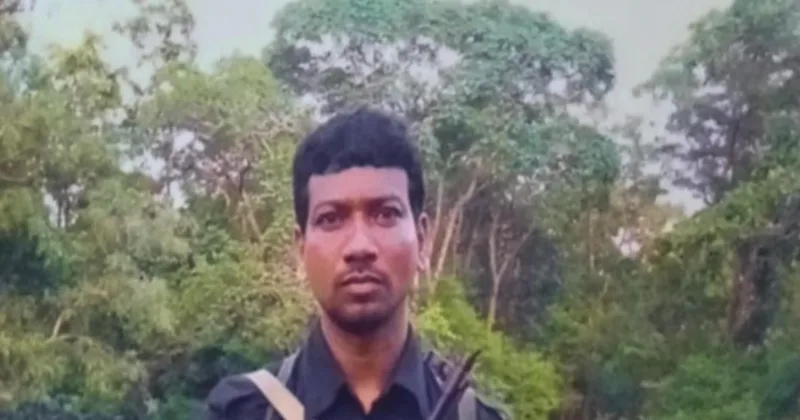
Nearly three decades ago, nobody in the nondescript tribal village of Puvarti in Sukma district of Bastar in Chhattisgarh (then in undivided Madhya Pradesh) could ever imagine that a teenager would eventually emerge as a synonym of terror not only in Bastar, but across the Red Corridor — a large, forested passage cutting across states in India with a significant presence and influence of Naxalite-Maoist insurgents.
It was the summer of 1995-1996. Badaranna, a young area commander (of Basaguda) of the then banned CPI (M-L)-People’s War, visited Puvarti to supervise digging of a pond in the village and distribution of rice to labourers — a job assigned to him by his ultra-Left organisation. Besides others, he came in contact with a 16-year old boy Santosh, who would grow up to become Madvi Hidma, the dreaded Maoist leader. Hidma was killed in an encounter in Andhra Pradesh on 18 November, a few days ago.
It was Badaranna who brought Hidma, a class 5 dropout, into Naxalism by getting him admitted as a member of their ‘Bal Sangathan’ — body that inducts children into the Maoist-fold.
“It was I who got him into the organisation when he was a young boy, almost 30 years ago. He was 16 that time. When I met him in his village, I noticed he had a good height and stout physical built, ahead of his age. Moreover, he was sharp and a perfect candidate for our organisation and our movement. I made him a member of our Bal Sangathan. But no one could expect that Hidma would become a sort of cult figure and an enigma amongst Maoist cadre,” former Maoist leader Badaranna, who surrendered in 2000 along with his wife (who too was in the cadre) and joined the mainstream, told this correspondent.
The people in Bastar, who are now in their sixties and above, confirm that Badaranna too was a known Naxal leader of his time who operated out of Konta and Basaguda.
Fast Forward 2009
Teenager Hidma, by now a youth, rose from the ranks within the organisation and was appointed as deputy commander of Battalion-1 of CPI (Maoist)’s People’s Liberation Guerrilla Army (PLGA) — an important and powerful position in the organisation, more as it provides military heft to a cadre member.
Hidma got the first mover advantage, because after his induction in the organisation, he was made to join the military platoon at an early age — which was in a formative stage that time.
After two years in 2011, he was appointed as a member of the powerful decision-making body Dandakaranya Special Zone Committee (DKSZC) and was made in-charge of the battalion. This made Hidma more ruthless and fierce in his actions in the form of ambushes and attacks on security forces; he virtually turned into a killing machine.
“Undoubtedly, Hidma was a terror for over two decades. His elimination is a great success both for the security forces and the government, which is determined to end this reign of red terror in Bastar and elsewhere,” Anil Kamboj, counter-terrorism analyst, who had earlier led operations in Bastar for the Border Security Force (BSF) remarked.
The Encounter
In the early hours of November 18, between 6 and 7 am, an operation was launched by the Greyhounds — an elite anti-Naxal security force of Andhra Pradesh, and the local police at Maredumilli forest in Rampachodavaram sub-division of Alluri Sitharamaraju district, Andhra Pradesh, and they gunned down India’s most wanted, elusive and dreaded Maoist leader and commander of the PLGA’s Battalion-1, Madvi Hidma, who had been an enigma for the security forces and the police for a long time.
Along with him, five other Maoists neutralised in the encounter were — Madagam Raje alias Rajakka — wife of Hidma, who was a Special Zonal Committee Member; Lakmal (Divisional Committee Member); Kamlu and Malla (both Platoon Party Committee Members) and Deve, the special guard of Hidma.
Hidma, who was carrying a Rs one crore bounty on his head, was the youngest and first tribal from Bastar to become a Central Committee (CC) member of the banned outfit CPI (Maoist). He became synonymous with some of the deadliest attacks in the country’s decades-long Naxal insurgency.
According to police sources, Hidma had been actively involved in more than 26 major attacks, including some of the worst Maoist attacks — 2010 Chintalnar attack in which 76 CRPF men got killed; 2013 Jhirum Ghati massacre in which the entire top Chhattisgarh Congress leadership got wiped out; 2017 Burkapal ambush in which 23 CRPF jawans were killed; and March 2020 Chintagufa (Sukma) ambush in which 17 jawans were killed. He also played a key role in the 2021 Sukma-Bijapur ambush in which 22 security personnel were killed.
“Hidma became so big because unlike me, he was in the military platoon right from the beginning. The aim of the platoon was armed rebellion and bloodbath. And as he was sharp, he rose up to the post of a commander,” added Badaranna.
According to Badaranna, Hidma was always under a tight security cover. Even when he used to go to attend the nature’s call, he was under security protection.
Who was Madvi Hidma?
Various versions about Madvi Hidma alias Idmul Podium Bhima alias Hidmalu, Hidmanna and Santosh gained currency in the market, but the most widely known fact is that Hidma was the commander of Battalion-1 in the Dandakaranya region of Bastar in Chhattisgarh, who rose from the ranks within the armed cadre.
He was also the youngest and the first tribal from Bastar, Chhattisgarh, to become a member of Central Committee.
Originally from Puvarti village (Jagargunda) in Sukma district, Hidma operated out from Naxal stronghold of the south Sukma region. According to locals, he never went to school after class 5, but could speak English and had knowledge of computer operations.
At present, Hidma’s mother, elder brother and two sisters are alive along with their respective families. His two younger brothers have passed away.
Considered an aggressive leader among Maoist cadre, Hidma was a master strategist in guerrilla warfare. It is said that the Bastar terrain was like the back of his hand, which had been proved again and again.
Why Hidma was an Enigma?
Till his death, the police never had any clue about Hidma’s physical appearance, what he looked like or about his background and age.
The police didn’t even have any photograph of Hidma, except an old black and white one — which was almost two decades old. The shadowy Maoist commander Hidma, who had a four-layered security cover, was often called ‘Ghost of Bastar’.
The most common description of Hidma was that he carried an AK 47 and led a strong group of about 250-300 Maoists.
“There are different versions about Hidma’s existence that have made this Maoist an enigma. Some say, he was killed in an encounter after Jhirum Ghati incident and his name is used as a post of a leader in the Maoist cadre. No one has seen him and even if he ever came to a village market, no one would recognise him,” a source from Sukma told this correspondent.
Though police claims Hidma’s age as 50, according to Badaranna he was between 45 and 48.
Jagdalpur-based journalist Rishi Bhatnagar said, “Madvi Hidma was one of the most dreaded Naxal leaders of Bastar, who had been an enigma both for the local police and security forces. He was the most ruthless, dreaded and insensitive face of the current Maoist movement and leadership. He had been a mastermind of more than 26 major attacks including the most infamous ones at Tadmetla and Jhirum Ghati.”
Why in Andhra Pradesh?
After facing the heat from security forces during Operation Black Forest in Bastar during April-May this year, Hidma moved to Andhra Pradesh and made Nalla Malla forest his temporary hideout. But he frequented Chhattisgarh, Andhra and Telangana in between. The security forces had been keeping a close watch of the movements of the Maoists.
According to a source, Hidma had been in Andhra Pradesh for his medical treatment at Rajahmundry, which was not possible in Bastar. “On 18 November, he was supposed to go for his treatment at Rajahmundry, and acting on a tip-off, the Greyhounds and district police neutralised him,” the source said.
Is there light at the end of the tunnel?
After CPI (Maoist) general secretary, Nambala Keshava Rao alias Basavraj or Basavaraju, was killed along with 26 Maoists at Abhujmad forests in Narayanpur (Chhattisgarh) on 21 May this year, the elimination of Hidma is undoubtedly a big achievement both for the security forces and the government.
The Inspector General of Police (Bastar), Sunderraj P confirmed that Hidma got neutralised in an encounter.
“We have regularly been appealing the Maoists to surrender and join the mainstream. In fact, we visited the families of Hidma and Deva and asked their mothers to convince them to surrender, but they didn’t. The anti-Naxal operation in Bastar will continue with full force till Mission-2026 is achieved. The Maoists should either surrender or face the consequences. We’ll end this menace,” said Sunderraj, who has been spearheading anti-Naxal operation in Bastar for nearly a decade.
Among the many key Maoist leaders who surrendered recently is Mallojula Venugopal Rao alias Bhupathi. Following his surrender on 14 October, Bhupathi had urged his active comrades to lay down arms and join the mainstream. While other Maoist leaders like Sonu in Maharashtra and Rupesh in Jagdalpur surrendered, Hidma remained defiant. With his elimination, people in Bastar seem hopeful that this decades-long menace will end.
“The counter-insurgency operations like Operation Black Forest etc launched by the security forces against the Maoists in Bastar, have broken the backbone of this movement in this region, which is one of the dreaded parts of the Red Corridor. Whether it is the Bastar police or the central security forces, the step taken by them is commendable. It looks like, with his elimination, Bastar is on its way to become free of Naxal menace, much ahead of the government’s Mission-2026 deadline to eradicate Maoism from the country. Till now, it was only a thought that Naxalism will end in Bastar, either with the surrender or elimination of Hidma, but now we can say that this Maoist movement is in its last phase,” added Bhatnagar, who has closely seen the Maoist menace in Bastar both as a resident and as a journalist covering the beat.
Added Kamboj, “Before Hidma, Basavaraju was killed in an encounter early this year. This will eventually break the backbone of Maoism. The organisation will be badly hit. But most important is to stop Urban Naxals — the people harbouring Maoist ideology, who target young minds, mostly poor from tribal areas and radicalise them either through conversion or by luring with offers. Most of these Urban Naxals do not have to lose anything, as they are never at the forefront. They get foreign funds to fuel this dirty game and enjoy urban life; whereas these poor tribals are left to die in gunfights.”
The Narendra Modi government’s plan to combat Maoist menace has prioritised equipping the security forces with high-end weapons, extending welfare schemes in Maoist-hit districts and developing infrastructure. By choking Maoist funding and by targeting leaders, it has crippled the organisation. According to the government, at present there only 11 Naxal-affected districts, down from 28 in 2024 — which is a silver-lining behind dark clouds.














Comments