





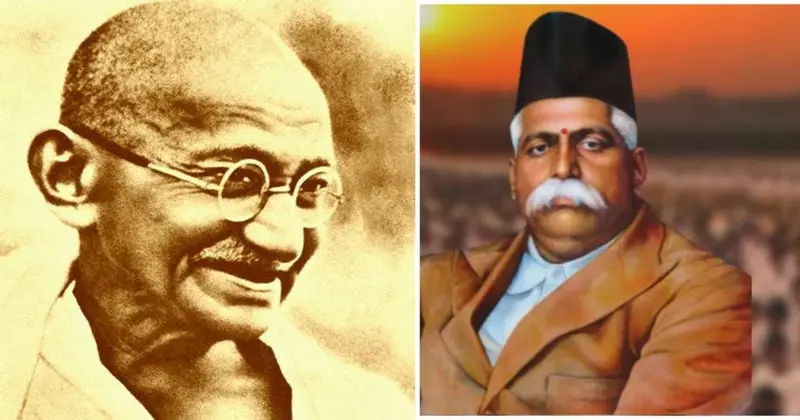
India’s independence was not merely a transfer of political power, it was the resurgence of the nation’s soul. Mahatma Gandhi and Dr. Keshav Baliram Hedgewar not only understood this profound truth but also embodied it through their actions in their respective spheres.
On one hand, Gandhi envisioned transforming the Congress into a Lok Sevak Sangh after independence, an idea he proposed, contemplated and advocated. On the other hand, Hedgewar, recognizing the same danger much earlier, parted ways with the Congress and actualized the ideal by founding the Rashtriya Swayamsevak Sangh(RSS). Though their actions occurred at different times and in different contexts, the underlying message was identical, when politics detaches itself from service, it corrupts the very dharma of the nation. This essay highlights the far sighted vision of Gandhi and Hedgewar, vision that continues to shape India’s moral and cultural renaissance even today.
Gandhi’s vision, From swaraj to public service
For Mahatma Gandhi, Swaraj was not synonymous with the mere exit of British rulers. In his seminal work Hind Swaraj (1909, Chapters XIV,XV), he unequivocally stated, “If white rulers are replaced by brown rulers, it will not be Swaraj”. To Gandhi, Swaraj symbolized self discipline, moral strength and self reliance. True freedom, he believed, would emerge only when society became ethically and socially empowered.
After independence, when Gandhi observed the Congress drifting toward the intoxication of power, he called for a transformation of its character. In his final testament, written a day before his assassination on 29 January 1948 (His Last Will and Testament, Collected Works of Mahatma Gandhi, Vol. 98, pp. 318,320), he wrote, “The Congress has fulfilled its role in the political struggle. It must now renounce unhealthy competition for power. It should dissolve and be reborn as a ‘Lok Sevak Sangh’ dedicated to village upliftment, sanitation, education, khadi and moral awakening”.
This was not merely a proposal to dissolve the Congress, but a vision of creating an institution above partisan politics, devoted entirely to public welfare. Gandhi’s message still reminds us, the true purpose of power is service, not self interest.
Gandhi’s forewarning, the allure of power and Congress’s decline
Gandhi repeatedly warned that the hunger for power would derail the Congress from its foundational purpose. In the meeting of the Congress Constructive Committee on 11 and12 December 1947, he told J.B. Kripalani, “We must not enter the race for power. The Constitution will be framed, but the real work will begin afterward”,(Gandhi in Politics, J.B. Kripalani, 1951, p. 142). This warning proved prophetic. After independence, the Congress gradually became a machine of political domination. Nepotism, factionalism, ideological confusion and corruption eroded its original character.
Today, the party’s stance on national issues, such as the abrogation of Article 370, the Uniform Civil Code, and the abolition of triple talaq, reflects a pattern of opportunism that validates Gandhi’s fears. His dream of a Lok Sevak Sangh remained unfulfilled, while the Congress became entangled in the web of power politics.
Hedgewar’s vision: Nation building through organization
Dr. Keshav Baliram Hedgewar recognized the limitations of political movements long before Gandhi’s final warnings. As an active Congress worker, he participated in the Non Cooperation Movement (1921) and endured imprisonment. Yet, he realized that mere political change could not ensure India’s long term well being. He believed, “Swaraj does not mean a change of rulers, it means the creation of character and the organization of society”, (Dr. K.B. Hedgewar: The Epoch Maker, C.P. Bhishikar, Vol. I, pp. 122,136).
In 1925, with the founding of the RSS in Nagpur, Hedgewar laid the foundation of an organization dedicated to social discipline, cultural revival and national unity, wholly independent of party politics. The RSS encouraged individual volunteers to participate in the freedom struggle but kept the organization above political entanglements. In essence, this mirrored Gandhi’s own vision of the Lok Sevak Sangh, centered on service, discipline and nation building.
A converging vision, national duty above political ambition
Both Gandhi and Hedgewar believed that politics becomes a tool of exploitation when divorced from national duty. As Gandhi wrote, “When power becomes an instrument of self interest rather than public service, it leads to tyranny”, (Collected Works of Mahatma Gandhi, Vol. 98, p. 319).
Hedgewar expressed a parallel conviction, “Enduring freedom is possible only when society is disciplined, organized, and moral”, (RSS: A Vision in Action, M.S. Golwalkar, 1968). Thus, even though their methods differed, their destination was identical, nation building through moral awakening and disciplined social organization.
RSS: A century long journey of cultural and social renaissance
Over the last hundred years, the RSS has actualized Hedgewar’s vision by serving in diverse fields, education, rural development, cleanliness, tribal welfare and social harmony. During the Emergency(1975), the organization played a historic role in defending democracy. In recent decades, its nationwide efforts for cultural revival and national awakening have intensified.
The RSS motto, “To take Mother India to her ultimate glory”, is not a political slogan but an expression of deep cultural commitment.
Gandhi and Hedgewar, Two paths, One national ideal
Though Gandhi and Hedgewar worked in different contexts and adopted different approaches, their ultimate goal was the same. Gandhi wished to dissolve the Congress so that it could rise above political ambition and dedicate itself to social service. Hedgewar founded the RSS to build a disciplined and value based society capable of sustaining true freedom. Jayaprakash Narayan highlighted this convergence in his book Meri Vichar Yatra (1978, p. 64), “Freedom is safeguarded not merely by constitutions but by cultured and organized citizens”.
Even after seven decades of independence, Indian politics remains dominated by opportunism, factionalism and the hunger for power. In this environment, the visions of Gandhi and Hedgewar are more relevant than ever. The Congress, against whose drift Gandhi had issued repeated warnings, is entangled in its own ideological confusion. In contrast, the RSS has fulfilled Hedgewar’s foresight, emerging as a moral and cultural force in national life.
History demonstrates one clear truth, “A nation does not transform through a change of rulers, but through the transformation of its character”. Gandhi’s Lok Sevak Sangh and Hedgewar’s Rashtriya Swayamsevak Sangh symbolize the eternal principle that India’s soul thrives not through power politics but through service, culture and discipline.
Today, at a time when political parties and ideologies often rise above national interest, the combined message of Gandhi and Hedgewar becomes the call of the age, “The nation above the party, culture and service above political power, this alone is true Swaraj”. In the present centenary year of the RSS, true Gandhians within the Congress can help realize Gandhi’s dream by joining hands with the Sangh in the spirit of selfless national service.
















Comments