





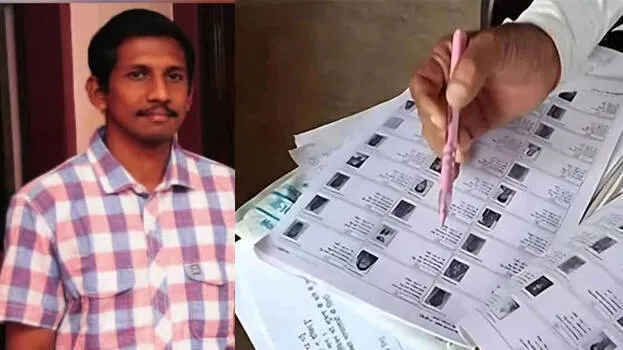
The suicide of Booth Level Officer (BLO) Aneesh George on 16 November in Kannur has triggered intense political turmoil in Kerala, with emerging audio evidence, conflicting official claims and rising accusations of political coercion drawing national attention. While initial reports suggested mental stress and workload may have contributed to the tragedy, new developments now point towards alleged threats from CPM workers, making the incident a central flashpoint in the ongoing Special Intensive Revision (SIR) of electoral rolls.
Congress has released an audio clip, circulating widely on social media, purportedly capturing a conversation between Aneesh and Congress Booth Level Agent Vaishakh, in which Aneesh is heard stating that he was “under pressure”. Kannur District Congress president Martin George alleged that CPM members regularly accompanied Aneesh during his field duties in Ettukkudukka, a CPM-dominated Panchayat where Congress has no organisational presence. He claimed that CPM branch secretary Chandran and DYFI leader Prajod had accompanied Aneesh on consecutive days, reflecting what the party alleges is a broader practice of pressuring BLOs to facilitate bogus voting.
However, the Kannur District Collector, in his report, stated that Aneesh had completed most of his work, with only 22% of enumeration pending, and had earlier informed officials that he could handle the remaining 50 forms without difficulty. The Collector concluded that Aneesh did not face occupational pressure, but the family has rejected this assessment, insisting that administrative conclusions do not reflect the ground realities Aneesh faced. Similar instances of political workers accompanying BLOs have been observed in several parts of the state, including Kochi, raising concerns among election observers.
The backdrop to this controversy is the Special Intensive Revision (SIR)—a routine, statutory exercise aimed at ensuring accurate electoral rolls. SIR is not a new mechanism; it has been conducted eight times between 1951 and 2004, with the last full-scale SIR carried out more than 21 years ago, during 2002 and 2004. After successful completion in Bihar, the ongoing Phase-II of SIR now covers 51 crore electors across 9 States—Chhattisgarh, Goa, Gujarat, Kerala, Madhya Pradesh, Rajasthan, Tamil Nadu, Uttar Pradesh and West Bengal—and 3 Union Territories, namely Andaman and Nicobar Islands, Lakshadweep and Puducherry, spanning 321 districts and 1,843 Assembly Constituencies. The Enumeration Phase, from 4 November to 4 December 2025, requires BLOs to conduct house-to-house verification and ensure the integrity of the electoral rolls.
Despite SIR’s well-established administrative history, the opposition, particularly the INDI alliance partners, has mounted a sustained campaign portraying the exercise as an attempt by the BJP-led NDA government to manipulate voter lists, especially in states like Kerala, Tamil Nadu and West Bengal. Parties including Congress, TMC, DMK, CPI(M) and CPI have accused the Election Commission of facilitating “voter card snatching”, alleging that the process disproportionately targets Muslim voters and opposition supporters. These claims have amplified as political leaders framed SIR as a deliberate effort to alter electoral dynamics.
Political observers now note that incidents such as Aneesh’s death are being woven into a broader political narrative designed to discredit the Election Commission, demoralise field officers and create distrust in the democratic process.
Observers point out that there is a targeted effort to project the Election Commission as an extension of the ruling NDA, despite SIR being a long-standing, routine exercise conducted under established statutory norms.
Adding to the controversy, Congress leader Rahul Gandhi has repeatedly attacked the Election Commission whenever they lose elections, without offering supporting evidence or filing formal complaints before the competent authorities. Campaigns like “vote chori” have been organised to project a nationwide conspiracy narrative.
Political analysts argue that, having suffered electoral setbacks since 2004, the Congress and its INDI allies have increasingly turned to questioning the credibility of institutions rather than addressing organisational weaknesses. This pattern, they contend, is now extending to democratic bodies such as the EC, with coordinated messaging seeking to erode public confidence in constitutional institutions.













Comments