





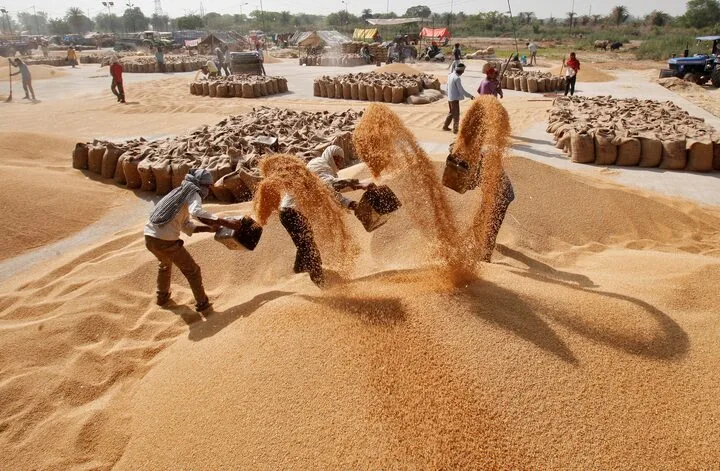
India’s farm sector has crossed a landmark achievement with foodgrain production for 2024-25 touching an unprecedented 357.73 million tonnes, the highest output recorded in the country’s history. The announcement was made in New Delhi by Union Minister of Agriculture and Farmers’ Welfare Shivraj Singh Chouhan, who lauded the contribution and resilience of India’s farming community. Singh highlighted that this milestone represents the sharpest increase in foodgrain output in a decade, underscoring the success of sustained government interventions, improved farming practices and favourable monsoon conditions across key agrarian regions.
This achievement is especially significant when viewed against the backdrop of India’s agricultural trajectory over the past ten years. Foodgrain production has risen by 106 million tonnes since 2015-16, when total output stood at 251.54 million tonnes. Such a steep rise demonstrates the cumulative effect of enhanced seed varieties, increased irrigation coverage, wider adoption of mechanisation and targeted policy frameworks aimed at boosting productivity.
The latest estimates show a broad-based surge across major crops, beginning with rice. Rice production has soared to a historic 1501.84 lakh tonnes, increasing by 123.59 lakh tonnes compared to the previous year. This rise has been attributed to expanded cultivation in eastern and southern states, improved water management systems and a growing shift towards high-yielding varieties supported by government-led extension programmes. The bumper harvest ensures comfortable domestic availability while supporting export capacity in the global rice market, where India remains a dominant player.
Wheat output has also touched a record high of 1179.45 lakh tonnes, marking a year-on-year increase of 46.53 lakh tonnes. The surge comes after two years of concerns related to heatwaves and moisture stress, signalling a strong recovery in the Rabi season. Improved temperature conditions during the wheat maturing phase, higher acreage under cultivation and access to quality seeds contributed to the strong performance. The record wheat numbers are expected to stabilise domestic prices and strengthen India’s public distribution system, which heavily relies on wheat and rice for food security operations.
Maize production too continues its upward trend, with estimates pegging output at 434.09 lakh tonnes. The growing demand for maize in the poultry, feed and ethanol industries has encouraged farmers to expand acreage, supported by better market linkages and procurement assurances. Meanwhile, the total production of nutri and coarse cereals stands at 639.21 lakh tonnes. This includes 185.92 lakh tonnes of millets, referred to as ‘Shri Anna’ after the government’s initiative to promote these climate-resilient grains both domestically and internationally.
The rise in millet output is particularly noteworthy, given the government’s thrust on positioning India as a global hub for millet cultivation and processing. Millets require less water, offer superior nutritional value and are more resilient to climate fluctuations, making their rising production crucial for long-term food and nutritional security.
Pulses, often the most vulnerable segment due to rainfall variability, have also shown impressive improvement. Total pulses production has reached 256.83 lakh tonnes. Within this, moong output rose to 42.44 lakh tonnes while chickpea production climbed to 111.14 lakh tonnes. These gains reflect the early impact of the government’s Self-Reliance in Pulses Mission, which focuses on reducing import dependency through expanded acreage, improved seed varieties and assured procurement.
Oilseed production too has registered its highest-ever output at 429.89 lakh tonnes, up by 33.20 lakh tonnes from the previous year. The record surge is driven by strong performances in soybean and groundnut cultivation, which delivered outputs of 152.68 lakh tonnes and 119.42 lakh tonnes, respectively. Rapeseed and mustard production has also remained robust at 126.67 lakh tonnes. The exceptional oilseed harvest comes at a crucial moment as India continues efforts to reduce its heavy dependence on edible oil imports. Stronger oilseed output is expected to bolster domestic crushing industries and help the country move closer to self-reliance in edible oils.
Among other major crops, sugarcane production is estimated at an impressive 4546.11 lakh tonnes, sustaining India’s position as one of the world’s largest sugar producers. Cotton output has reached 297.24 lakh bales, while jute and mesta production stands at 88.02 lakh bales. These figures indicate stability in commercial crop segments that support millions of farm households across central and eastern India.
Following the release of the final estimates, Minister Chouhan chaired a review meeting with senior officials to strategise the next phase of agricultural policy. He expressed optimism that ongoing initiatives would further accelerate productivity, especially in the pulses and oilseeds sectors which remain crucial for India’s import reduction goals. He emphasised that the government’s approach remains centred on farmer welfare, technology adoption and sustainable crop diversification.
A key component of this support system is the Minimum Support Price mechanism. The Minister reaffirmed that MSP procurement for crops such as tur, urad, chana and moong continues to provide essential financial security to farmers. Rising procurement volumes in recent years have helped stabilise markets, protect farm incomes and encourage wider participation in the cultivation of essential crops.
Chouhan stressed that agriculture remains a top priority for the government, with policy interventions increasingly focused on improving productivity, expanding irrigation networks, enhancing post-harvest infrastructure and supporting agri-innovation. He added that institutions, from Krishi Vigyan Kendras to national research centres, are playing a critical role in knowledge dissemination and farm-level capacity building.
India’s record foodgrain production in 2024-25 stands as evidence of the country’s agricultural strength and the ability of its farmers to adapt and thrive despite unpredictable weather events and market fluctuations. As the nation advances towards long-term food security and agricultural modernisation, the latest output numbers offer both reassurance and direction.
















Comments