





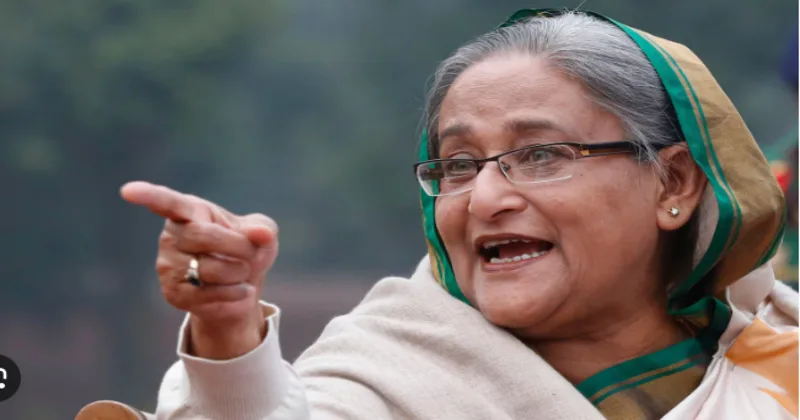
Bangladesh stands today at its most perilous turning point since 1971. What was once a secular, pluralistic republic is now sliding at frightening speed toward a theocratic, militarized, foreign-influenced dystopia. The recent death sentence handed down to former Prime Minister Sheikh Hasina – Bangladesh’s longest-serving elected leader and for decades the strongest bulwark against Islamist extremism – symbolizes not justice, but the completion of a political purge engineered by radical forces and legitimized through a tribunal whose credibility is widely questioned.
As Sheikh Hasina was tried in absentia, it fundamentally undermines the right to a fair trial as set out in Article 14 of the International Covenant on Civil and Political Rights (ICCPR), which is crucial to a legitimate legal process. The United Nations Human Rights Committee (UNHRC), which monitors compliance with the ICCPR has stated that to guarantee defendant’s rights, “all criminal proceedings must provide the accused with the right to an oral hearing, at which he or she may appear in person or be represented by counsel and may bring evidence and examine witnesses”.
While the verdict has stunned many outside the region, within Bangladesh it was anticipated for months. Muhammad Yunus – once celebrated as the “banker to the poor”, now the chief executive of a regime increasingly aligned with Islamist actors and foreign intelligence interests – has presided over a systematic dismantling of every secular and republican pillar of the state. The death sentence for Hasina is not merely a judicial decision; it is the single most visible milestone in Bangladesh’s ongoing transformation into what analysts warn could soon resemble another Iran, another Pakistan, or worse – a failed state with nuclear-adjacent aspirations under the influence of transnational jihadist networks.
What happens next will determine not only the fate of 170 million Bangladeshis, but the geopolitical stability of South Asia and India’s long-term national security.
The Yunus regime and its political partners – Bangladesh Nationalist Party (BNP), Jamaat-e-Islami (JeI), Islamist pressure groups, and transnational jihadist organizations such as Hizb-ut-Tahrir (HuT) – had long signaled their intention to remove Sheikh Hasina permanently from the political landscape. The verdict was thus not a surprise; it was a culmination.
The day the sentence was pronounced, a disturbing scene unfolded in Dhaka. Members of Jamaat’s student wing, Hizb-ut-Tahrir (HuT), and radicalized Stranded Pakistanis stormed toward Sheikh Mujibur Rahman’s demolished Dhanmondi residence attempting to seize it and turn it into a “playground” – a symbolic erasure of history. They were stopped only by the combined intervention of the police and the Bangladesh Army.
According to analysts, questioning the legality of the verdict is futile because the process itself – starting with the formation of Yunus’s unelected regime -was illegitimate. The International Crimes Tribunal, which delivered the sentence, has a long history of politically selective prosecution. This time, it delivered what Jamaat-e-Islami and its foreign patrons have long desired: the humiliation and elimination of the woman who crippled their organizational and militant capacities for over a decade.
Michael Kugelman of the Atlantic Council described it bluntly: the verdict is not perceived through the lens of justice, but through decades of political mistrust and selective convictions. When courts become instruments of vengeance rather than law, they cease to serve the public and instead serve the ruling coalition – especially when that coalition includes those dreaming of an Islamist state.
Following the verdict, the Yunus administration immediately demanded Sheikh Hasina’s extradition from India. Here lies the core geopolitical tension.
India has sheltered Hasina because she has been New Delhi’s most reliable partner in the region, providing unmatched intelligence cooperation against jihadist networks and preventing northeastern India from becoming a sanctuary for insurgents. Her removal and the rise of Islamist forces in Dhaka have already created a new strategic headache for New Delhi.
Kugelman’s analysis captures India’s impossible choice:
- If India refuses extradition, it risks further deterioration of ties with a hostile, Islamist-leaning government in Dhaka.
- If India complies, it betrays a historic ally and may help install a theocratic state on its eastern border.
- The “third country solution”, where Hasina is sent to a neutral authoritarian state, is widely discussed – but there appears to be no willing host.
Commenting on Sheikh Hasina’s verdict, Reuters in a report said, “Moments after Tuesday’s ruling drew cheers in court, families of protest victims called for Hasina’s hanging. But repeated attempts to extradite her from India have stalled, straining ties between the once close partners”.
Regarding extradition of Sheikh Hasina, an Indian government source told Reuters, “extradition is a lengthy process requiring review of tribunal documents to ensure due procedure, fair representation, and credible testimony. India cannot act without these records, and exemptions to the treaty apply if the case appears political”.
Amnesty International’s Secretary General, Agnès Callamard in a statement said, “Those individually responsible for the egregious violations and allegations of crimes against humanity that took place during the student-led protests in July and August 2024 must be investigated and prosecuted in fair trials. However, this trial and sentence is neither fair nor just. Victims need justice and accountability, yet the death penalty simply compounds human rights violations. It’s the ultimate cruel, degrading and inhuman punishment and has no place in any justice process”.
It may be mentioned here that following execution of Jamaat-e-Islami leader Motiur Rahman Nizami, while the United States, alongside Turkey and Pakistan send strong messages of condemnation, where the US State Department said that despite improvements to the tribunal process that has tried those accused of committing war crimes during the war, more work needs to be done to “ensure these proceedings meet domestic and international obligations”, Trump administration, which had been lately romancing with Islamabad remained totally silent on Sheikh Hasina’s conviction.
Sheikh Hasina’s conviction comes at a crucial time, when Yunus regime is repeatedly promising of holding the next general elections in Bangladesh during the first-half of February 2026, where it is attempting to keep Sheikh Hasina’s party Awami League and its alliance partners along with other leftist and secularist parties. Many experts see the February 2026 general elections as mission impossible, as Yunus has signaled of remaining in power indefinitely, where he enjoys strong support from his key allies – Pakistan, Turkey, European Union and even the United States.
Meanwhile, in Bangladesh, a silent coup is unfolding in Bangladesh. Behind the facade of governance, an alliance of Islamist networks, foreign intelligence agencies, and radical ideologues is methodically dismantling the country’s most secular and stabilizing institution – the Armed Forces. Currently 25 serving and retired officers of Bangladesh Army are facing trials in the International Crimes Tribunal. The orchestrator of this quiet purge is Muhammad Yunus, once celebrated as a Nobel laureate, now at the helm of an increasingly fundamentalist-leaning regime that threatens to upend decades of democratic progress. At stake is not merely Bangladesh’s political future but the security architecture of South and Southeast Asia.
It may be mentioned here that the Bangladesh’s International Crimes Tribunal (ICT), a domestic tribunal, issued arrest warrants for a total of 32 individuals, including 25 current and former military officers, in connection with charges of “crimes against humanity” and enforced disappearances during the previous Sheikh Hasina regime. The accused were ordered to be produced before the tribunal on October 22, 2025, and 15 serving officers were taken into military custody following the order.
This tribunal, which bears no relation to the International Criminal Court (ICC), has become a political instrument designed to intimidate, discredit, and ultimately dismantle Bangladesh’s military establishment. Intelligence insiders warn that the list could soon expand to over 150 officers, possibly including the current chiefs of the Army, Navy, and Air Force.
Amid these extremely disturbing developments, on October 20, 2025, a stunning revelation appeared on social media. Asif Mahmud Shojib Bhuyain – an influential as well as controversial adviser to the Yunus regime – publicly announced the recruitment and training of 8,850 individuals across seven training centers. He detailed the program: trainees would undergo martial arts, judo, taekwondo, and firearms training.
Sources within Dhaka confirm that this is only the first phase of a larger plan. At least five successive batches of 8,850 recruits each are scheduled to complete training by January 2026. The recruitment process reportedly includes written, viva, and physical tests – all overseen by retired Bangladeshi officers with strong pro-Pakistan leanings, alongside covert representatives of Pakistan’s Inter-Services Intelligence (ISI) and Turkey’s Millî İstihbarat Teşkilatı (MIT).
The ideological justification for this armed formation is rooted in a narrative propagated by Islamist organisations aligned with the Yunus regime, especially Jamaat-e-Islami. On September 27, 2025, Jamaat’s Nayeb-e-Ameer, Syed Abdullah Muhammad Taher, declared in a New York gathering that five million Jamaat youth were ready to “fight for independence” against India.
He went further: “If India enters Bangladesh, the bad name that was imposed on us in 1971 will be wiped off. We shall prove ourselves as true freedom fighters. One part of five million Jamaat youth will engage in guerrilla warfare, while the rest will spread inside India to implement Ghazwa-e-Hind”.
This rhetoric is not symbolic. It echoes jihadist war doctrine, portraying India as the enemy and glorifying a “holy war” to redeem perceived historical humiliation. For Bangladesh’s security establishment, this marks a dangerous revival of 1971 revisionism – an attempt to recast pro-Pakistan collaborators as “freedom fighters” in a new Islamist narrative.
The rise of Islamist extremism in South Asia is entering a new and troubling phase. What began as a political movement cloaked in piety has increasingly transformed into a campaign of cultural and religious erasure. In Bangladesh, the latest target of jihadist wrath is the International Society for Krishna Consciousness (ISKCON), a global Hindu organization. Islamists now brand it an “extremist Hindutva group”, call for banning it, commit arson against its temples, and violence against its followers. Their real goal, however, is far darker than banning a Hindu organization: it is to purge majority-Muslim Bangladesh of its remaining Hindu population and to reshape the country into a theocratic state.
Since last year’s jihadist-backed coup in Bangladesh, attacks on ISKCON centers and Hindu temples in the country have sharply escalated. Hardline groups such as Hefazat-e-Islam (HeI) and Intifada Bangladesh have taken the lead in this campaign, with vocal support from elements within the country’s government. In a disturbing development, the government’s response to a court petition demanding a ban on ISKCON described the movement as a “religious fundamentalist organization”. This rhetoric, once confined to the fringe, now finds a place in official discourse – a dangerous sign of how far Islamist influence has penetrated the state.
In October this year, security agencies uncovered a chilling plot that could have ignited nationwide violence.
Islamists fabricated a story that Mawlana Muhibullah Miyaji, a 60-year-old Muslim cleric from Tongi, had been abducted and tortured by ISKCON members. The narrative spread rapidly on social media, prompting calls for jihad against Hindus. Only a swift police investigation – aided by surveillance videos and forensic evidence – exposed the story as a complete fabrication.
Authorities believe the motive behind this staged abduction was to incite mob attacks on Hindu communities and ISKCON centers, plunging the country into chaos while distracting attention from the rapid radicalization of Bangladesh’s Islamist ecosystem.
What makes this current wave of anti-Hindu agitation particularly alarming is its transnational dimension. Intelligence officials in Dhaka have identified growing coordination between Bangladeshi and Pakistani Salafist groups, some with direct ideological or logistical ties to organizations once linked to Al Qaeda and ISIS.
Even more disturbing is the arrival of Ibtisam Elahi Zaheer, a senior figure in Pakistan’s Markazi Jamiat Ahl-e-Hadis and close associate of Hafiz Saeed, the mastermind of the 2008 terror attacks in Mumbai, India. Zaheer’s speeches – urging Muslims to “kill apostates” and denouncing Jews and Christians as “enemies of Islam” – have drawn scrutiny from UK authorities for inciting violence. His presence in Bangladesh today raises urgent questions about who facilitated his entry and what networks stand behind him.
The bigger challenge for Muhammad Yunus and his administration shall emerge from the second week of next month, as according to constitutional provisions, he should transform his current interim government into election-time administration and drastically cut the size of his council of advisors. Once there is no such measures in December and pro-Yunus Bangladesh Nationalist Party in particular clearly realizes the uncertainty of any election in February next year, it will most definitely switch to street protests, which would be joined by few other political parties in the country. And this will almost rattle Yunus regime, where for it, bigger challenge will be remaining in power by hook or crook – instead of playing anti-India, Sheikh Hasina or Awami League cards.
The death sentence for Sheikh Hasina is not merely a judicial decision – it is the symbolic execution of secular Bangladesh. It marks the triumph of Islamist forces who have waited half a century to reverse the outcome of 1971. It represents the foreign infiltration of Bangladesh’s political institutions, the weaponization of its judiciary, and the radicalization of its youth.
Bangladesh today stands at the cusp of becoming – a second Pakistan – a second Iran – or worse – a battleground for extremist ideologies seeking regional dominance.
India, the region, and the world must understand the gravity of the moment. A radicalized Bangladesh on India’s eastern border is not just a geopolitical inconvenience – it is a serious security threat.
















Comments