





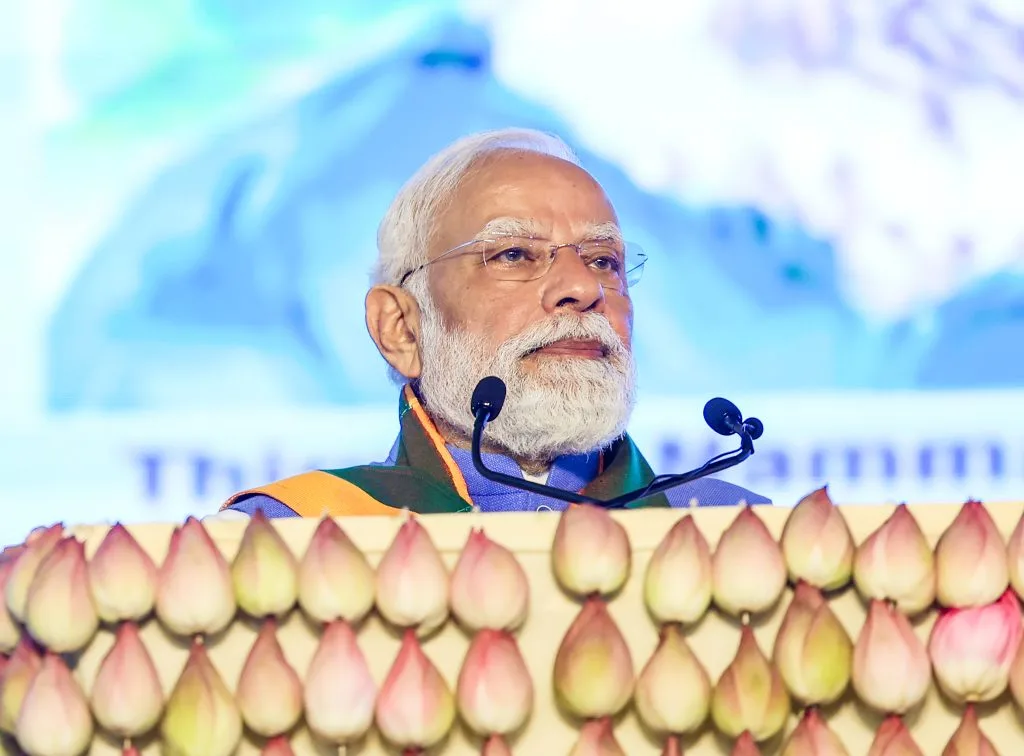
Prime Minister Narendra Modi on Wednesday (Nov 19) released the 21st instalment of the Pradhan Mantri Kisan Samman Nidhi (PM-KISAN) scheme while attending the South India Natural Farming Summit in Coimbatore. Pressing the digital transfer button at the event, the Prime Minister transferred Rs 18,000 crore directly into the Aadhaar-linked bank accounts of nearly 9 crore farmers under the government’s Direct Benefit Transfer (DBT) system.
Addressing thousands of farmers, agricultural scientists and stakeholders gathered at the summit, he described PM-KISAN as a critical support system for small and marginal farmers, who form more than 85 percent of India’s farming community. “India’s farmers are the backbone of our civilisation and our economy. This assistance gives them strength, confidence and security,” he said, emphasising the government’s commitment to ensuring stable incomes in the agricultural sector.
Launched on February 24, 2019, PM-KISAN was conceived as an assured income-support programme, providing Rs 6,000 annually to eligible landholding farmer families. The amount is released in three instalments of Rs 2,000 each, timed to coincide with crucial stages of the cropping cycle. Over the last six years, the programme has grown to become one of the world’s largest welfare and DBT architectures, having disbursed more than Rs 3.70 lakh crore to over 11 crore farmer families across India. Women farmers represent more than one-fourth of the total beneficiaries, signalling the growing and institutionalised participation of women in India’s agricultural landscape. The 21st instalment holds particular significance, with funds reaching farmers across all states and union territories, including remote, tribal and aspirational districts with limited banking infrastructure.
A key reason behind PM-KISAN’s scale and efficiency is its strong digital backbone. The scheme’s implementation framework is designed around Aadhaar-based verification, digital land record authentication, and automated payment monitoring. Mandatory Aadhaar-based e-KYC ensures that benefits are transferred only to verified beneficiaries, eliminating duplication and reducing the possibility of fraudulent claims. The digital verification of land records by state governments has improved accuracy and reduced clerical lapses, while the self-registration option on the PM-KISAN portal allows farmers to enrol without relying on middlemen or physical paperwork. Real-time sanctioning and payment monitoring through the Public Financial Management System (PFMS) ensures full transparency, enabling both the Centre and states to track instalments at every stage.
The government has also strengthened digital outreach tools to make scheme-related services more accessible. The PM-KISAN Mobile App, relaunched in 2023 with face authentication capabilities, allows farmers to complete e-KYC from their homes, check instalment status, update key documents and access scheme guidelines. Meanwhile, the Kisan-eMitra AI chatbot, functional in 11 regional languages, has resolved more than 95 lakh farmer queries related to registration, eligibility, documentation errors and grievance redressal. Its introduction has sharply reduced waiting times at local agriculture offices and significantly improved service delivery, particularly in rural and semi-urban areas.
In recent years, the government has undertaken major saturation efforts to ensure that no eligible farmer is left out of PM-KISAN. The Viksit Bharat Sankalp Yatra in 2023 resulted in the identification and inclusion of over one crore new beneficiaries, many from tribal, hilly and border regions where welfare penetration had been historically low. The momentum continued in June 2024, when an additional 25 lakh farmers were added during the first 100 days of the new government. Uttar Pradesh once again accounted for the highest number of beneficiaries in the 20th instalment, followed by Maharashtra, reflecting the large number of agricultural households in these states.
For countless small and marginal farmers, most of whom own less than two hectares of land, PM-KISAN continues to serve as a stabilising financial lifeline. The instalments typically arrive during high-expense phases of farming, such as seed procurement, fertiliser purchase, diesel for irrigation pumps, and payment to seasonal labourers during sowing and harvesting seasons. By providing timely cash flow, the scheme has reduced farmers’ dependence on informal moneylenders and helped cushion the impact of crop losses, price fluctuations and climate-related disruptions. The recurring instalments also help farmers manage unforeseen expenses, especially in regions vulnerable to droughts, floods or market instability.
To maintain accountability and strengthen the scheme’s credibility, both the Centre and state governments jointly monitor its implementation. Beneficiary lists are mandatorily displayed at panchayat and village levels to ensure transparency and offer an opportunity for eligible farmers to seek inclusion or appeal against errors. States and Union Territories are also required to recover funds mistakenly paid to ineligible persons. As of August 2025, authorities have recovered Rs 416 crore that was credited wrongly, reflecting an increasingly rigorous verification and monitoring system.
The Ministry of Agriculture is developing the National Farmer Registry, an ambitious digital database designed to streamline farmer identification across the country. The registry aims to consolidate farmer information, reduce repetitive documentation, and provide seamless access to multiple government schemes through a single digital identity. Officials believe this unified database will form the backbone of future agricultural reforms, enabling better planning, targeted delivery of subsidies, faster integration with crop insurance and credit systems, and improved access to digital advisory services. The registry is expected to transform the welfare ecosystem by linking farmers to a wide range of government benefits, from crop insurance and soil health cards to natural farming initiatives and extension services.
As Prime Minister Modi concluded his address in Coimbatore, he reiterated the government’s commitment to strengthening farmers through a combination of direct income support, technological innovation and sustainable agricultural practices. The release of the 21st PM-KISAN instalment, he said, is not just a financial transfer but a reaffirmation of the nation’s respect and gratitude towards the farmers who feed India.
















Comments