





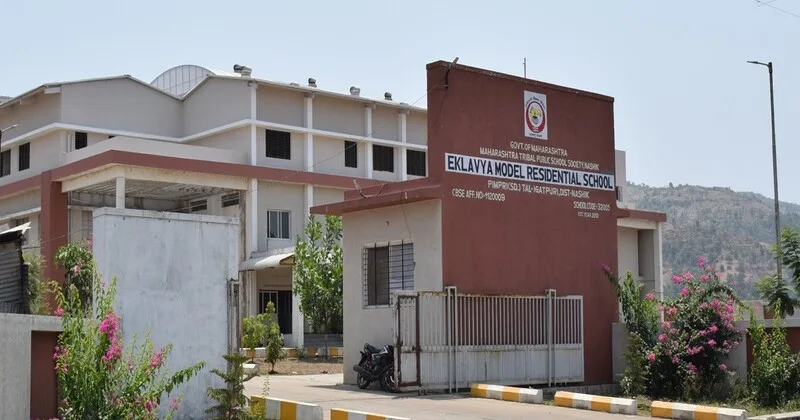
In large parts of India, the journey from a remote tribal village to a well-equipped classroom has been very difficult and uncertain. For years, fractured infrastructure, lack of qualified teachers and inadequate access to new ways of learning, had severely limited the academic options available to students from Scheduled Tribe communities. Government support has made transformational shift supported by policy and led by a scientific focus on learning has steadily built over the last few years. The Eklavya Model Residential Schools system has started to redefine the tribal education through its continued investment, planning and outcomes-based practice.
The extent and pace of change has become visible in the performance indicators registered across three academic cycles. In 2022–23, only two students from EMRS cleared India’s top engineering or medical entrance examinations. The following year saw a jump to 22 students. By 2024–25 this figure rose to 597 where students has cleared JEE Main, JEE Advanced and NEET. What makes this development noteworthy is not just the increase but the underlying conditions that made such growth possible.
This improvement is a result of several factors such as expanded school infrastructure, better teacher support, targeted exam preparation systems and the growing availability of digital resources. This convergence reflects a shift from interventions to a stable and systemic model of educational delivery.
Building a Strong Institutional Base
The EMRS scheme was designed to address gaps in tribal education on a long-term basis. As on July 2025, 722 such EMRS schools have been sanctioned and 485 are already functional which house more than 1.38 lakh students. These are no ordinary residential schools, these are meant to provide free CBSE education, accommodation, nutrition, healthcare and structured mentoring within the cultural and geographical context of tribal communities.
This model derives its underpinning from one fundamental scientific principle of learning flourishing in stable, predictable environments. Seasonal isolation, poor connectivity or difficult-to-reach terrain is not uncommon characteristics in many tribal areas. EMRS overcomes these challenges by building self-sufficient learning environments that house laboratories, libraries, smart classrooms and sports facilities within its campus, which reduces dependency on external infrastructures.
Data from government sources also indicate that the expansion of institutions also goes hand in hand with rising enrolment and increased engagement at the state level. The Ministry of Tribal Affairs has been gradually increasing funding under Article 275(1) of the Constitution, which provides grants-in-aid for the welfare of Scheduled Tribes. These funds cover both construction and recurring needs to ensure that schools are functional, well-staffed and well-maintained.
Turning Schools into Learning Hubs
The modern EMRS campus is much more than a place of residence, it stands as the nucleus for scientific and analytical learning. Many specialized programs have been included over the years to strengthen academic preparation in both foundational subjects as well as in competitive domains.
Many state governments particularly Madhya Pradesh, Maharashtra and Andhra Pradesh, have established Centres of Excellence which impart systematic training for JEE and NEET aspirants. These institutions follow standardized curriculum, regular assessment cycles and collaborates with accredited partners with experience in preparing students for competitive examinations.
Also digital tutorial programs work in conjunction with groups like the Ex-Navodayan Foundation and PACE IIT & Medical which offer subject-specific instruction. This is delivered on virtual platforms, lessening the divide between students in isolated areas and the quality of coaching available in city centres.
Another strong impact visible has been on strengthening conceptual learning. The introduction of the Atal Tinkering Labs, experiential STEM labs like the iHUB DivyaSampark initiative and smart classroom infrastructure, supported by ERNET and the Ministry of Electronics and IT, exposes students to scientific equipment and hands-on learning. For many tribal students, these are their first opportunities to engage with robotics kits, 3D printers, AI modules and electronic tools-resources that evoke curiosity and problem-solving skills from an early age.
Role of Policy and Constitutional Support
The Constitution of India establishes a strong foundation for equity in education. Articles 15(4) and 15(5) provide for special provisions by the State for socially and educationally backward groups. Article 46 directs the government to protect the educational and economic interests of the Scheduled Tribes. The legal ecosystem has changed to support this mission. The Central Educational Institutions, Reservation in Admission Act 2006 makes reservation binding in leading central institutions like IITs, NITs and central medical colleges, so that quality ST students have a fair opportunity for admission into top professional institutions.
Legislative updates and proposals have been laid down to refine this system according to the current times educational needs. The success of EMRS cannot be viewed in a vacuum but as part of larger constitutional and legislative attempts that recognize past inequities and try to make amends with necessary structural support.
There is always a quantifiable effect behind any policy, the data from EMRS tells that story.
In the 2024–25 academic cycle:
• 219 students qualified JEE Main
• 34 students cleared JEE Advanced
• 344 students cracked NEET
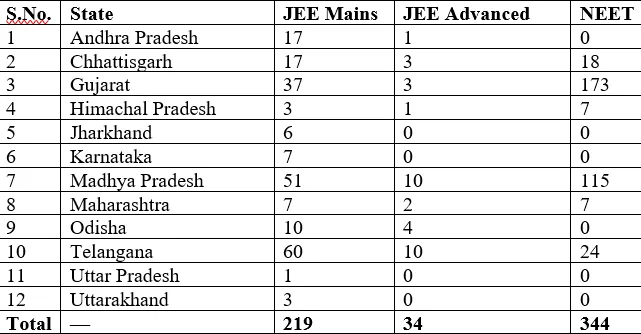
These accomplishments were distributed across various states:
Top-performing states include Gujarat, Madhya Pradesh, Telangana and Chhattisgarh. Among these states Gujarat took a lead in NEET with a staggering 173 qualifiers and performed well in JEE assessments. Madhya Pradesh had a good score of 51 in JEE Mains, 10 in JEE Advanced and 115 in NEET qualifiers, indicating that sustained academic support structures have been effectively carried throughout their EMRS institutions. Telangana has shown remarkable results as well, where 60 students cleared the JEE Mains and 24 qualified in NEET.
While Chhattisgarh and Andhra Pradesh performed well with 17 students each who qualified in JEE Mains, Odisha, Himachal Pradesh, Karnataka and Maharashtra have made steady improvement. Even states with relatively small tribal populations, such as Uttarakhand and Uttar Pradesh, registered qualifying students, showing the expanded footprint and impact of EMRS.
101 EMRS schools recorded at least one student clearing either JEE or NEET. This wide base shows an increase in consistency and exemplifies that the ecosystem is maturing, not just producing exceptional outliers.
Systemic Support as the Growth Engine
This transformation of EMRS over the years signifies the shift from infrastructure-centric development to an outcome-oriented academic strategy. NESTS entrusted with the implementation of EMRS, undertook scientific monitoring methods, namely regular testing, feedback mechanisms and digital learning analytics, including need-based teacher capacity building.
Different events such as:
• CBSE Skill Labs
• Vocational Labs under PMKVY 4.0
• Amazon Future Engineers Program
Cybersecurity and AR/VR training for teachers are diversifying learning opportunities beyond traditional academic subjects. This ensures that tribal students are not confined to conventional paths but are exposed to future-facing skill sets in line with the national economic needs.
Programs like TALASH, a digital aptitude and life-skills platform created in consultation with UNICEF, identify strengths among students in seven core areas and give them personalized career guidance to make sure the career decisions are informed, structured and in line with the ability of each student.
Story of Community Transformation
The story of EMRS is not about examination results alone but a reshaping of the educational landscape of tribal India. As schools get better equipped, children stay enrolled longer. When meals and healthcare are provided, attendance remains steady. When teachers are trained and supported classroom learning improves. When students gain access to scientific tools, they begin to imagine careers in fields previously unknown to their communities.
These are measurable and replicable pathways to empowerment. As the EMRS schools multiply and improve, they will gradually break decades-old inequalities by creating scientific temper, self-confidence and academic continuity. The cumulative impact is visible not only in exam results but in rising aspirations and growing participation in national academic spaces.
This is a transformation that has only just begun through EMRS but whose direction already is clear. Backed by constitutional support, policy continuity, targeted funding and scientific pedagogies for learning, this program holds a model for how India can fill historical gaps in education. The story the numbers tell is one of a system on track to align with the nation’s goals of equity and progress.
The achievements of the past three years are not the endpoint but are indicators of what becomes possible when sustained investment meets structured educational planning. As India looks ahead, the expansion and strengthening of EMRS will be key for building an inclusive future wherein tribal communities participate fully in the nation’s academic, scientific and professional landscape.











Comments