





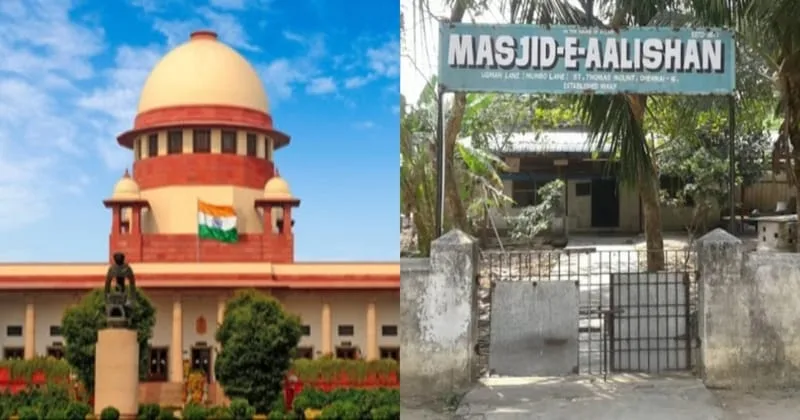
The Supreme Court has dismissed a plea seeking permission for civilians to offer prayers at the Masjid‑E‑Aalishaan, a mosque located within military quarters in Chennai, citing security concerns.
The bench, comprising Justices Vikram Nath and Sandeep Mehta, delivered the order while hearing a challenge to an April 2025 ruling of the Madras High Court, which had upheld a single judge’s decision refusing to interfere with military authorities’ administrative discretion regarding access to Army premises.
The petitioner, representing a group of Muslim worshippers, argued that civilians had historically been allowed to pray at the mosque from 1877 to 2022 and that restrictions had been imposed only during the COVID‑19 pandemic. The counsel for the petitioner contended that there had been no security issues at the mosque for over a century and questioned the continued denial of access. However, the Supreme Court emphasised that current security concerns must take precedence.
The bench observed, “There are security issues and so many things. How can we allow that?” signalling that the historical usage of the mosque did not override the need for maintaining strict security protocols within a military area.
The legal dispute traces back to a petition filed before the Madras High Court, where the petitioner contended that the Army authorities were preventing civilians from offering prayers in the mosque situated inside the military quarters. The division bench of the High Court noted that the station commander had rejected the petitioner’s representation in June 2021 through a verbal order. The order explicitly stated that the Masjid‑E‑Aalishaan was primarily for personnel associated with the unit and strictly not for outsiders, in accordance with the Cantonment Land Administration Rules, 1937. These rules empower military authorities to regulate the use of buildings on defence land, including places of worship, and to restrict access to outsiders if deemed necessary for security or operational reasons.
The High Court had also emphasised that it was the administration’s prerogative to decide whether civilians could be allowed entry. “Relying on the Cantonment Land Administration Rules, 1937, the authority has decided not to permit outsiders,” the court observed, refusing to interfere with the single judge’s earlier dismissal of the petition. This legal framework played a decisive role in the Supreme Court’s dismissal of the plea, reinforcing the principle that decisions concerning access to defence land fall squarely within the domain of military administration.
The petitioners’ attempt to secure access to the mosque within military quarters failed on multiple fronts. The Supreme Court reinforced the High Court’s position that security concerns, administrative discretion, and statutory rules under the Cantonment Land Administration Rules, 1937, collectively outweigh historical usage or religious claims. By emphasising that worship rights are not confined to a single location, the apex court upheld the principle that access to defence property must be strictly regulated. The case serves as a clear precedent that religious claims, while constitutionally protected, cannot compromise security or administrative authority in sensitive defence areas.















Comments