





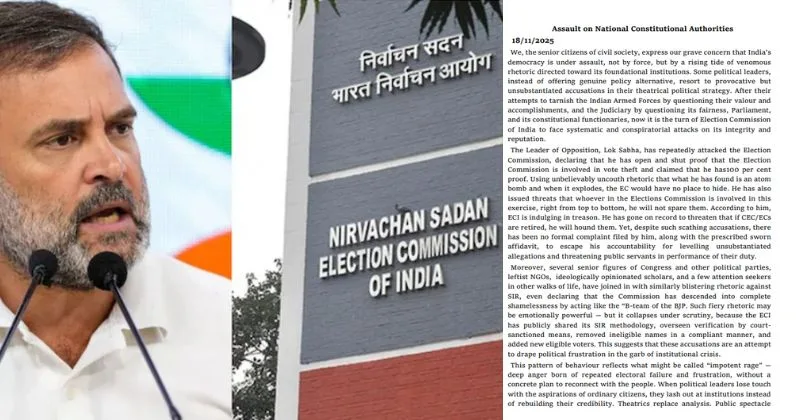
NEW DELHI: A powerful collective of 272 eminent Indian citizens — comprising former judges, senior bureaucrats, diplomats, and armed forces veterans — on Wednesday issued a scathing open letter denouncing Leader of the Opposition Rahul Gandhi and the Congress party for what they termed a “deliberate and systematic attempt” to erode public trust in the Election Commission of India (ECI). The unprecedented intervention reflects deep concern within sections of India’s institutional and strategic establishment over the rising political rhetoric directed at the country’s constitutional bodies.
The signatories include 16 retired judges, 123 former civil servants, 14 ambassadors, and 133 former officers of the Army, Navy, and Air Force. In their joint statement, they accused the Opposition of making “recurrent, unproven, and provocative allegations” of electoral fraud that, they argue, risk destabilising public faith in the democratic process. “Such statements erode public trust in democratic systems and fundamentally misrepresent the functioning of constitutional authorities,” the letter warns.
272 eminent citizens, consisting of 16 Judges, 123 retired bureaucrats, including 14 Ambassadors, 133 retired armed forces officers, write an open letter condemning the LoP and the Congress Party’s attempts to tarnish constitutional bodies like the Election Commission of India.… pic.twitter.com/lcHnboFV57
— ANI (@ANI) November 19, 2025
Rahul Gandhi’s Repeated Charges of Electoral Manipulation
Rahul Gandhi has been vocal in his allegations against the BJP-led government and the ECI, accusing them of collusion to engineer “vote chori” (vote theft) and manipulation of electoral rolls in states like Haryana and Karnataka without any solid proof. Among the specific instances he has cited are:
- Thousands of alleged duplicate voter entries
- The appearance of a Brazilian model’s photograph on voter rolls
- Voters registered under “house number 0”
- Claims of genuine voters being deleted or replaced through centralised systems
These claims have formed the cornerstone of Gandhi’s recent political campaign, especially after the Congress’s setbacks in the Bihar Assembly Elections and previous defeats in Haryana and Maharashtra.
Click here to download the list of Signatories
Click here to download the open letter
Election Commission and Supreme Court Pushback
The Election Commission has categorically rejected the allegations as “baseless and misleading.” In an unusually direct response, the Chief Election Commissioner issued a public challenge to Gandhi, urging him to submit a sworn affidavit naming specific illegitimate voters so that the claims could be independently verified. So far, no such affidavit has been submitted.
The Supreme Court, too, has previously upheld the integrity of ECI processes while dismissing challenges to electoral mechanisms such as EVMs and voter list management.
The open letter uses unusually strong language, accusing the Opposition of exhibiting “impotent rage,” which it describes as “anger born of repeated electoral failure and frustration, without a concrete plan to reconnect with the people.” It notes that criticism of the ECI appears only when outcomes are unfavourable to Opposition parties, while praise or silence marks elections they win. “The Commission becomes the villain only when the verdict is not in their favour,” the signatories claim.
The group urged citizens to “stand firmly with the Election Commission — not out of flattery, but out of conviction,” emphasising that credibility of institutions must not be sacrificed at the altar of partisan politics. They appealed for political actors to offer substantive policy alternatives rather than “theatrical denunciations” and conspiracy-laced narratives.
The letter also encouraged the ECI to maintain transparency and continue making data publicly accessible. “Publish complete data, defend itself through legal channels when necessary, and reject politics dressed up as victimhood,” the statement read.
Concluding their appeal, the signatories called upon political leaders to respect democratic verdicts, engage constructively, and protect the constitutional framework that underpins the world’s largest democracy.













Comments