




During an election rally at Kanti in the 2020 Bihar Assembly polls, a group of youngsters shouted “Nitish Murdabad” as the Chief Minister addressed the gathering. Nitish Kumar shot back instantly: “Apne maa-baap se jaakar puchna raajad shashankaal ke baare mein. Woh log batayenge kya haal tha” (Go and ask your parents about the RJD rule. They would tell you how bad it was). It was not an isolated incident. Throughout the 2020 campaign, Nitish faced similar protests and repeatedly invoked the memories of the Lalu era, commonly branded as “Jungle Raj.” But analysts noted at the time that voters seemed uninterested in history. They wanted to know what Nitish had done recently, not what Bihar had endured 15 years earlier.
Five years later, the mood was dramatically different. Even before the 2025 campaign had formally begun, the air in Bihar was thick with stories, almost folklore, about the 1990s. YouTube channels ran episodes dissecting the era. News segments dedicated long primers to the collapse of law and order. Social media was flooded with snippets of long-forgotten anecdotes. It was as if Bihar had collectively opened an old chapter, one that somehow felt newly relevant.
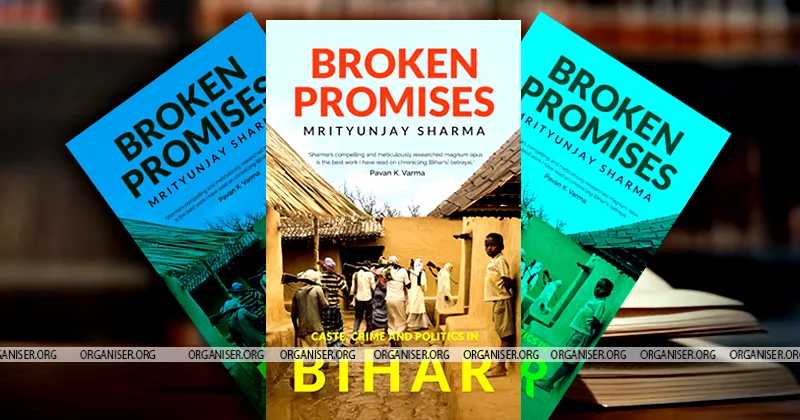
At the centre of this shift, many observers point to an unexpected catalyst: a book. “Broken Promises: Caste, Crime and Politics in Bihar” by Mrityunjay Sharma, published by Westland Non-Fiction in March 2024, began as a detailed account of the Mandal-era social churn. Sharma, who grew up in Ranchi when it was still part of undivided Bihar, wrote about the contradictions of the time, the promise of dignity and representation colliding with weak institutions, rising crime and decaying administrative structures. For many readers, the stories echoed what their parents, grandparents or older neighbours had narrated for years.
The book may have remained confined to political and academic circles, but a series of podcasts propelled it into mass consciousness. The turning point came with Sharma’s appearance on Raj Shamani’s show. The conversation was long, anecdotal and easy to digest, distilling the idea of “broken promises” into everyday experiences from the 1990s and early 2000s. Clips from the episode soon went viral across Instagram, YouTube Shorts and X.
Media houses across the spectrum took note. Over the next few months, the author featured in over fifty such high-impact podcasts and interviews including with Hindustan Live, Aaj Tak, ABP, Jist, Real Hit and many others. What had begun as a book was now turning into a national conversation. Reaction videos, explainers and commentary threads multiplied.
Stories of the Shilpi-Gautam murder case, Misa Bharti’s MBBS admission saga, the daylight looting of shops in Patna during Rohini Acharya’s wedding, or Shahabuddin’s reign of terror in Siwan once again became part of public chatter. Equally haunting were the author’s retellings of the caste massacres that ravaged the Magadh region, reminding many of wounds that had not fully healed.
Millions who had no memory of the period suddenly stopped mid-scroll to understand what institutional collapse looked like in real time. Older viewers found their own memories put into words. Within weeks, the book had broken out of niche circles and entered mainstream conversation, from coaching centres to college hostels, from WhatsApp groups to neighbourhood tea stalls.
This online wave significantly influenced the political climate heading into the 2025 elections. For the NDA, the ground was already prepared. Unlike previous campaigns, they did not need to expend energy reviving the “Jungle Raj” narrative; the public conversation had already done it for them. All they had to do was connect Sharma’s stories with their pitch of stability, governance and welfare delivery. In 2020, historical comparisons had fallen flat. Bihar was dealing with the aftermath of the migrant crisis. Unemployment shaped voter sentiment. Nitish Kumar was confronting anti-incumbency. The opposition’s appeal to change found space. But by 2025, welfare schemes, especially those targeted at women, had deepened their roots, the NDA projected rare internal cohesion, and the opposition was grappling with internal contradictions. The political atmosphere was ready for a return to historical reckoning, and “Broken Promises” filled that vacuum before the first rally hit the road.
A series of podcasts featuring other significant voices from Bihar amplified this narrative. Prashant Kishor’s sharp criticism of Lalu Yadav’s rule further reinforced the perception of the 1990s as a period of governance breakdown. His mention of the Shilpi-Gautam murders in a press conference opened floodgates of such incidents.
The Prime Minister caught the public mood and recounted several stories of Jungle Raj in his speeches including those of the Champa Biswas rape case and the Golu kidnapping case. In a meeting of BJP booth workers, PM Modi said: “I would tell all the youngsters in Bihar to gather all the young people at every booth and have the elderly people in that area come and tell everyone about the old stories from the Jungle Raj”.
Social media teams, from individual creators to official BJP and JD(U) handles, actively curated clips, stitched commentaries and circulated content at scale. The result was a rare synthesis: podcasts offered younger voters a vivid understanding of a period they had not lived through, and older voters a vocabulary for memories they often struggled to articulate. This created something far more potent than a campaign slogan; it created a cultural moment. Once the idea of “Broken Promises” merged with rising digital chatter, the NDA simply tapped into a narrative the public was already telling itself.
The opposition found itself unable to counter the shift. Its defence of the Mandal legacy could not neutralise the book’s argument, that while caste representation improved, governance collapsed. The opposition, while busy with the Voter Adhikar Yatra, could not catch the narrative that was brewing underneath. Even a last-minute attempt to redirect attention toward unemployment and migration faltered as the campaign drifted back to questions raised by Jungle Raj stories and amplified endlessly online. The impact was serious enough to rattle some leaders. Lalu Prasad Yadav’s brother-in-law, Sadhu Yadav, reportedly called Sharma demanding a retraction, and later served a defamation notice of Rs 5 crores.
The revival of the “Jungle Raj” narrative in 2025 emerged through a slow build-up of research, storytelling and digital dissemination. Sharma’s book reminded Bihar of a chapter it had never entirely forgotten. The podcasts ensured that chapter reached every corner of the smartphone universe. The NDA then did what political actors do best, convert a social conversation into electoral advantage. In a state like Bihar, politics has always hinged on which story captures the public imagination. In 2025, Broken Promises supplied the most powerful story of all, one that settled in the collective consciousness long before the first vote was cast.












Comments