





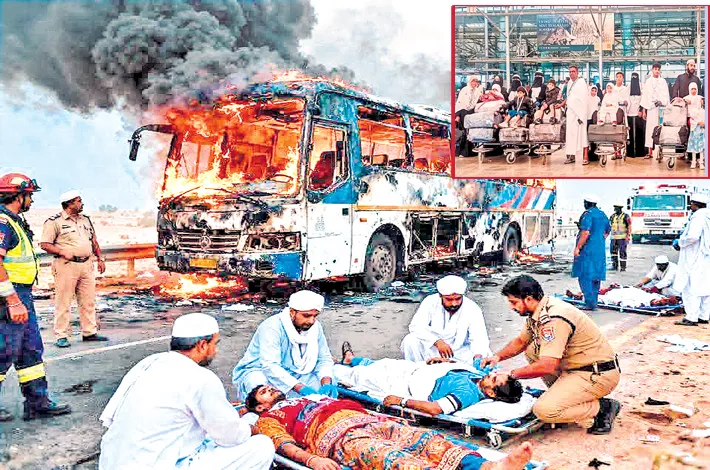
The recent bus accident in Saudi Arabia that left forty-two Indian Umrah pilgrims feared dead has once again put a harsh spotlight on the persistent shortcomings in managing mass religious pilgrimages. The tragedy unfolded shortly after 1:30 am on Monday (Nov 17) when a bus carrying pilgrims from Mecca to Medina collided with a diesel tanker and burst into flames, trapping passengers who were mostly asleep. Many of the victims, including women and children, were from Hyderabad and had undertaken the sacred journey with the hope of spiritual fulfilment.
What happened on that dark highway is not merely an unfortunate accident but a painful reminder of how systemic mismanagement, infrastructural gaps, and repeated administrative lapses continue to haunt the pilgrimage ecosystem in the region. This incident comes barely a year after the catastrophic 2024 Haj heatwave disaster, where more than 1,300 pilgrims died, 83 percent of them unregistered and forced to walk in extreme temperatures without adequate shelter or medical assistance.
A Tragedy in the Night
The fatal bus collision occurred when most of the passengers were asleep, making escape nearly impossible as the flames spread rapidly. The Consulate General of India in Jeddah quickly set up a 24×7 control room and released a toll-free number to help distressed families trace their loved ones.
Prime Minister Narendra Modi expressed grief, assuring that Indian missions were providing every possible assistance. Yet, beyond the official condolences, the grim reality remains that the tragedy could have been avoided with stronger oversight and enforcement of transport safety regulations.
Saudi Arabia’s highways connecting Mecca, Medina and Jeddah are among the busiest religious transport corridors in the world, especially during peak Umrah months. Despite this, night-time travel remains loosely regulated, even though fatigued drivers, long hours, unrestricted heavy vehicle movement, and inadequate emergency services have collectively contributed to frequent accidents over the years.
What is Umrah and why it attracts millions?
Umrah, often referred to as the “minor pilgrimage,” is a voluntary spiritual journey that Muslims undertake to seek purification and closeness to Allah. Unlike Hajj, which is obligatory and confined to specific dates in Dhul-Hijjah, Umrah can be performed at any time of the year, making it accessible to millions of believers.
The ever-growing number of pilgrims means that even a simple ritual sequence becomes a complex operational challenge requiring strict coordination between transport authorities, medical units, security forces and international liaison teams.
Problem denied, then repeated
Despite massive investments in Saudi Arabia’s infrastructure, expansion of the Grand Mosque, introduction of digital identification systems and widening of transport corridors, several deep-rooted issues remain unresolved.
Overcrowding
One of the most persistent problems is overcrowding and the presence of unregistered pilgrims. During the 2024 Haj season alone, more than 400,000 undocumented individuals participated in the pilgrimage. Without official permits, they had no access to cooling tents, shaded walkways, medical units or hydration stations, leaving them dangerously exposed to extreme heat.
Extreme heat
This contributed directly to the enormous death toll during that season’s heatwave, where temperatures soared to nearly 52°C. The unprecedented heatwave during the recent Hajj, with temperatures exceeding 52 °C (123°F), highlighted severe risks posed by extreme weather. Rising global temperatures have increased the frequency of heatwaves, impacting health significantly.
An investigation in Egypt led to the cancellation of sixteen tourism licences after authorities found that companies were illegally facilitating Hajj travel using ordinary visit visas. These pilgrims, unregistered and outside the official support structures, accounted for a disproportionate share of the 630 Egyptian deaths during the 2024 disaster.
Another long-standing issue is the region’s climatic vulnerability. Scientists had warned as early as 2019 that, due to climate change, the Hajj seasons between 2047 and 2052 would likely expose pilgrims to “extreme danger thresholds.” Yet the 2024 disaster demonstrated that these predictions are no longer distant possibilities; they are unfolding now. The mitigation measures, limited shaded spaces, insufficient cooling centres and sparse medical tents were inadequate for the sheer volume of pilgrims on the ground. Many deaths could have been prevented with more aggressive, climate-sensitive planning.
Transportation challenges
Transport-related mishaps are another recurring theme. Over the past decade, multiple fatal accidents have involved buses ferrying pilgrims between Mecca and Medina. Investigations routinely cite driver fatigue, unregulated private operators, and inadequate road monitoring systems. While Saudi authorities often attribute accidents to individual error, the repetition of these incidents points toward systemic deficiencies that have not been addressed.
Undocumented pilgrims
Undocumented pilgrims pose significant challenges to safety during Hajj. The Saudi health minister reported that one-quarter of health services were provided to undocumented pilgrims. Despite security measures, an estimated 400,000 undocumented individuals attempted Hajj, driven by desperation and facilitated by illegal brokers. This highlights systemic failures and exploitation by fraudulent operators. High costs of official Hajj packages push economically strained individuals towards illicit means.
Why 2024 should have been a turning point
The 2024 heatwave disaster should have transformed pilgrimage governance. With more than 1,300 deaths, international pressure mounted on Saudi authorities to overhaul permit systems, intensify monitoring of illegal travel operations, expand medical access points and implement temperature-responsive movement schedules. India, Egypt, Indonesia and other countries urged for reforms such as better digital permit verification, multilingual emergency alerts and dedicated medical units for specific national zones.
While certain improvements were made, the continued presence of unregistered pilgrims, sporadic enforcement of transport safety rules and uneven emergency response systems reveal that reforms remain superficial.
The 2025 Umrah bus crash exposes systemic fault lines
The latest tragedy clearly shows how multiple systemic weaknesses converged. Night-time travel, though chosen to avoid daytime heat, increases the risk of high-speed collisions on poorly lit desert highways. The presence of a heavy diesel tanker on a route frequently used by pilgrim buses raises questions about traffic segregation and highway patrol surveillance.
Fire safety standards appear insufficient, as buses ferrying large groups must ideally have flame-retardant interiors, multiple emergency exits and functioning extinguishers. Past survivors of similar accidents have reported that many private buses fall far below these norms.
The increasing intensity of heat in the Gulf region means that pilgrimage management must adapt rapidly. Climate change has made heatwaves more common, more intense and more unpredictable. Without a redesign of cooling infrastructure, increased distribution of water points, shaded shelters, and recalibrated movement schedules that account for heat forecasts, mass pilgrimage events risk becoming annual humanitarian crises. Climate models predict that future Hajj and Umrah seasons will become increasingly hazardous unless strong mitigation measures are adopted.
Why poor pilgrims suffer the most
A troubling pattern emerges from both the 2024 heatwave and the 2025 bus crash: the most vulnerable pilgrims, elderly travellers, low-income individuals, and those relying on small-scale or unauthorised agents bear the brunt of failures.
Following the 2024 disaster, India urged Saudi authorities to enhance oversight of travel agencies, improve medical access for Indian zones, strengthen permit verification systems and expand rapid-response teams. While some efforts were initiated, much remains unresolved, particularly in terms of coordinated safety protocols and transport monitoring.
The Saudi bus accident that killed forty-two Indian pilgrims is not simply a moment of profound grief, it is a warning that the world can no longer afford to ignore. The recurring patterns of mismanagement, overcrowding, inadequate transport regulation, climatic risks and unregulated pilgrimage operators show that systemic reform is urgently needed. The 2024 heatwave disaster should have triggered a massive overhaul; instead, the 2025 Umrah tragedy reveals that lessons were not fully learned.
Without decisive, coordinated reforms between Saudi authorities and participating countries, more such tragedies will occur with predictable and preventable regularity, turning sacred journeys into fatal ordeals for thousands of innocent pilgrims.














Comments