





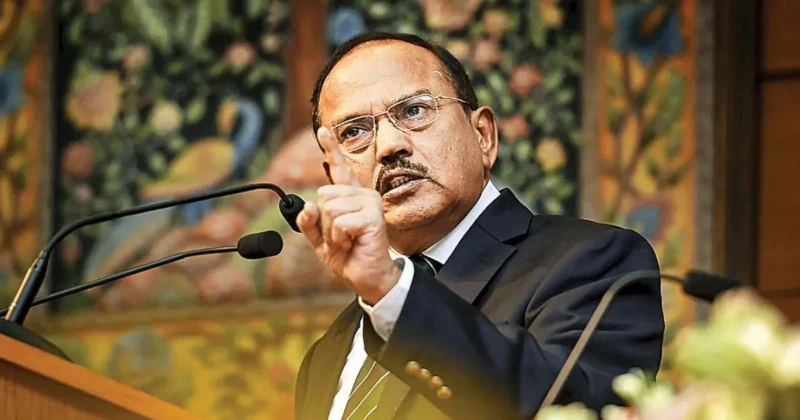
National Security Advisor (NSA) Ajit Doval has issued a sharp, unequivocal rebuttal after a maliciously doctored video circulated on social media, falsely portraying him as claiming that “more Hindus are attracted to ISIS than Muslims.” Calling the clip a clear case of deepfake manipulation, Ajit Doval told media that he has never made such a statement and warned that the fabrication represents a direct assault on India’s national-security narrative.
The viral video which also falsely shows him saying that foreign intelligence agencies recruit more Hindus than Muslims in India marks one of the most brazen instances of synthetic media being used to twist the words of one of the country’s highest security officials. According to Ajit Doval, its intent is unmistakable: to distort public perception, inflame communal tensions, and undermine India’s long-standing counter-terrorism framework.
Ajit Doval said the content appears to have been engineered through advanced AI-driven manipulation tools that are increasingly being weaponised in geopolitical information warfare. These technologies, he warned, are no longer being used merely for online mischief but for targeted disruption of strategic narratives, including those central to India’s security posture.
The manipulation is particularly dangerous because it seeks to sabotage India’s global counter-terrorism messaging. For years, India has maintained backed by intelligence data that ISIS recruitment within the country has been limited, closely monitored, and primarily fuelled by transnational propaganda networks, rather than indigenous radicalisation. The deepfake attempts to deride this position by planting false communal comparisons in Ajit Doval’s voice.
Significantly, the clip surfaced at a moment of heightened geopolitical tension and polarised domestic politics—leading experts to suspect deliberate timing. Officials familiar with influence-operation patterns note that such deepfakes do not emerge in a vacuum. Instead, they often coincide with periods of national strain, when hostile actors seek to exploit societal vulnerabilities and weaken faith in institutions.
By injecting fabricated communal narratives, the manipulation appears calculated to manufacture fissures, provoke political outrage, and portray discord where none exists.
The NSA warned that deepfakes of this nature pose a severe threat to democracy itself. The more credible and realistic such fabrications become, the more they risk eroding the public’s ability to trust authentic information even when it comes from constitutional or security authorities.














Comments