





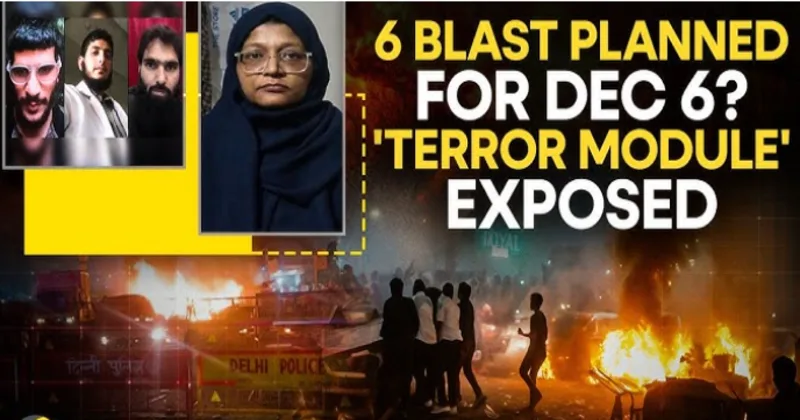
The interrogation of suspects arrested in the Delhi blast case has begun to unravel what investigators now describe as one of the most meticulously planned multi-city terror conspiracies in recent years. At the heart of this web lies a covert operation internally code-named “D-6 Mission”, a reference to the date, December 6, on which the module allegedly intended to carry out coordinated attacks across six Indian cities.
The trail leads investigators through years of radicalisation, foreign handlers, clandestine travel, hawala routes, encrypted communication systems, and finally to the medical professional they claim became the conspiracy’s pivotal asset: Shaheen Shahid, or “Madam Surgeon,” as her associates referred to her.
According to interrogation inputs, members of the module undertook a clandestine trip to Turkiye in March 2022. There, they allegedly met Abu Ukasha, an ISI-affiliated handler long associated with Jaish-e-Mohammed’s (JeM) foreign operations.
Officials say this meeting was more than routine contact, it served as the “green signal” for the D-6 Mission. While planning had been underway since 2021, this approval reportedly accelerated preparations, giving the module confidence that cross-border handlers were now fully invested in the plot.
A plot brewing since 2021
Central agencies, through seized devices, handwritten diaries, and planning notes, have traced the operational arc of the module. The evidence suggests:
-Radicalisation began around 2010, when Shaheen allegedly came into contact with an Indian-origin doctor abroad who shared extremist literature and videos.
-She adopted the hijab soon after and often expressed her desire to move overseas.
-By 2015–16, the module’s future members were allegedly drawn into deeper JeM-linked circles.
-From 2021, the group began structured planning for synchronised attacks in six cities, investigators say.
The recovered diaries contain elaborate details, including target lists, recruitment pitches, money movements, safe-house arrangements, and secure communication instructions. The phrase “D-6 Mission” appears repeatedly, always linked to December 6, the anniversary of the demolition of the disputed Babri Mosque.
Documents recovered by investigators outline the roles of three key operatives at the heart of the D-6 conspiracy. Dr Muzammil is believed to have managed the logistics and reconnaissance required for the coordinated attacks, ensuring movement, locations, and operational details were aligned with the group’s broader plan. Umar Nabi, meanwhile, allegedly played a more direct operational role and is accused of driving the explosive-laden car that detonated near the Red Fort in Delhi, triggering the November 10 blast. At the centre of the conspiracy is Dr Shaheen Shahid, who investigators say handled ideological coordination, fund distribution, and oversight of several components of the planned multi-city terror blueprint. With all three suspects now in custody, officials describe the case against them as “layered, substantive, and deeply coordinated,” pointing to a sophisticated and long-term operation rather than an isolated act of violence.
Madam Surgeon
Among all the operatives, 43-year-old Shaheen Shahid stands out not only for her alleged central role in the conspiracy but also because she embodies what investigators describe as a “white-collar radicalisation pathway.” Known within the module as “Madam Surgeon,” Shaheen was a highly qualified medical professional who completed her MBBS and MD from SRN Medical College in Allahabad before joining GSVM Medical University in Kanpur as an Assistant Professor of Pharmacology in 2006. However, her career took an abrupt turn in 2013 when she left her job without explanation and later resurfaced at the Al-Falah School of Medical Sciences. The National Medical Commission has since cancelled her medical registration along with those of three other doctors linked to the case. According to investigators, her radicalisation began around 2010 and gradually intensified as she was influenced and groomed by handlers who offered her the prospect of overseas placements and a “greater ideological purpose.” A relative recalled confronting her about her growing detachment from her personal life, to which she allegedly responded, “I have lived enough for myself. Now it’s time to repay the debt of my community.”
The Delhi Blast
The November 10 blast in Delhi, triggered by a slow-moving car near Red Fort, left at least 12 people dead. The vehicle was allegedly driven by Umar Nabi. Following the attack, Shaheen is believed to have acted swiftly to execute an escape plan. She reportedly applied for a new passport in late October as part of her attempt to flee the country, but delays in verification, caused by the ongoing Delhi blast investigation, thwarted her efforts. Surveillance records indicate that she began systematically cutting off communication with local contacts immediately after the explosion, further underscoring her operational awareness. Her central role in both the planning and aftermath of the attack has placed her at the core of the National Investigation Agency’s ongoing investigation.
Investigators’ recovery of digital and handwritten materials has revealed the extensive scope of the D-6 Mission, detailing plans for coordinated attacks across six Indian cities. The documents include target lists, recruitment pitches, indoctrination notes, encrypted communication protocols, fund movements, including hawala channels, and the procurement of chemicals, devices, and potential safe-house locations. Authorities say the date, December 6, was symbolically chosen to “avenge the demolition of Babri Masjid.” One of the most significant findings is a Rs 20-lakh hawala trail allegedly routed through a JeM handler, with funds reportedly used for recruitment, safe houses, encrypted devices, and reconnaissance. Around Rs 3 lakh may have been spent on procuring 26 quintals of NPK fertiliser, an agricultural compound that can be converted into explosives. Investigators are auditing Shaheen Shahid’s seven bank accounts across Kanpur, Lucknow, and Delhi to trace any foreign transactions.
Beyond the main operatives, Shaheen, Dr Muzammil, and Umar, authorities have identified additional figures, including Adeel Majeed Rather, who is employed at a private hospital in Saharanpur, and Shaheen’s brother, Parvez Ansari, who was detained during a J&K Police–led probe. Several doctors linked to the module have had their registrations revoked by the National Medical Commission, while Al-Falah University, where two accused had professional ties, has distanced itself, stating it has no connection beyond official capacities and does not store or use restricted chemicals.
Forensic teams at the blast site recovered three 9mm cartridges, two live and one empty, but no firearm. Officials noted that this calibre is generally restricted to the armed forces or individuals with special permission, highlighting the sophistication of the operation. What began as a single explosion near the Red Fort has now evolved into a sprawling investigation across multiple states and international borders, with agencies decoding communication logs, tracing handlers, and mapping the wider network. The D-6 conspiracy exposes not only a terror plot but also the systematic radicalisation of a professional, educated network over a decade, orchestrated by foreign handlers and activated at a strategically chosen moment. While the December 6 mission may have been thwarted, investigators caution that the ecosystem enabling such operations remains active, and the reconstruction of the entire operational chain is far from complete.











Comments