





The International Crimes Tribunal(ICT) in Dhaka is set to deliver its long-awaited verdict on November 17(Monday), in the case accusing ousted Prime Minister Sheikh Hasina, former home minister Asaduzzaman Khan Kamal and former Inspector General of Police Chowdhury Abdullah Al-Mamun of committing crimes against humanity during the July-August 2024 unrest which was followed by the massive anti-discrimination student movement.
Tribunal-1, a three-member bench headed by Justice Md Golam Mortuza Majumder, is scheduled to announce its judgment on the afternoon of November 17. Closing arguments concluded on October 23, with Chief Prosecutor Mohammad Tajul Islam and Attorney General Mohammad Asaduzzaman presenting the prosecution’s final statements. State-appointed defence counsel Md Amir Hossain argued on behalf of the accused, with prosecutors Mizanul Islam, Gazi MH Tamim, Faruk Ahmed, Moinul Karim, ABM Sultan Mahmud and others in attendance.
The tribunal had initially fixed November 13 for the verdict, before rescheduling it for November 17. Up to October 22, the state defence presented arguments for the accused Sheikh Hasina and Asaduzzaman Khan Kamal as well as for the present “royal witness”, former IGP Chowdhury Abdullah Al-Mamun. The prosecution has sought for the maximum punishment for all three.
The defence, after three days of submissions, urged the tribunal to acquit them, challenging the credibility of several key witnesses, including Mamun himself, Daily Amar Desh Editor Mahmudur Rahman and National Citizen Party (NCP) Convener Nahid Islam. Hossain dismissed their testimonies outright, arguing that Mamun’s cooperation was coerced and that Mahmudur Rahman’s political leanings biased his statement. Mamun’s lawyer, Zayed Bin Amjad, later delivered separate arguments on behalf of the witness-accused.
The prosecution has brought five charges of crimes against humanity, supported by extensive documentation: 8,747 pages in total, including 2,018 pages of references, 405 pages of seized materials, and a 2,724-page list of the dead. With the verdict due this afternoon, today’s ruling is expected to be one of the most consequential in the tribunal’s recent history.
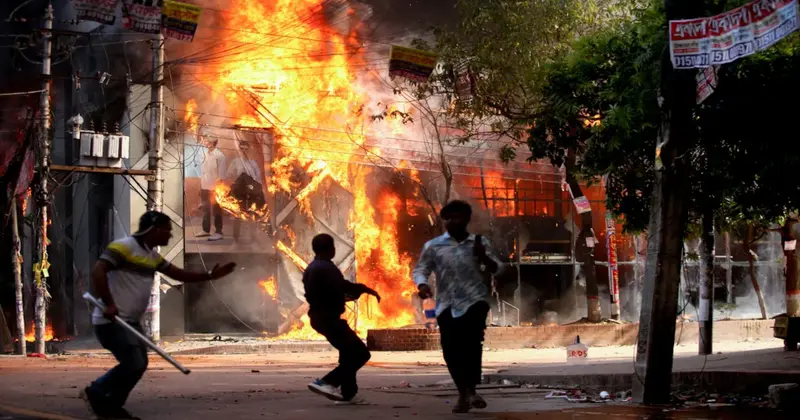
Violent protests entangle Bangladesh ahead of the verdict
Ahead of the verdict in the case filed against former Prime Minister Sheikh Hasina, widespread violence has erupted in various parts of Bangladesh. There have been incidents of car arson, cocktail explosions and road blockades across the country. The interim government led by Muhammad Yunus has deployed border guards in addition to the army and police. People have blocked the highway by throwing stones at several places. However, Border Guard Bangladesh is clearing the highway.
The situation in Bangladesh has become tense ahead of the verdict. Sheikh Hasina’s Bangladesh Awami League has announced a two-day shutdown across the country, starting on the morning of November 16, thus disrupting normal life. Traffic in the capital, Dhaka, has been relatively light, while firecracker explosions have been reported in some areas. Business leaders have expressed concern over the political situation, hoping that the upcoming general elections will help restore stability in the country.
Quazi Moniruzzaman, former President of the Bangladesh Garments Manufacturers and Exporters Association (BGMEA), said, “I think it is not a very comfortable situation. We are very scared about the situation. We hope there will be free and fair elections, people will cast their votes peacefully and an elected government can resolve all problems related to business, social issues, law and order which are currently in very bad shape”.
“As a freedom fighter who fought for the country in 1971, I feel very sorry for all the inconvenience caused to the people of Bangladesh. Last year was very difficult. We hope the 2026 elections will give new hope to the people of Bangladesh. We also aim to maintain good relations with all neighbouring countries while protecting our sovereignty. Above all, we must come together for a peaceful situation in the region”, he added.
Moniruzzaman also stressed the importance of maintaining strong ties with neighbouring India, saying, “India helped us in 1971 and as a freedom fighter, I received training there. We need to maintain strong ties with India while respecting our sovereignty. As a big neighbour, India will respect our sentiments and we hope to have good relations in the future”.
Since the interim government, led by Muhammad Yunus, has banned the activities of the Awami League and its affiliated organisations, party leaders inevitably have been announcing programmes through social media from undisclosed locations while actively campaigning online.
(With Inputs from ANI)














Comments