




“If you really care for freedom, liberty, there cannot be any democracy or liberal institution without politics. The only true antidote to the perversions of politics is more politics and better politics. Not negation of politics.”
– Loknayak Jayaprakash Narayan
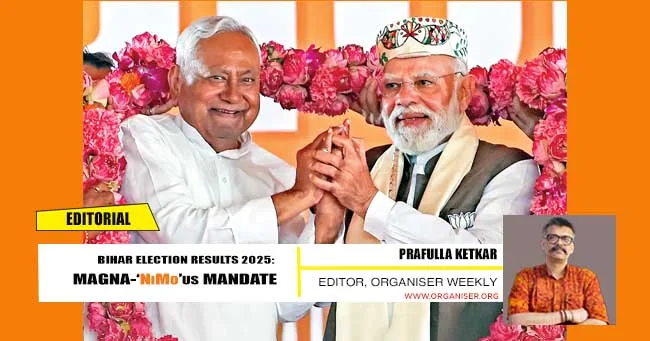
The people of Bihar have given a massive mandate to the National Democratic Alliance (NDA), yet again defying poll predictions of close contest. The voters of Bihar proved the pollsters wrong who were harping on the traditional understanding of casteism and communalism-based politics. There are various ways to look at this mandate. The opposition’s expectation of weakening the Union Government at the Centre after the 2024 Parliamentary elections has been shattered with this verdict. Along with the synergy among NDA allies and successful vote transfers among themselves, the clarity of purpose in contesting the elections proved critical in ensuring a thumping victory. Naturally, the discussion revolves around the leadership models of Prime Minister Narendra Modi and Chief Minister Nitish Kumar, which have led to this electoral Tsunami, drowning the discrediting agenda of vote-chori. It is not just about the individuals, but also the nature of politics they stand for, which makes this mandate magnanimous.
For the last two decades, Nitish Kumar has proven to be a necessity in Bihar, irrespective of his choice of alliance. He comes from a minuscule Kurmi community with less than three per cent of voters, and still, he has been at the helm of affairs for two decades in Bihar. In one of his conversations, he had remarked that even with differences of opinion about his performance, nobody would abuse him or accuse him of corruption. This assertion by Nitish Kumar was not mere political rhetoric, but the confidence of a person of impeccable character. He is also the product of Lohia’s socialist ideas, his fight against the Emergency, and Mandal politics, similar to those of Lalu Prasad Yadav. Still, unlike the RJD supremo, the JD(U) leader was never equated with dynastic corruption and criminalisation. He never used the social justice plank to create enmity among various sections. On the contrary, he created space for himself among extremely backward Scheduled Castes by creating a Maha-Dalit category, when reservation within reservation was not a very popular idea. Through bicycles, ban on liquor and recruitment of teachers, he carved out his own space among women. His model of social justice is inclusive and harmonious, and not hateful and exclusionary.
Prime Minister Narendra Modi personifies decisiveness and delivery. The schemes that reach out to every section of society, with the family as the unit of beneficiary, changed the equations in caste-complex societies of Uttar Pradesh and Bihar. The unapologetic protector of the cultural heritage, combined with clear development goals on the ground, perfectly complemented his leadership with that of Nitish Kumar. His caste also does not have any presence in Bihar; his policies and politics are clearly based on Hindutva, and still, people find him a leader of all sections. The way he inspires the organisation, mobilises the people on the ground, and employs machinery and resources across the region makes PM Modi a true national leader with a pan-Bharat appeal. His communication is clear, effectively balancing local sentiments with national objectives. Instead of doling out a few benefits, his approach of providing monetary assistance for empowerment and self-sufficiency led to the development of schemes like Mudra and Drone-didi. Real politics is not just about winning elections but transforming lives through policy initiatives.
The combination of Nitish and Modi leadership has certainly taken Bihar beyond the Mandal dynamics. The Jan Suraj Party experiment, led by Prashant Kishor, proved ineffective due to the absence of ideological clarity and organisational structure. The only concerning factor now is the Congress’s politics of negation and discrediting institutions. There will be systematic efforts to create doubts about the election results by continuing the vote-chori narrative, which the voters have categorically rejected. The foreign entities are awaiting their chance to intervene in Bharat, and the communist-maoist forces are keen to subvert the democracy through democratic means.
The Nitish-Modi combination, on the lines of Jayaprakash Narayan’s wisdom, has demonstrated that the true antidote to the perversions of politics is better politics and negation of the same. After this massive mandate, reconnecting Bihar with its glorious legacy, from Magadh and Vaishali, to chart the journey for the future will be the real challenge. The Bihar Assembly verdict also represents growing expectations and aspirations, and constructively addressing them without falling into the trap of populism will be a significant task. However, the biggest and immediate assignment for the new Government would be to protect the institutions from the politics of negation through a participatory approach. Then only, this Tsunami for the NiMo model will be magnanimous for Bihar and Bharat.















Comments