





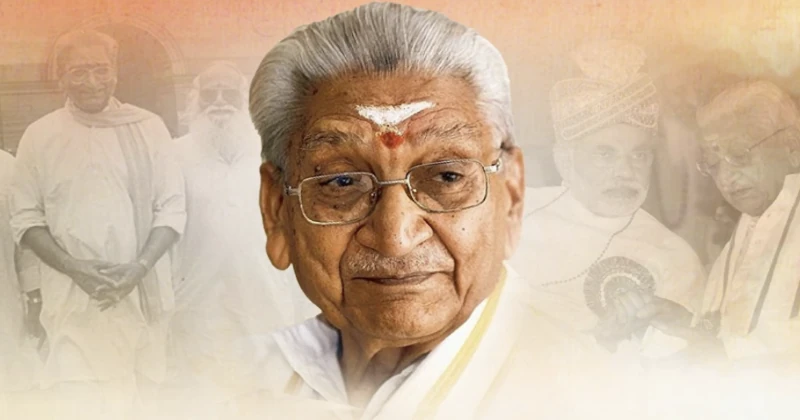
The Vishva Hindu Parishad (VHP) commemorated the death anniversary of Ashok Singhal on X, hailing him as the Hindu Hriday Samrat, an unshakable pillar of the Shri Ram Janmabhoomi movement, and a tireless champion of Hindutva and Sanatan values. The organisation described him as a “source of inspiration,” a “skilled leader,” and a guiding force for countless volunteers who continue to draw strength from his lifelong dedication to Hindu society.
हिन्दू हृदय सम्राट, भारतीय संस्कृति के संवाहक, श्री राम जन्मभूमि आंदोलन के प्रमुख स्तम्भ, सनातन व हिंदुत्व के संरक्षण में अपना सर्वस्व अर्पित करने वाले, कुशल नेतृत्वकर्ता, सभी कार्यकर्ताओं के प्रेरणास्रोत व मार्गदर्शक, विश्व हिन्दू परिषद के पूर्व अध्यक्ष परमपूज्य अशोक सिंघल जी की… pic.twitter.com/IkfAEiykqX
— Vishva Hindu Parishad -VHP (@VHPDigital) November 17, 2025
Ashok Singhal, the former International President of the VHP, was one of the most influential architects of the Ram Janmabhoomi movement—an ideological and socio-religious campaign that shaped the trajectory of Hindu mobilisation for decades. A meticulous organiser, a disciplined swayamsevak, and a spiritual nationalist, Ashok Singhal’s legacy continues to reverberate across India’s cultural and socio-religious landscape.
Born on 27 September 1926, Ashok Singhal hailed from a devout and prosperous family originally from Bijoli village in Aligarh district. He was the son of Shri Mahavir Singh, a Deputy Collector, and Shrimati Vidhyawati, whose deep spirituality shaped the ethos of the household. Religious practices such as Agnihotra and Gayatri Havan were daily rituals, and their home was a constant confluence of saints and spiritual visitors.
Ashok Singhal was the fourth of eight siblings, and the family was united by the mother’s strong spiritual grounding. Each child chose a different professional path, yet shared the same values of discipline and devotion. His sister Usha married in 1963, while his younger brother Bhartendu, who later became the Director General of Uttar Pradesh Police, married in 1950. His other brothers, Piyush and Vivek, entered the business world in the mid-1960s.
Despite being a gifted singer with a natural spiritual inclination, Ashok Singhal pursued Metallurgical Engineering at Banaras Hindu University, graduating in 1959 largely to fulfil his father’s aspirations. However, his true calling lay elsewhere. Even during his student years, he spent long hours meditating, reading spiritual texts, and participating in Rashtriya Swayamsevak Sangh (RSS) activities.
Ashok Singhal desired a life of celibacy and national service, dedicating himself fully to the cause of cultural nationalism from a young age.
Ashok Singhal joined the RSS as a dedicated swayamsevak and soon became known for his discipline, clarity of purpose, and organisational acumen. He served extensively in Kanpur Metropolis before being appointed to oversee the Delhi and Haryana provinces of the organisation.
It was RSS Sarsanghchalak Madhav Sadashiv Golwalkar (Revered Guruji) who identified Ashok Singhal’s potential to uplift Hindu society at a national and global level. Guruji’s guidance encouraged Ashok Singhal to take the VHP forward as a key platform for Hindu unity.
This marked the beginning of an era where Ashok Singhal became synonymous with the VHP’s international expansion and mass mobilisation efforts.
As International President and later chief guardian of VHP, Ashok Singhal transformed the organisation into a global force for Hindu causes. He integrated youth organisations such as Bajrang Dal and Yuva Vahini, broadening VHP’s grassroots involvement and expanding its outreach.
But his defining achievement was leading the Ram Janmabhoomi movement, a historic mobilisation to reconstruct the Shri Ram mandir at Ayodhya. Ashok Singhal converted the Ram Mandir campaign into a mass cultural awakening, drawing millions into a movement that blended devotion, identity, and civilisational reclamation.
Under his stewardship, the VHP spearheaded numerous yatras, campaigns, and international conferences aimed at uniting Hindus and strengthening efforts for the mandir’s reconstruction.
Ashok Singhal remained the face and backbone of the VHP until his final days. His unflinching dedication, austere lifestyle, and spiritual fortitude made him an inspiration for generations of volunteers across Bharat and the world. During crises involving Hindu communities from the Indian subcontinent to global diaspora regions Ashok Singhal played a significant role in organising relief efforts, advocacy, and protection campaigns.
Even years after his passing, his ideological foundations, organisational strategies, and spiritual leadership continue to influence the functioning of the VHP and the broader Hindutva movement.















Comments