





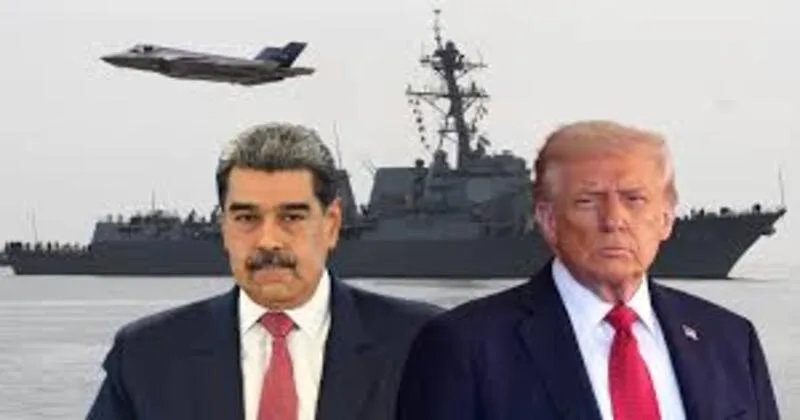
Senior officials in the Trump administration convened a series of high-level meetings at the White House this week to examine potential military options in Venezuela, according to multiple US officials, amid a rapidly expanding American military presence in the Caribbean. The deliberations come even as President Donald Trump presents himself as a global peacemaker, saying he remains committed to diplomatic mediation worldwide, including during India’s Operation Sindoor, even as he escalates the threat of military force in Latin America.
Rising military build-up
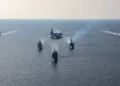
US defence officials confirm that Trump has ordered the deployment of F-35 fighter aircraft, naval warships and a nuclear-powered submarine to waters around Venezuela, marking one of the most significant US regional buildups in recent years. Earlier this week, the Gerald Ford aircraft carrier strike group entered the wider Latin America region with more than 75 aircraft and over 5,000 troops, deepening expectations that Washington is preparing for a long-term military posture. Trump indicated to reporters aboard Air Force One on Friday that he had “made up his mind” regarding potential action on Venezuela, though he did not specify what measures he was prepared to authorise. He has repeatedly accused the Venezuelan government of maintaining close links to illegal drug networks and has suggested that a decision on whether to launch military operations could be made soon.
Four US officials and another source familiar with the internal discussions said that the National Homeland Security Council held three meetings this week to consider response options. Three of those officials confirmed that the latest such meeting took place on Friday. The council, which typically advises the president on homeland security matters, is normally chaired by Homeland Security Adviser Stephen Miller. One official said a small preparatory group met on Wednesday, followed by a larger meeting on Thursday that included Vice President JD Vance, Miller, Defence Secretary Pete Hegseth, and Chairman of the Joint Chiefs of Staff General Dan Caine.
🚨President Briefed on Venezuela plans
The USS Ford, a "nuclear death fortress," arrives on station in the Caribbean
—Colonel (Retired) John Mills
“The president was briefed by Secretary of War Pete Hegseth and Chairman of the Joint Chiefs of Staff Dan Caine, sources told CBS… pic.twitter.com/fY0d43uA8y
— Tony Seruga (@TonySeruga) November 13, 2025
According to the source familiar with the discussions, Trump personally attended Thursday’s session in the Situation Room, where he was briefed on a range of military scenarios. The media have not determined the specific options presented, although Trump has in the past floated the possibility of limited land operations inside Venezuela. At the same time, he has repeatedly insisted that he is not seeking regime change.
Venezuelan President Nicolas Maduro maintains that Washington’s actions are aimed at removing him from power. In August, Washington doubled its reward for information leading to Maduro’s arrest to $50 million, alleging that the Venezuelan leader has ties to drug trafficking and organised criminal groups. The White House did not immediately comment on the latest round of deliberations.
Escalating tensions and legal questions
So far, US forces have focused on operations against suspected drug-smuggling vessels in the Caribbean and Pacific. The Pentagon has conducted at least 20 strikes in recent months, resulting in 80 deaths. These actions have prompted concerns among Democratic lawmakers and legal experts, who have questioned whether the operations comply with international and domestic law. Several European allies have also criticised the strikes and called for greater transparency. A recent Media house visual investigation found that the US military is renovating a long-abandoned Cold War naval base in the Caribbean, suggesting preparations for prolonged or expanded operations that could support any future actions inside Venezuelan territory. In response, Venezuela has begun deploying weapons, primarily older Russian-made systems, and is reportedly preparing for a guerrilla-style resistance campaign or efforts to create instability should the US launch air or ground strikes.
Public and regional repercussions
Despite the White House’s intensifying preparations, military intervention in Venezuela appears broadly unpopular among American voters. A new Reuters/Ipsos poll released Friday found that only 35 per cent of respondents supported using US military force in Venezuela. Meanwhile, tensions between the United States and neighbouring Colombia have escalated sharply. Trump has publicly labelled Colombian President Gustavo Petro an “illegal drug leader” and has imposed sanctions on him. Petro has countered by accusing the US of committing murder through its recent targeted strikes.
The conflicting signals, assertions of global peace leadership on one hand and escalating preparations for military action on the other, underscore the administration’s increasingly aggressive posture toward Venezuela. With significant military assets now concentrated in the region and high-level discussions underway, Washington appears closer than at any point in recent years to authorising a strike, even as Trump continues to cast himself as a mediator striving for stability on the world stage.









Comments