





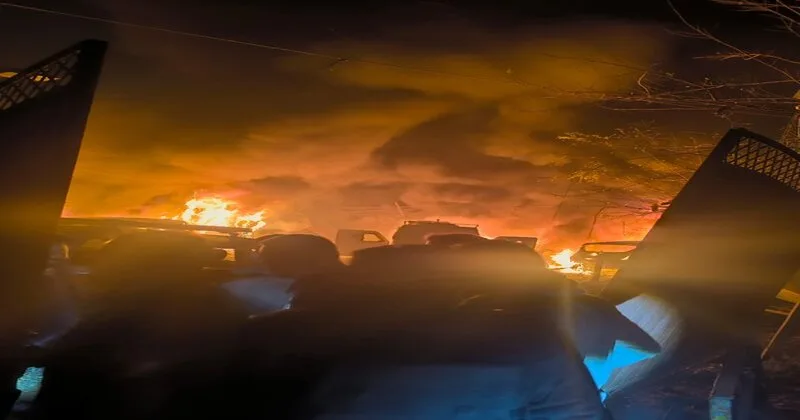
Srinagar: A powerful explosion occurred inside the Nowgam Police Station on November 14 after a large quantity of ammonium nitrate—seized during an ongoing terror investigation—detonated while officials were inspecting it. The blast tore through the station premises, damaged adjacent structures, and left several personnel injured, officials said. Emergency teams evacuated the wounded to a nearby hospital as senior officers rushed to the site and cordoned off the area.
According to police sources, the explosive material had been confiscated during raids on a suspected terror module linked to the extremist group Jaish-e-Mohammed. A forensic team from the Forensic Science Laboratory (FSL) was examining the material when it unexpectedly ignited, causing the devastating explosion.
A massive explosion was caught on CCTV near Nowgam, Srinagar, on Friday. Fire brigade, ambulances, and senior police rushed to the site.
Further details are awaited. pic.twitter.com/LWPpHm8HKk
— IndiaWarMonitor (@IndiaWarMonitor) November 14, 2025
The Nowgam Police Station has been at the centre of a complex investigation after its Station House Officer (SHO) uncovered a network responsible for spreading Jaish-e-Mohammed posters across the region. These posters, which issued threats of major attacks on security forces and non-locals, were crucial in helping police identify a cluster of radicalised individuals—many of them highly qualified professionals.
#Srinagar's Nowgam Police Station blast on Nov 14, 2025,injured 1 during a forensic inspection of confiscated ammonium nitrate, causing vehicle fires.J&K Police confirmed no terror link,despite the station's probe into a #JaisheMohammed module tied to a Delhi explosion #BREAKING pic.twitter.com/BsXUu7kQgf
— Thepagetoday (@thepagetody) November 14, 2025
The probe first led authorities to Dr. Adeel Ahmad Rather, who was captured on CCTV placing the threatening posters. Rather, previously employed at Government Medical College Anantnag, was arrested on October 27. A subsequent search of his locker yielded an assault rifle, deepening suspicions about the group’s sophistication and intent.
His interrogation uncovered the involvement of another doctor, Muzammil Shakeel, associated with Al-Falah Medical College in Faridabad. A raid on locations linked to Shakeel resulted in the dramatic seizure of nearly 3,000 kg of ammonium nitrate, triggering alarm among investigators. Shakeel’s arrest led police to yet another suspect, Dr. Shaheen Saeed, marking the unravelling of what officers described as a “white-collar terror ecosystem” with foreign links.
Connection to the Delhi blast that killed 13
Just hours after these arrests, a car explosion near the Red Fort in Delhi killed 13 and injured more than 20. The timing and nature of the attack led investigators to believe the same ecosystem was involved. The next day, intelligence inputs pointed to the role of Dr. Umar Nabi, whom sources said was driving the Hyundai i20 car that exploded at a traffic light.
Officials in the National Investigation Agency (NIA) now believe the seizure of ammonium nitrate may have put the module under intense pressure, pushing the suspects into panic mode. Investigators suspect the improvised explosive device (IED) used in the Delhi blast was “improperly assembled,” suggesting the group may have rushed the execution of the attack.
Friday’s explosion inside the Nowgam Police Station is now being examined for links to the broader terror investigation. The detonation of confiscated material during inspection has raised questions about the stability of the seized chemicals and the methods used in storing and handling them.
Authorities said a detailed inquiry would be conducted to determine whether the blast resulted from procedural lapses, unexpected chemical volatility, or intentional tampering.












Comments