





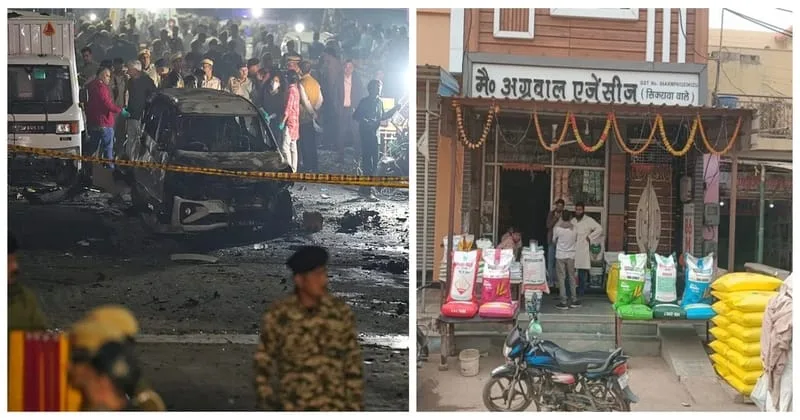
Investigators tracing the source of the explosives used in Monday’s deadly blast near Delhi’s Red Fort have linked the procurement network to Basai Meo village in Haryana’s Nuh district, as well as nearby areas of Faridabad, Gurugram, and Saharanpur. Officials said the findings indicate a complex chain of fertiliser and ammonium nitrate purchases allegedly orchestrated by Dr Umar Un Nabi and his associates from the Faridabad module over the past several months.
People familiar with the investigation said Umar and another suspect had posed as farmhouse owners while approaching fertiliser shops in Nuh, where they began purchasing NPK fertilisers in small quantities over the last three to four months. Senior officers said the module collectively raised Rs 20 lakh to buy more than 26 quintals of NPK fertiliser and over 1,000kg of ammonium nitrate – materials powerful enough to make multiple bombs.
A senior Delhi Police officer stated that the network was “actively discussing ways to procure ammonium nitrate and NPK in bulk quantities.” “They spent over Rs 20 lakh, with contributions from each member. The group also purchased rifles and cartridges from Srinagar with assistance from handlers, including one codenamed ‘Ukasha,’” the officer added. Investigators have identified at least three fertiliser dealers in Faridabad who allegedly supplied materials to the suspects. One dealer, a resident of Pinangwan, told police that the men posed as landowners looking to buy fertiliser for their farms. Payments were made digitally, a detail that police now consider a crucial lead in the investigation.
Based on interrogation and location data, officials said Nuh was the primary source of the explosive materials. Among the accused, Dr Muzammil Shakeel Ganaie, one of the Al-Falah doctors arrested last week, allegedly visited the fertiliser shops multiple times and later brought Dr Umar to the same suppliers. “They didn’t purchase everything at once. The materials were collected gradually over three to four months,” an investigator said.
The multi-agency investigation, involving the Delhi Police Special Cell, Haryana Police, and the NIA, has revealed that Dr Umar and Dr Muzammil, both formerly affiliated with Al-Falah University, relied on local contacts in rural Faridabad to identify sellers and transport the chemicals.
Meanwhile, forensic teams from the Forensic Science Laboratory (FSL) are visiting multiple locations to search for traces of explosives in vehicles and residences linked to the accused doctors. Police said the cars of several suspects and their associates are being examined to determine if they were used to transport explosives across state lines. “We are also investigating potential sites where chemical residue from the Red Fort blast may have been disposed of,” an officer added.
Nuh’s mining belt under scrutiny
The investigation expanded this week after NIA and Delhi Police teams traced the ammonium nitrate supply chain to Nuh’s mining belt, a region known for illegal quarrying and frequent use of blasting chemicals. Officials said the ammonium nitrate used in the blast was sourced from fertiliser dealers and mining suppliers in Basai Meo, Tauru, and Ferozepur Jhirka, where the chemical is commonly employed for blasting rocky terrain.
Police have detained Dinesh Kumar, also known as Dabbu Singla, a fertiliser dealer from Pinangwan, who allegedly sold around 300 kilograms of ammonium nitrate to the module. Investigators have so far identified at least three fertiliser dealers in Sohna and one in Nuh who allegedly supplied materials to the suspects.
A joint team from Faridabad and Nuh police conducted extensive searches around mining sites on Wednesday and Thursday, questioning over 50 individuals, including mine operators, transporters, and chemical dealers.
During interrogations, locals reportedly confirmed that Dr Umar had visited the area multiple times in recent weeks. He allegedly claimed he wanted to start a mining business in Kashmir and was inquiring about procuring and handling blasting chemicals. “He introduced himself as a doctor exploring investment opportunities,” said one local trader questioned by police. Officials now believe these visits were a cover to survey suppliers and learn how to acquire large quantities of explosive material without raising suspicion.
Searches in Ferozepur Jhirka also led to the recovery of several ammonium nitrate stockpiles from sheds used for illegal quarrying. Forensic teams have collected samples to match them with residue found in the Hyundai i20 and red EcoSport recovered earlier this week.











Comments