






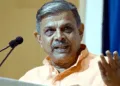
“Before understanding the role of the Sarsanghchalak and how he guided the organisation forward, it is essential to recognise that as any organisation grows, the situations it faces also evolve. There is always an action–reaction between circumstances and organisations. The leadership of any organisation must understand the prevailing situation and provide direction accordingly. The direction Balasaheb Deoras and Rajju Bhaiya gave shaped the situation itself”, said RSS Sah-Sarkaryavah Atul Limaye while addressing the gathering on Day 3 of the four-day lecture series ‘Rashtriya Swayamsevak Sangh ki Shatabdi Yatra: Netritva ki Disha aur Bhumika’ organised by Bharatiya Vichar Manch to mark the centenary of the RSS at the Gujarat University Convention and Exhibition Centre on November 11, 2025..
The topic for the third day of the lecture series was “Social Transformation and Acceptance: Shri Balasaheb Deoras and Shri Rajjubhaiya.”
“During the tenure of Balasaheb Deoras and Rajjubhaiya as Sarsanghchalaks, the country witnessed significant transformations. Balasaheb ji served as the Sarsanghchalak from 1973 to 1994. Until then, a Sarsanghchalak would serve until his last breath, but due to deteriorating health, Balasaheb ji entrusted the responsibility of Sarsanghchalak to Rajju Bhaiya in 1994. This period saw the student movement in Gujarat, the Navnirman Movement in Bihar, the imposition of Emergency, and several other events. For the first time, a non-Congress government came to power. During this era, the BJP was also formed. In the 1980s, an entire village of Scheduled Caste families in Meenakshipuram was converted to Islam; Khalistani extremism rose; the Ram Janmabhoomi movement gained momentum; the nation lost two Prime Ministers because of terrorism; terrorism reached its peak in Jammu & Kashmir, forcing one lakh Hindus to flee from the Valley; and in 1991, liberalisation brought far-reaching changes”, Atul Limaye said.
The head of any organisation has three key responsibilities, to add new dimensions to the organisation, to respond to societal developments with sensitivity, and to initiate change and work proactively for social transformation. Balasaheb Deoras and Rajju Bhaiya fulfilled all three responsibilities and inspired society through their leadership, he said.
“When we look at Balasaheb ji, we find that Pragya Bharati Bhandanekar ji described him through a Sanskrit shloka he composed. He wrote, “Devaḥ svarāṣṭrāt aparo na yaḥ, Rasaḥ yathā’nyatra na saṅghakāryāt” (Those for whom there is no deity apart from their own nation. Those who have no interest or taste in anything other than Sangh work). By analysing deva and rasa, he created this shloka. This shloka, in its truest sense, is an apt description of Balasaheb ji”, he said.
“Balasaheb was born in 1915. He was eleven years old when he entered the Sangh. The Sangh was founded in 1925, and from 1926 onwards, Balasaheb became associated with it. Thus, he witnessed the development of the Sangh’s working system, experienced it firsthand, and contributed to it. In his childhood, Balasaheb ji served as the Company Commander of the Young Battalion D Company. Today it feels surprising, but at that time such responsibility was quite normal. Later, he also became Company Sergeant Major. carrying such responsibilities from a young age shaped him. Doctorji had the vision of taking promising young swayamsevaks along and giving them exposure. Once, during a camp in Pune, Balasaheb was sent for preparation of the Hindu Yuvak Parishad. Doctorji travelled with him to several places. In 1939, a major ideological meeting was held in Sindh, one year before Doctorji’s passing in 1940. In that meeting, many of the terms, responsibilities, and commands used in the Sangh today were restructured, adopting more Sanskrit terminology. Balasaheb played the primary role in designing this entire achar vibhag. Thus, he became deeply proficient in the Sangh’s working system from the beginning, he said while narrating an anecdote on Balasaheb ji.
“In 1939, Balasaheb became a Pracharak. But even as a Pracharak, he was called back and made Nagpur Mahanagar Karyavah. The shakhas there ran with exemplary discipline, producing outstanding swaysmsevaks who were then sent across the country. For a long period, Balasaheb served as Nagpur Mahanagar Karyavah. In 1942, the national situation demanded large-scale expansion of Sangh work. In Balasaheb’s own words, it was “now or never,” and a large number of Pracharaks emerged from that call. After Doctorji’s demise in 1940, when Guruji became Sarsanghchalak, he mentioned Balasaheb in several speeches. ‘It is because of him that I am known as the Sarsanghchalak,’ Guruji said about Balasaheb ji. Elsewhere, he said: ‘Those who have not seen Doctorji, if you wish to truly understand his nature and conduct, look at the life of Balasaheb. From it, you will get a true picture. This shows the regard in which Guruji held Balasaheb”, he said.
“When Gandhiji was assassinated and the Sangh was banned, a different, more assertive aspect of Balasaheb emerged. The issues at that time were the safety of the Sangh and the protection of Guruji. Negotiations with the government regarding the ban required strong leadership. A three-member team was formed for this dialogue, Eknathji Ranade, Bhaurao Dani, and Balasaheb. Balasaheb also played an important role in the founding of Akhil Bharatiya Vidyarthi Parishad”, he further said.
“After the first ban on the Sangh was lifted, the Government strongly insisted that the Sangh must be registered. The question was placed before Balasaheb and he decided firmly that the Sangh would not be registered. ‘We are not an organisation within society; we are an organisation of the entire society,’ he said. Under the constitutional right of Association of Persons, the Sangh would continue as its own unique form. For the first time in the Sangh, the Jigyasa Samadhan (question–answer Interaction) programme was introduced by Balasaheb. He believed that everyone must be heard, including differing opinions”, he said.
He further said, “When Balasaheb ji became Sarsanghchalak, two portraits were always placed at programmes, Doctorji’s and Shri Guruji’s. It was the tradition. Balasaheb announced that from now on, only these two portraits would remain; no portrait of any future Sarsanghchalak would be displayed. This reflected his vision”.
“In 1992, after the disputed structure at Ayodhya was demolished, there was a brief period in which confusion existed about what stand Hindu society should take. At that time, one statement from Balasaheb brought complete clarity. He said, ‘Just as an individual has a limit of tolerance, society too has its limit of tolerance. When that limit is crossed, what follows is what we are witnessing.’ With this, he took an unapologetic and unambiguous stand. Thus, we see Balasaheb as a man of sharp intellect, a master of the Sangh’s working system, an organiser, and a balanced leader”, he said.
Speaking on Rajju Bhaiya, he said, “Rajju Bhaiya came from a highly respected and prosperous family. After Independence, his father served as Chief Engineer in the Uttar Pradesh Government. He himself was exceptionally brilliant. But once he came into the Sangh, he worked continuously and wholeheartedly for the organisation. At the age of 20, he became Karyavah of Prayag Mahanagar. Within three years, he became Zila Karyavah; then, Vibhag Karyavah; four years later, Sambhag Karyavah; and by the age of 30, he became Prant Karyavah of Uttar Pradesh. At that time, he was teaching physics at the university. Yet, Guruji saw something extraordinary in him and appointed him Prant Pracharak, even though usually a working professional was not made a Pracharak. After 24 years of teaching, he voluntarily retired and became a full-time Pracharak. Later, he became Kshetra Pracharak, and during the Emergency, he handled responsibility for the entire Uttar Pradesh, Delhi, and North India. After that, he served as Akhil Bharatiya Sah Sarkaryavah, then Sarkaryavah. When his health declined, he stepped back to become Sahkaryavah again, something unique to the Sangh, where positional consciousness is minimal. Promotion and demotion are never viewed in worldly terms. At the age of 72, he became the Sarsanghchalak and served for six years”, he said.
“In the Valmiki Ramayana, a special adjective is used for Shri Ram- ‘Purva-bhāṣī,’ meaning (one who initiates conversation himself.) Many leaders maintain a formal distance due to status consciousness, but such was never the case with Rajju Bhaiya. He communicated with complete ease and approachability. A life of non-possession, simplicity, and humility was his hallmark”, he said.
The manner in which he handled the situation during the Emergency, all of this revealed his organisational mastery.
He further said that, Rajju Bhiaiya was himself a composer of songs. “Dason dishaon mein jaye, Path ka antim lakshya nahin hai singhāsan chadhte jana,” and numerous other songs were written by him. He was the first Sarsanghchalak to extensively travel abroad. He guided the work of the Vishwa Vibhag. He travelled to Kenya, Myanmar, America, Canada, England, various European countries, Mauritius, South Africa, Hong Kong, Japan, thus in him we see a combination of simplicity, gentleness, and heroic resolve.
In the last rites of both Balasaheb and Rajju Bhaiya and of Doctorji and Guruji, we observe a continuity of thought. Before Doctorji passed away, he discussed how the last rites of any senior Sangh functionary should be performed. He said it must not follow any military style. ‘This is a family organisation. The final rites should be just like those of any ordinary person in society in the natural, traditional manner, Dr Hedgewar said. Guruji left a written instruction that no memorial should be constructed for him. Balasaheb stated that his cremation must take place in a public cremation ground. Rajju Bhaiya said, ‘Wherever I die, in that very village my cremation should take place.’ He passed away in Pune, so his last rites were performed there. All this show that, The Sangh must not become a sect, The Sangh is not an organisation within society; it is the organisation of the entire society, It should never appear separate from the people”, Atul Limaye said.
Narrating an anecdote, Atul Limaye said, “In 1974, Balasaheb delivered a speech in the Vasant Vyakhyanmala at Pune on “Social Equality and Hindu Organisation”, where he said, ‘The caste and varna systems are no longer systems; they have become distortions, and both should gradually end. ‘If untouchability is not bad, then nothing in the world is bad.’ And ‘Untouchability, inequality, and caste discrimination must be uprooted completely — lock, stock and barrel.’ This speech remains a reference text for all who work on samrasata even today. When the Meenakshipuram incident took place, where people of Scheduled Castes converted to Islam the entire nation debated the influence of petro-dollars. But within the Sangh, the reflection also included, ‘Not only petro-dollars — discriminatory behaviour is also responsible’.
“In 1981, a resolution supporting reservation and emphasising its necessity was passed. In Sangh meetings, nothing is autocratic; discussions are open and free. Many swayamsevaks held different views at that time. Balasaheb informed the delegates that since the discussion had gone on for an entire session, it would continue again in the next session. But before returning for the next round of deliberations, he made a heartfelt request, ‘Imagine for a moment that you yourself were born in a Scheduled Caste community. Then reconsider this proposal.’ This instruction revealed not only his sensitivity, but also the nobility of the swayamsevaks, their capacity to introspect, their sense of justice, and the depth of their thought process. After this reflection, when the next session resumed, the entire House unanimously and gladly accepted the proposal”, he told the gathering.
“In 1990, when the Government decided to extend reservation benefits to Buddhists, the Sangh passed a resolution welcoming that decision. Again, in 1994, the Sangh passed a resolution urging society to discard social evils and ensure equality, harmony, and justice for all. Even in 2005 and 2007 several resolutions related to social harmony were passed. This long list of resolutions reflects the Sangh’s consistent stance on social harmony rooted in equality and fraternity. Balasaheb openly supported inter-caste marriages”, he said.
“When the Ram Janmabhoomi Shilanyas took place, the foundation brick was placed by Shri Kameshwar Chaupal, a person from the Scheduled Caste community. He also took the initiative to ensure that girl students in Purvanchal should be able to undergo the Upanayan ceremony. In 1983, on Varsha Pratipada, (Doctorji’s birth anniversary) and April 14, Dr Babasaheb Ambedkar’s birth anniversary, fell on the same day. This auspicious alignment became the occasion to establish the Samajik Samarasata Manch, which undertakes a variety of activities to strengthen harmony in society”, he said.
Emergency Era: The Sangh’s Contribution to Protecting Democracy
“Another significant contribution of the Sangh during this period was its role during the Emergency. Notably, Balasaheb ji had foreseen the possibility of an Emergency a year in advance. In 1974, in one of his speeches, he cautioned that such an Emergency could be imposed and that even a ban on the Sangh was possible. Jan Sangh’s national convention took place in 1975, Jayaprakash Narayan himself attended. On June 30, Balasaheb was arrested and on July 4, a ban was imposed on the Sangh. But, Sangh swayamsevaks had already sensed what was coming. Therefore, if a struggle had to be waged, thorough preparation was essential. Balasaheb with his disciplined, combative leadership had prepared for this with meticulous planning. It was instructed beforehand that no pracharak should allow himself to be arrested; all must go underground. At that time, the Sangh had about 15,000 pracharaks nationwide and every single one of them went underground.
Other karyakartas with jobs and families could go underground only to a limited extent, but pracharaks had full freedom, and thus could disappear completely when needed. The entire country was quickly reorganised into four zones, each assigned to a senior karyakarta: Uttar Pradesh, Delhi, and North India – Rajju Bhaiya, Bihar and Eastern India – Bhaurao Deoras, Western India including Maharashtra – Moropant Pingale, Southern India – Yadavrao Joshi. All of this was coordinated under Madhavrao Mule, who was then Sarkaryavah. Coordinating with opposition parties and bringing all anti-Emergency forces together was the task assigned to Rambhau Gawande and Nanaji Deshmukh. Because all this pre-planning was already in place, the Sangh did not panic when the ban struck, unlike many political and social organisations”, Atul Limaye told the gathering.
He further said that, “when the movement intensified, lakhs of swayamsevaks participated in satyagraha. Across the nation, 1,30,000 people were arrested, and more than 1 lakh of them were swayamsevaks. This shows the scale of awareness and determination within the organisation. The Emergency era is filled with countless stories, inspiring, painful, and courageous. They demonstrate how creatively and fearlessly the movement was carried out”, he said.
“The moral of the swayamsevaks remained unbroken, kept high by the senior leaders who were also behind bars and one of the reason and inspiration behind this was matrushakti. It was they who kept courage alive, who held their families together”, he said.
“At the end of 1975, when people asked Balasaheb about the situation, he replied calmly, ‘Nothing will happen in 1975 or even in 1976. Whatever is to happen, will happen in 1977 and it will be a very big change.’ Balasaheb would explain that this was ‘a war of patience, a war of nerves.’
Atul Liamye further said, “When elections were finally announced in January 1977 and political prisoners were being released, but the swayamsevaks were not released. Then a message came from the PMO. A representative arrived and held discussions with Lala Hansraj Gupta, Brahmadevji, and Bapusaheb Mokhe. And based on intelligence feedback, Congress was confident of victory. Therefore, if the RSS assured that it would not cooperate with the Janata Party, would not engage in political activity, and would not oppose Congress, then the swayamsevaks would be released. Naturally, the swayamsevaks had one united answer, The Sangh would not bow before such an offer which was nothing short of a threat.
The RSS remained steadfast”, he said. “Even The Economist, the London-based newspaper, which had until then celebrated the so-called revolutionary movements of the Left, wrote something remarkable.
It noted that even though the RSS was not a Left organisation, it had carried out an extraordinary mass movement. It wrote that the primary inspiration behind this massive struggle was the Rashtriya Swayamsevak Sangh, and that their sole aim was to defend India’s democracy”, he told.
“Before the Emergency, the RSS had about 13,000 shakhas, but after the Emergency, the Sangh crossed 20,000 shakhas. This is the courage and capability of swayamsevaks to turn even adversity into opportunity,” he informed.
During the Ram Janmabhoomi movement, Balasaheb told everyone clearly, ‘Remember, once we take up this movement, it cannot be abandoned midway. You will have to carry this movement for 30–35 years. Only then will success come.’
“This movement began in 1984 with the Ram–Janaki Yatra. Then the Ram Janmabhoomi Nyas was formed. Pressure was put on the government and the locks was opened. In 1989, programmes of Ram-Shila pujan was done. In nearly 2,75,000 villages these Ram-Shila programmes were organised. The Shilanyas was performed. In 1990, the Rath Yatra from Somnath to Ayodhya was taken out. Advani ji was leading it. In 1990 itself, the first Kar Seva took place. And finally, in 2019 Supreme Court verdict came, and in 2024, Pran Pratishtha) of Ram Lalla took place. This movement was of an extraordinary nature. Much more can still be described about it”, he informed.
“In 1978, Balasaheb made said that the Muslim and Christian society of this land has not come from outside.
Therefore, in a broader sense, all are Hindus. If everyone understands this truth, then the communal problem existing in the country will end. He further said that minorities should become part of the national mainstream. They should feel a sense of belonging towards this country’s history, culture, and great personalities. The Sangh’s stand was that there should not be a Minority Commission but a Human Rights Commission, one that cares for everyone’s rights”, Atul Limaye said.
While defining Hindutva in 1985, Balasaheb said, ‘One who considers this land as mother and sees himself as an inseparable part of the traditions of Hindustan can be a Hindu.’ On Muslims and Christians be allowed to enter the Sangh Shakha?
He said, ‘All those who consider this country as their motherland, who feel proud of being Indian, and who find themselves connected to the history and culture of this country, all such people can come to the Sangh Shakha.’ In a broader sense, even today when Mohan ji speaks of ‘the same DNA’, it refers to the same idea-One culture, one ancestry, one motherland”.
While speaking on terrorism, Atul Limaye said, “Sangh had to face Khalistani terrorism directly in Punjab. In 1989, Khalistani terrorists attacked a Sangh Shakha and 25 people had to sacrifice their lives. This was done so that the Sangh would react and the Hindu–Sikh divide could be widened. Naturally, the same stance Guruji had taken earlier during the linguistic reorganisation of states, when the question arose regarding what should be the language of Punjab, Guruji said it should not be Hindi; it should be Gurmukhi as their own language. In the same manner, during the period of terrorism too, the Sangh maintained the stand that under no circumstances should a Hindu–Sikh divide occurs. Similarly, in the face of Islamic terrorism in Kashmir, where massive displacement took place, the question arose,
‘As a social organisation, can we only provide service?’ The answer was ‘no’, not only service; the entire society must form one unified mind regarding Kashmir. Therefore, initiatives like Akhanda Bharat Smaran Diwas and many such programmes were carried out, and for years RSS swayamsevaks continued these efforts. They kept this subject alive in society. As a result of this awareness, Article 370 was removed”.
He further said that, “When liberalisation and globalisation began in 1991, for the first time the Sangh adopted an economic theme, the concept of Swadeshi. It was explained that this is not merely an issue for India; for every country, the idea of Swadeshi can be a universally acceptable concept. And the feeling of Swadeshi is not limited to products alone; it extends to language, attire, architecture, travel”
“The Sangh has always held that politics is an important part of social life. Therefore, it too must be influenced by national and cultural thought. After Gandhiji’s assassination, a ban was imposed on the Sangh; at that time, there was no one to present the Sangh’s side. After the second ban, however, the atmosphere completely changed. In 1979, some states-imposed restrictions. In Karnataka still today, Government employees cannot participate in Sangh activities. In Tamil Nadu, to hold RSS Path Sanchalan, one must obtain a court order or special permission, and even then, the sanchalan cannot be held with lathis. This situation continues in Tamil Nadu even today. The Sangh has always believed that governance should be favourable to Hindutva, whoever governs should be aligned with Hindutva values. There was a time when, after elections were declared, all political leaders would go to Imam Bukhari of Delhi’s Jama Masjid, and their photos were intentionally printed to send a message everywhere. It was in this environment that, after the Ram Janmabhoomi movement, a sustained effort was made for public opinion reform (Lokmat Parishkar)” Atul Limaye said.
“In 1979, Balasaheb Deoras made a significant statement, ‘as long as Hindus remain the majority, this country will remain secular.’
“During this period, the RSS uniform changed. Physical activities also changed, earlier there were sword and spear drills; later, the danda and niyuddh were introduced, which could be practised more easily everywhere. Morning prayers (Pratah Smaran) were modified into the Ekatmata Stotra, which all who seek national integration should recite regularly. The new dimension added to the Sangh during this period was the Seva Vibhag,” he said.
“During this period, the number of shakhas increased from 13,000 in 1973 to 43,000. Weekly milan reached 8,000, and Sangh Mandali, also reached 8,000. This was a massive expansion”, he informed.
“This phase of the Sangh’s journey was one of struggle and tests. But with the courage and hard work of all swayamsevaks during this period was transformed into a phase of victory, expansion, and becoming truly society-wide”, he said.












Comments