





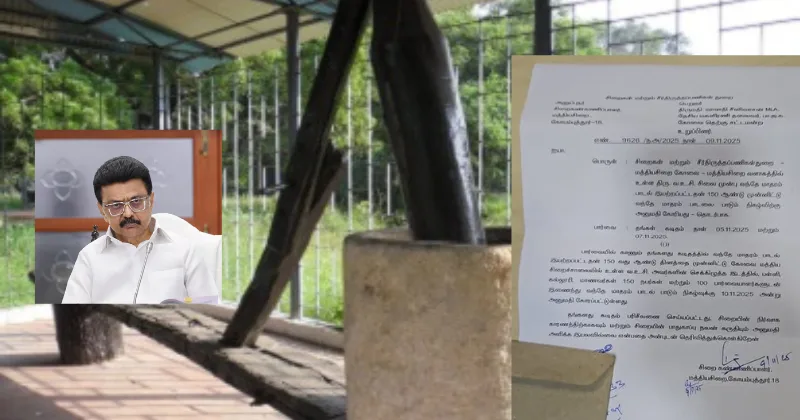
The Dravidian stock DMK government has once again courted controversy by denying permission to sing Vande Mataram at Coimbatore Central Prison, drawing sharp criticism from various quarters for its perceived anti-national stance.
The Coimbatore prison authorities, in a letter to BJP’s National President of the Mahila Wing and Coimbatore MLA Vanathi Srinivasan, stated that due to “administrative and security reasons”, they could not allow the singing of Vande Mataram inside the prison premises. The BJP had sought permission to conduct the programme on 10 November to mark the 150th anniversary of India’s National Song, with 150 students and 100 visitors expected to participate.
It is significant to note that the Coimbatore Central Prison houses the historic manual oil press (chekku in Tamil) once used by freedom fighter V.O. Chidambaram Pillai, who was imprisoned there by the British. During his incarceration, he was subjected to hard labour, forced to operate the oil press manually, a task usually done by bulls, earning him the revered title Sekkizhutha Semmal (scholarly gentry oil press puller).
The jail superintendent’s letter dated November 9 cited the usual reasons for refusal. Vanathi Srinivasan, taking to social media platform X, criticised the decision: “The @arivalayam government has denied permission for Vande Mataram to be sung by 150 students in front of V.O. Chidambaram Pillai’s statue at Coimbatore Central Prison, citing ‘administrative’ and ‘security’ reasons. This clearly demonstrates how little respect this government seems to have for India’s national pride.”
She added, “No valid reason has been given for the refusal. What exact security threat does a group of students singing the national song pose? Tamil Nadu deserves a government that honours the spirit of Vande Mataram, not one that suppresses it under flimsy pretexts.”
The @arivalayam government has denied permission for Vande Mataram to be sung by 150 students infront of V.O.Chidambaram Pillai statue at the Coimbatore Central Prison, citing ‘administrative’ and ‘security’ reasons. This is a telling decision which clearly demonstrates how… pic.twitter.com/1O43LwT6hN
— Vanathi Srinivasan (@VanathiBJP) November 9, 2025
A netizen responding to her post wrote, “For anything and everything, we have to visit courts. This is the fascist government’s last rule. They will be slippered in 2026 for sure! #DMKFailsTN #ByeByeStalin.”
150 Years of Vande Mataram: The Song That United a Nation
This year, 7 November 2025, marks the 150th anniversary of India’s National Song, Vande Mataram, meaning “Mother, I Bow to Thee.” The composition by Bankim Chandra Chatterjee was first published in the literary journal Bangadarshan in 1875 and later featured in his celebrated novel Anandamath (1882). Set to music by Rabindranath Tagore, it became a timeless anthem of Bharat’s struggle for freedom and continues to symbolise national unity and sacrifice.
The Central government has planned a year-long programme to commemorate this milestone. States like Uttar Pradesh have made singing Vande Mataram compulsory in schools and colleges as a mark of respect. However, in Tamil Nadu, the DMK government, true to its so-called Dravidian model, has shown no such sentiment.
When the entire nation celebrated Azadi Ka Amrit Mahotsav to mark 75 years of Independence, the Tamil Nadu government denied permission for Tiranga rallies, citing routes passing through “minority-dominated areas.” Similarly, police prevented BJP workers from hoisting the national flag in a fishing hamlet near Chennai, arrested participants, disallowed the screening of PM Modi’s Mann Ki Baat, and obstructed events such as RSS route marches, Vinayagar Chaturthi celebrations, and the Ayodhya Mandir inauguration live telecast even defying Supreme Court and High Court orders.
Another Temple Row in Salem
In another incident, the Hindu Religious and Charitable Endowments (HR & CE) Department denied permission to play Kailasa musical instruments inside the famous Sugavaneswarar Temple in Salem. Devotees say these instruments such as the damaru, Rudra Veena, and traditional pipes are part of ancient Agamic rituals meant to please Bhagwan Siva.
Authorities reportedly cited “noise pollution” as the reason, permitting their use only in the outer mantap, not in front of the sanctum sanctorum. Local devotees expressed outrage, calling it an act with an ulterior motive.
They questioned, “If noise pollution is the reason, why not remove loudspeakers from mosques that blare five times a day? Why target Hindu temples alone? During Diwali, we were restricted from bursting firecrackers for ‘pollution’, but the same rule was silent during Christmas, New Year, or political celebrations. Do crackers cause pollution only during Hindu festivals?”










Comments