





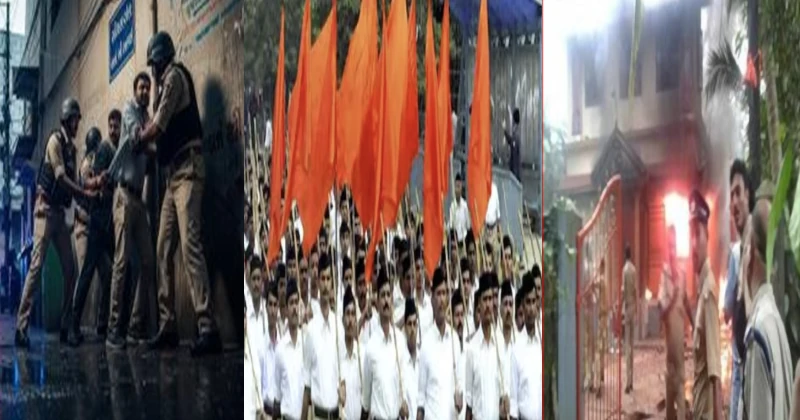
For over 36 years, the Rashtriya Swayamsevak Sangh (RSS) has stood as the ideological and cultural backbone of Bharat, nurturing nationalism, discipline, and unity across generations. But this very influence has made it a prime target of Islamist terror networks operating from within and outside India. From the brutal massacre of swayamsevaks in Punjab in 1989 to the ISIS-linked plot foiled in 2025, the RSS has faced repeated, coordinated, and ideologically motivated assaults. These attacks, executed or inspired by Pakistan-based terror outfits and their Indian affiliates, reveal a sustained jihadist campaign aimed at weakening the Hindu nationalist movement at its roots.
ISIS terror network unmasked: Lucknow RSS office among targets (November, 2025)
On November 10, 2025, the Gujarat Anti-Terrorism Squad (ATS) unearthed a chilling ISIS-linked conspiracy to attack the RSS office in Lucknow and Delhi’s Azadpur Mandi. The operation led to the arrest of three radicalised individuals Dr. Ahmad Mohiuddin Sayed from Hyderabad, and Azad Suleman Sheikh and Mohammad Suhail from Uttar Pradesh.
According to investigators, the trio had travelled across Lucknow, Ahmedabad, and Delhi, conducting reconnaissance of RSS buildings and crowded markets. They planned to carry out synchronised bombings inspired by ISIS doctrine, aiming to “punish” institutions perceived as the backbone of Hindu identity.
Preliminary questioning revealed that Dr. Sayed, a medical professional, was the group’s recruiter, radicalised through encrypted Telegram channels operated by ISIS handlers abroad. The ATS seized incriminating electronic evidence showing communications about “RSS offices as priority targets”.
JeM operative plots attack on RSS HQ, Nagpur (March, 2025)
On March 21 2025, in Nagpur, Maharashtra, the Bombay High Court denied bail to Rais Ahmad Sheikh Asadullah Sheikh, a Jaish-e-Mohammed (JeM) operative from Jammu & Kashmir who had conducted surveillance of the RSS Headquarters and Dr. Hedgewar Memorial at Reshimbagh.
Arrested in 2021, Rais Ahmad was caught passing geotagged photographs of the RSS HQ to Pakistani handlers. Intelligence agencies later linked him to a broader JeM plan to attack ideological symbols across India, including RSS offices, Hindu temples, and political gatherings.
The court, while rejecting his bail, observed that his acts were not isolated but part of a transnational terror network orchestrated from Pakistan, highlighting how deeply Islamist groups fixate on the RSS as a strategic and ideological target.
Islamist attackers hurl petrol bomb at RSS office in Kerala (September, 2022)
Kerala ,often described as the political frontline between the RSS and radical Islamist outfits, witnessed yet another attack when two unidentified men on a motorbike hurled a petrol bomb at the RSS office in Kannur on September 23, 2022. The incident coincided with violent protests across the state following the arrest of Popular Front of India (PFI) leaders by the NIA.
The explosion shattered windows but, by fortune, no lives were lost. Police sources later confirmed that the timing and modus operandi matched PFI retaliation tactics, designed to create fear among Hindu activists and disrupt Sangh activities in the region.
Kannur has long been a hotspot where Left-wing and Islamist extremists have targeted RSS offices, often working through local networks to execute politically motivated assaults.
Jaish-e-Mohammed reconnaissance at RSS HQ (January, 2022)
On January 7, 2022, the RSS headquarters in Nagpur, Maharashtra was placed under heightened security after intelligence reports confirmed that Jaish-e-Mohammed operatives had conducted reconnaissance of the complex. This development came shortly after the arrest of several JeM-linked suspects in Jammu who had confessed to plans for a “symbolic strike” on the RSS a direct order traced back to handlers in Pakistan’s Bahawalpur region.
Officials said the RSS HQ remained a perennial target for Islamist networks, as it represented the ideological seat of the nationalist movement that challenges radical Islamism.
Mastermind of Nagpur RSS attack killed in Pakistan (2006)
Razaullah Nizamani Khalid alias Abu Saifullah Khalid, the Lashkar-e-Taiba (LeT) commander who masterminded the 2006 RSS HQ attack, was shot dead in Sindh, Pakistan. Khalid, a senior LeT operative, had long operated under multiple aliases while coordinating cross-border terror strikes against Hindu organisations. He was also linked to the 2005 IISc Bengaluru and 2008 CRPF Rampur attacks.
Indian agencies confirmed that the 2006 Nagpur attack was foiled due to alert RSS guards and police action. The plan was to storm the premises with automatic rifles and explosives. Khalid’s elimination in Pakistan, reportedly by rival factions, closed one chapter in a decades-long jihad against the RSS.
RDX explosion kills 11 in RSS Tamil Nadu HQ (Tamil Nadu, 1993)
At 2:30 PM on August 8, 1993, in Chetpet, Chennai, Tamil Nadu, an RDX-laden explosive device tore through the RSS Tamil Nadu headquarters during the annual Guru Pooja function. The explosion instantly killed 11 people, including 8 RSS pracharaks, and injured many others.
The attackers linked to Islamist terror outfits with networks extending into Sri Lanka targeted the event to cause maximum casualties among the state’s leading swayamsevaks.
Subsequent investigations revealed the bomb’s components were identical to explosives used in Pakistan-trained modules, and the plot was part of a series of attacks aimed at Hindu nationalist and cultural institutions. The Chetpet blast remains one of the deadliest assaults on the RSS, exposing the deep-rooted jihadist networks that had infiltrated Tamil Nadu in the 1990s.
Moga Massacre: 25 Swayamsevaks martyred (1989)
On June 25, 1989, the RSS bore one of its heaviest losses when armed Islamist terrorists attacked a morning shakha in Moga, Punjab, killing 25 swayamsevaks and civilians. The attackers, shouting separatist slogans, demanded the RSS flag be lowered. When the swayamsevaks refused, they opened indiscriminate automatic fire.
Despite the carnage, the Sangh held its shakha again at the same location the very next day a remarkable act of courage that came to symbolise Punjab’s revival of Hindu–Sikh solidarity during the height of Khalistani terrorism.
The site is now known as Shaheedi Park, an enduring reminder of those who laid down their lives to keep the saffron flag flying high.
Recurring Islamist assaults on RSS offices (2017–2024)
While major jihadist plots drew national attention, smaller-scale assaults continued in several states:
Bhind Grenade Scare: Plot to Instill Panic in Madhya Pradesh (February, 2024)
On February 24, 2024, a major security scare unfolded when police recovered a hand grenade from the RSS office premises in Bhind, Madhya Pradesh, near the flag post late at night. Acting swiftly on a tip-off, the police, accompanied by a dog squad and bomb disposal unit, secured the site and defused the explosive.
Authorities confirmed that the grenade estimated to be 30–35 years old and rusted appeared to have been thrown to create panic rather than cause mass destruction. The RSS office was vacant that night as most workers were attending a meeting in Indore. The incident drew immediate attention from local MLA Narendra Singh Kushwaha and Superintendent of Police Dr. Asit Yadav, both of whom rushed to the scene as investigators launched a probe into potential extremist links.
While the grenade’s age suggested it was an old device, its deliberate placement near the RSS flag post signaled a symbolic act an attempt to threaten and unsettle an institution long viewed by radicals as the ideological bedrock of Bharat’s cultural nationalism.
Stone-pelting and power cuts: RSS office attacked in Sehore (December, 2023)
Just two months earlier, on December 29, 2023, unidentified miscreants cut off electricity and pelted stones at the RSS office near the Siwan River in Sehore, Madhya Pradesh, around midnight. The sudden blackout followed by stone pelting was clearly designed to instill fear among the swayamsevaks present inside.
Police under Kotwali station in-charge Vikas Khichi launched an investigation, assuring strict legal action against the perpetrators. Local leaders such as Vishwa Hindu Parishad district president Jagdish Kushwaha alleged that the attack was not random but aimed at disrupting Sangh operations and intimidating volunteers. The assault came amid heightened communal tensions and was seen as part of a broader trend of targeting nationalist organisations across Madhya Pradesh.
Armed attack on RSS Office in Meerut, Uttar Pradesh (August, 2023)
On August 27, 2023, violence struck the RSS office in Shastri Nagar, Meerut, when two assailants arrived in a Creta car, broke the door, and assaulted three swayamsevaks inside. The attackers brandished a pistol, threatening to shoot the workers before being overpowered and handed over to police.
The Medical Station Police arrested both attackers and seized the weapon used in the assault. According to Neeraj Kumar, caretaker of the Lohia Nagar RSS office, the victims Hrithik, Satyam, and Himanshu were sleeping when the assailants broke in, demanding to know about senior Sangh functionaries. The attackers’ intent was clearly to terrorize the cadre and desecrate the space symbolic of nationalist resistance in western Uttar Pradesh.
Rae Bareli office vandalised and set on fire (August, 2023)
Barely weeks before the Meerut assault, on August 3, 2023, the RSS office in Rae Bareli city, Uttar Pradesh, was attacked by a group of unruly elements. The mob vandalized the office, beat up a student, and set two LPG cylinders on fire, causing significant damage.
The violence erupted late at night in the Kotwali area near the Gandhi Dharamshala Railway Station, with the attackers reportedly searching for the district campaigner before targeting the student, Lalit, who was present at the time. The incident caused outrage among local supporters, prompting the intervention of Development Minister Mahendra Singh, who directed police to ensure swift arrests.
Police detained 12 individuals for questioning, while the RSS and BJP leadership condemned the attack as an organised act meant to demoralise volunteers and obstruct cultural and nationalist activities in the region.
Kerala: Epicentre of bomb and arson attacks on RSS offices
Kerala, long known as a flashpoint between the RSS and radical political elements, remains the most volatile region for Sangh offices. Multiple incidents between 2017 and 2022 reveal a consistent pattern of targeted violence, primarily in Kannur district often described as the ideological battleground between nationalist and leftist-Islamist forces.
- Payyannur Blast, 2022: On July 12, 2022, a bomb was hurled at the RSS office in Payyannur, shattering window panes and damaging doors. CCTV footage captured two motorcycle-borne assailants conducting reconnaissance before the blast. While no injuries were reported, police suspected the attack was intended to intimidate local Sangh functionaries amid escalating political tensions.
- Kannur Bomb Attack, 2017: Earlier, on November 8, 2017, the RSS office in Koothuparamba, Kannur, was targeted with steel bombs allegedly by CPI(M) workers. The assailants vandalised both the office and a nearby Sree Narayana Guru temple, desecrating portraits of Hindu icons before fleeing. The Sangh immediately called for a dawn-to-dusk hartal, denouncing the attack as an act of ideological and religious intolerance.
- RSS Office Set Ablaze, 2017: On July 11, 2017, the RSS office in Payyannur’s Perumba locality was vandalised and set on fire, allegedly by CPI(M) workers. The office was completely destroyed, and even the nearby BJP office was damaged. This incident followed political clashes involving senior CPI(M) leaders and was widely seen as retaliation against rising nationalist presence in the region.
- Crude Bomb Blast in Nadapuram, 2017: In March 2017, a crude bomb blast at the RSS office in Nadapuram injured four workers. The assailants, who remain unidentified, fled after the explosion. The attack came hours after a controversial statement by an RSS functionary in Madhya Pradesh, hinting at possible pre-planned retaliation by local extremist groups.
Over three decades, these attacks form a consistent chain of Islamist aggression, motivated by ideological hatred toward the RSS’s Hindu nationalist philosophy. Pakistan-based groups like Lashkar-e-Taiba, Jaish-e-Mohammed, and ISIS-linked operatives have repeatedly plotted to attack RSS offices, viewing them as symbolic strongholds of Bharat’s resurgence.
Within India, radical Islamist fronts such as the banned Popular Front of India (PFI) and smaller jihadist cells in Kerala, Uttar Pradesh, and Tamil Nadu have adopted the same playbook reconnaissance, low-intensity explosives, and symbolic targeting to intimidate swayamsevaks.















Comments