





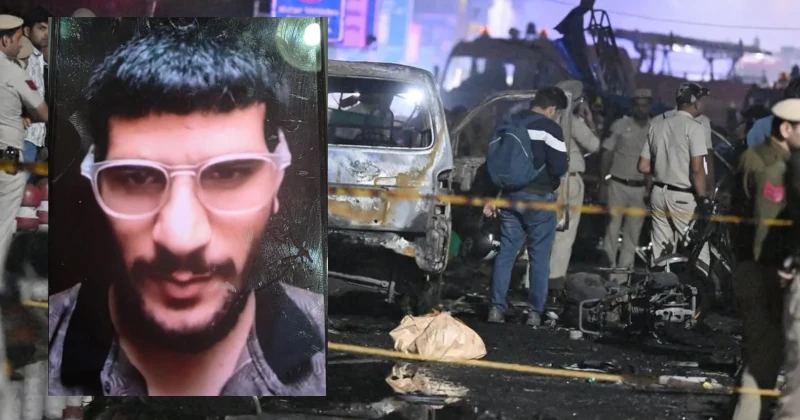
The evening calm of Delhi’s historic Red Fort stretch was shattered on November 10, when a white Hyundai i20 turned into a blazing inferno, killing twelve and injuring over two dozen people. The explosion, one of the most devastating in the capital since the 2011 High Court blast, has exposed what investigators now call a “carefully choreographed act of terror with chilling precision.”
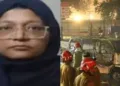
As the charred remains of vehicles were cleared from Subhash Marg on November 11 morning, security agencies zeroed in on a face that may hold the key to the entire plot Dr Umar, a medical practitioner turned suspected terrorist. His image, retrieved from CCTV footage moments before the explosion, now dominates every investigative briefing, marking him as the central figure in a terror network that may extend from Faridabad to Pulwama.
At 6:52 pm, the narrow, crowded stretch near Red Fort Metro Station Gate No. 1 was choked with evening traffic office commuters, tourists, rickshaws, and vendors. Amid the chaos, a white Hyundai i20 bearing registration number HR 26CE 7674 rolled to a stop at the Subhash Marg traffic signal.
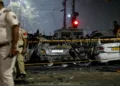
In seconds, a massive blast ripped through the vehicle, engulfing nearby cars, motorcycles, and e-rickshaws in flames. The explosion was so intense that windows shattered nearly 500 metres away, including those near the historic Sis Ganj Gurdwara. Within moments, thick black smoke and screams filled the air. Eyewitnesses described scenes reminiscent of a war zone flames leaping skyward, twisted metal strewn across the road, and bodies lying amidst burning debris.
Fire officials received the first SOS at 6:55 pm and rushed seven fire tenders to the site. It took two hours to douse the flames. Among the charred remains, investigators found traces of ammonium nitrate, fuel oil, and detonator fragments the signature components of a planned explosion.
Hours later, when investigators pieced together CCTV footage from the area, they found a disturbing clue. The Hyundai i20 had entered the Red Fort parking lot at 3:19 pm and remained there for over three hours before it began to move again around 6:48 pm moments before the blast.
Inside the car was a man in a blue-and-black T-shirt, his left hand resting casually on the window. Facial recognition systems identified him as Dr Umar, a 38-year-old physician last known to be working at a private clinic in South Delhi.
But Umar was not just a doctor he was also a person of interest in a 2023 explosives seizure case in Faridabad, where investigators had discovered detonators, ammonium nitrate, and remote circuitry in a rented flat linked to a suspected sleeper cell.
The Faridabad Police had on November 10 morning busted a suspected terror module near Dhauj Police Station limits, arresting two individuals and recovering explosive material identical to what was later found at the Red Fort site. The timing is chilling the Faridabad operation happened barely eight hours before the Delhi blast.
Sources within the NIA confirmed that Umar’s Hyundai i20 was registered to a Gurgaon resident named Salman, later sold to a Tariq from Pulwama, J&K. Tariq’s name had appeared in intelligence dossiers as a courier for a banned terrorist organisation operating under proxy networks in North India.
This revelation has led investigators to suspect that the Red Fort explosion was part of a larger coordinated plot, possibly designed to mirror the fidayeen-style attacks seen in Kashmir, but executed in the heart of the national capital.
A senior NIA officer said, “The sequence the sale of the car, its re-registration, and the movement pattern indicates deliberate planning. This was not an accident, not an act of desperation. It was an operation designed to cause maximum civilian casualties and terror impact.”
Even as investigators tighten their net, the family of the suspect has surfaced with an emotional plea. Naseema, the mother of Dr Umar and Dr Muzammil, told reporters, “He left home four years ago to work as a doctor in Delhi. We had no contact with him. When he was arrested, we came to know from others. Now both my sons have been detained. I just want them to be released.”
Her words, though filled with anguish, contrast sharply with the evidence emerging from the blast site and the Faridabad module. Both sons are reportedly under interrogation by Delhi Police and NIA, with forensic teams matching chemical traces from the seized material to the residues found in the exploded Hyundai i20.
Officials say that Dr Umar’s medical background may have given him the technical knowledge to handle explosive substances with precision a chilling reminder of how educated individuals have been co-opted into terror networks in recent years.
Following the explosion, Union Home Minister Amit Shah chaired an emergency security review meeting on November 11. Top officials from the NIA, NSG, Delhi Police Special Cell, Intelligence Bureau, and Forensic Science Laboratory were present.
Amit Shah stated, “All possibilities are being explored. The investigation is multi-layered and involves several agencies. We will uncover every link behind this conspiracy.”
Prime Minister Narendra Modi, speaking from Bhutan, echoed this resolve, “The conspirators behind this attack will not be spared. I was in touch with agencies through the night. India will bring all those responsible to justice.”
Following directives from the Home Ministry, Delhi, Mumbai, Bengaluru, and Hyderabad were placed on high alert. Security forces intensified inspections at transport hubs, metro stations, and religious sites. The CISF tightened surveillance at airports and government installations, while Delhi Police sealed off Chandni Chowk, Daryaganj, and Red Fort zones for forensic sweeps.
The US Embassy also issued a travel advisory urging its citizens to avoid the Red Fort area and remain alert in tourist-heavy zones, signalling the global reverberation of the blast.
Forensic teams recovered fragments of ammonium nitrate crystals, metal shrapnel, and wiring suggestive of a remote triggering mechanism. The explosion pattern a concentrated detonation from the rear side of the Hyundai i20 suggests pre-placement of an explosive device rather than an accidental fire.
According to an NSG source, the blast velocity and the nature of damage indicate that the charge may have been remotely triggered, possibly via a mobile signal jammer circuit. The near-simultaneous ignition of fuel vapours and detonation charge caused the devastating fireball effect.
Investigators are also examining the possibility that the driver may have been unaware of the timed detonator, suggesting the use of a “sacrificial courier” tactic seen in cross-border terror operations.
The Pulwama link has intensified scrutiny on J&K-based sleeper cells that may have revived old logistical routes into North India. The timing coming amid heightened security ahead of the winter session of Parliament and the use of ammonium nitrate mirror earlier patterns seen in 2011 Delhi HC blast and 2019 Pulwama suicide bombing.










Comments