





“Strong, fearless, resolute —when the sun sets, and the game is done, thou shalt know well, little one, that I, Kali, the giver of manhood, the giver of womanhood, and the withholder of victory, am thy Mother.” – Bhagini Nivedita, The Voice of the Mother, The Complete Works of Sister Nivedita – Vol. 1, Ramakrishna Sarda Mission, Calcutta, 1967, p. 502
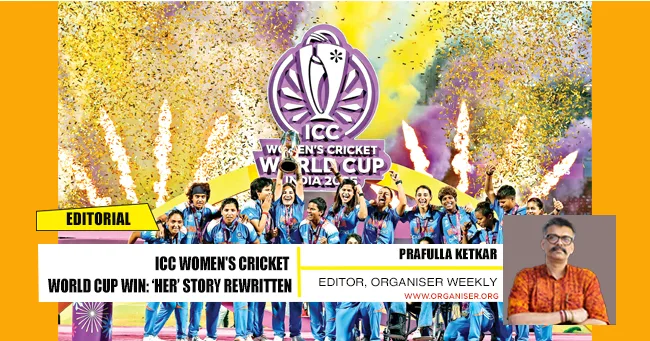
It is just a game of cricket. It is just another victory for a team of a few women from Bharat over a team of women from other countries. Why is the Women’s Cricket Team of Bharat becoming champion in the ICC Womens’s Cricket World Cup being celebrated like a national victory? Is it just about some players? What do they signify? Is there any message for all of us as a nation?
Women’s sports did not have much fan-following in Bharat a few years ago.. Even though the Women’s Hockey team sometimes invoked national emotions, they cannot match the spirit and sentiments that cricket carries in Bharat. This World Cup, organised on the soil of Bharat along with Sri Lanka as co-host for a few matches, was different in many ways. In the last few years, the Women’s Premier League, modelled after the IPL, has provided opportunities for girls from different parts of Bharat to participate in competitive sports, breaking the shackles. The 2025 World Cup first resonated with the names of Harmanpreet and Smriti Mandhana, Kranti Gaud and Sree Charini, inspiring many to follow women’s cricket. Women in blue received attention for the first time, almost on par with the men in blue. In the country, where cricket is a religion, people found Goddesses on the ground to follow along with their God like heroes.
The process was not accidental. The women’s World Cup started in 1973, two years before the inauguration of the first men’s World Cup. In the same year, the Women’s Cricket Association of India was also formed. The Bharatiya women’s team has been participating in the cricket World Cup since 1976, even though their test debut occurred in 1976 itself. When cricket was viewed more as a gentleman’s game and making sports a profession was considered taboo, icons like Diana Eduji, Shantha Rangaswamy, Shubhangi Kulkarni, and, in recent times, Anjum Chopra, Mithali Raj, and Jhulan Goswami broke through the barriers and created a legacy. Harmanpreet and her teammates decided to build on that legacy. Of course, initiatives by the Board of Control for Cricket in India (BCCI) to promote women’s cricket, and the Government of Bharat generally being proactive about promoting the sporting culture across regions, irrespective of gender, certainly helped the team. Beyond that, the team has shown remarkable character and passion that made all the difference.
All these girls came from different regions of Bharat, but they shared common factors that bound them – a humble background and a passion for playing for the nation. Like any professional sports person, individual ambitions are there, but their struggle to reach that level, overcoming all odds, made them an inspiration to ordinary people. They represent the aspirational Bharat that wants to prove itself amidst odds, hence the celebration.
In any team game, developing the spirit of companionship with a sense of trust and interdependence is of utmost importance. The team-building process that the head coach Amol Muzumdar, and Captain Harmanpreet Kaur had evolved over two years was not an easy task. The team members were ready to celebrate each other’s successes and stand together, even in the face of adversity and failure. Playing to each other’s strengths and overcoming individual weaknesses is what constitutes a great team. Women in blue exemplified that spirit with a rare sense of reciprocity. Again, a lesson for us as a nation, where collective work with a consistent, disciplined approach towards a desired goal has to be part of our national character as envisioned by our freedom fighters. By defeating England in England in July 2025 during the T20 series and then thrashing mighty teams like Australia and South Africa in the semi-final and final, respectively, the women’s cricket team has displayed a new character for the aspirational youth, especially girls. Not that the other teams did not have good individual players, but as a team with mental strength and zeal to be victorious proved to be better on the decisive days.
While doing so, these young girls did not lose their Bharatiyata. They were grateful to their families and coaches. They expressed their emotions by crying, even after being victorious, as a sign of strength, not weakness. The resolute and hardworking girls have great opportunities in resurgent Bharat. The victory of the cricket team symbolises that spirit. Yes, it is just a game of cricket played by 11 players on the ground. However, the struggle, resolution, team spirit and passion of the entire unit guided by the right leader and composed coach has rewritten their inspirational story in the pages of Itihasa, which can be called ‘Her’Story, making the victory special and worth celebrating.
















Comments