





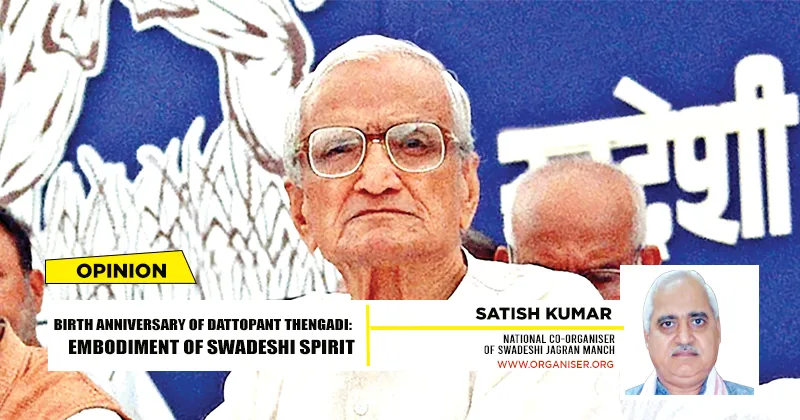
There is a Western saying: “It is impossible to find an organiser, a leader, and a philosopher—all in one person. If such a person exists, it is a rare event in history.” Indeed, this rare phenomenon occurred in Bharat, and that name is Dattopant Thengadi.
Born in 1920 in Arvi, Maharashtra, to advocate Bapu Rao Thengadi, Dattopant Ji embodied the perfect blend of these three qualities. He was a born leader. After completing his BA LLB in 1942, he became a pracharak (full-time worker) of the Rashtriya Swayamsevak Sangh (RSS). Because of his excellent command over English, he was first sent to Kerala, and after about two and a half years, to Bengal. Later, during the ban on the RSS, he returned to Nagpur.
After Independence, though Congress came to power, the ideological influence across Bharat was largely dominated by anti-national leftist forces. Slogans like “Laal kile par laal nishaan, maang raha mazdoor kisaan” (Red flag on the Red Fort, the worker and the farmer demand it) echoed not just in the labour sector but all over Bharat. Concerned about this, Shri Guruji Golwalkar, the second Sarsanghchalak of the RSS, decided that Dattopant Thengadi should work among labourers. Through the then Chief Minister of Madhya Pradesh, DP Mishra, he became active in the Congress labour union (INTUC) and later in the postal and telegraph workers’ union dominated by communists. There he studied how labour unions functioned, their strengths, and their weaknesses.


Finally, in 1955, during a meeting in Bhopal, he founded the Bharatiya Mazdoor Sangh (BMS) — based on tireless effort, far-sighted vision, organisational skill, and nation-first ideology. Today, the BMS stands as Bharat’s largest labour organisation. The same communists who once mocked it as a capitalist organisation have long since faded away.
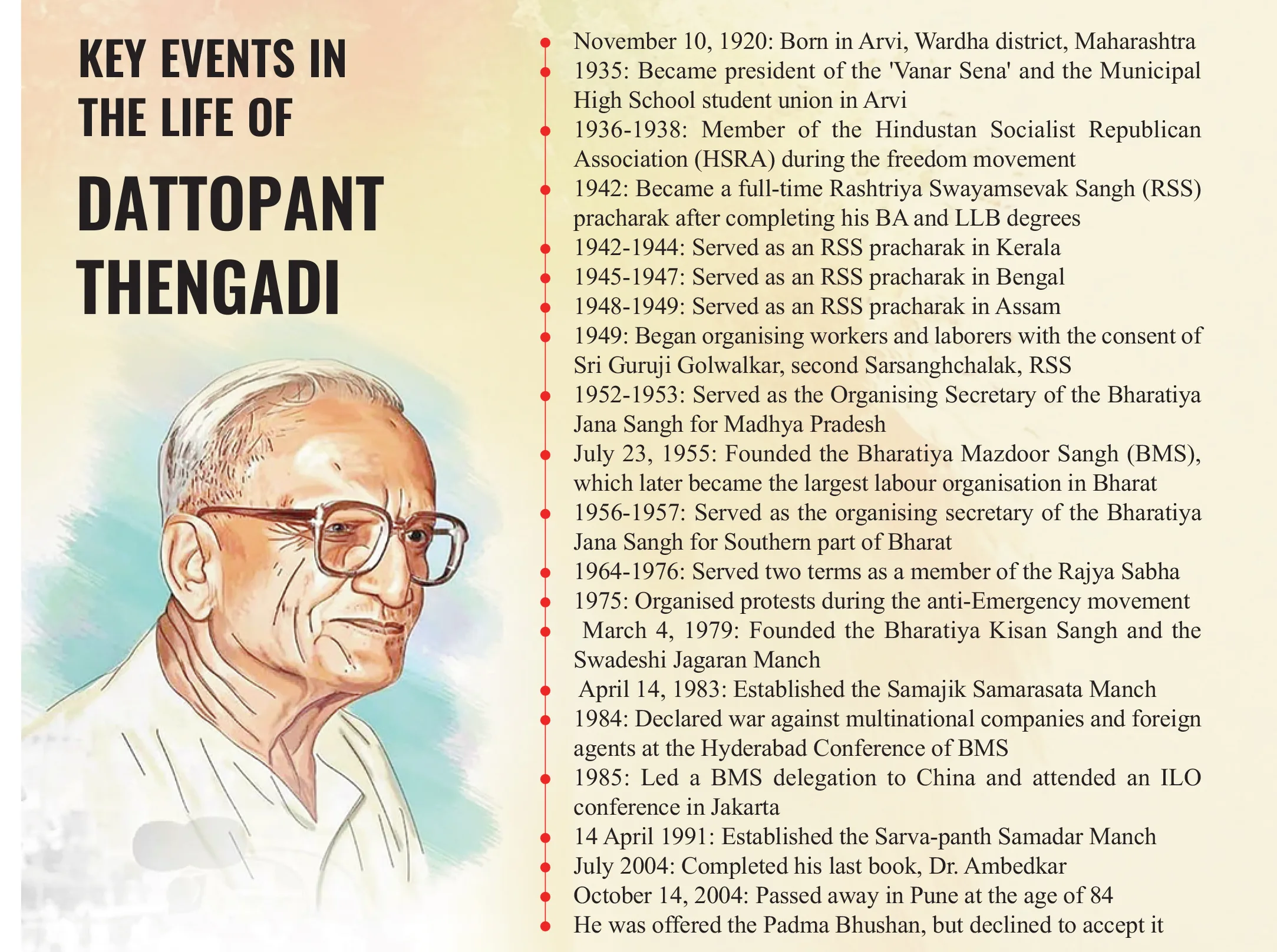
From 1964 to 1976, Thengadi Ji served two terms in the Rajya Sabha. There he became the leading voice of labour, nation-first, Hindutva, and Bharat. He deeply studied the economies of Russia, China, America, and capitalist countries, went there and held discussions and deliberations, and travelled across the world. His visit to China in 1979, and his talk broadcast on Chinese Radio, gained much recognition. Based on his deep analysis and experience, he had predicted as early as 1972–73 that the Soviet economy would collapse within 15–20 years. And everyone saw the prophecy come true in 1989–90 with the fall of the USSR.
Founded Organisations Of National Importance
Recognising that the farmer was Bharat’s largest social group, Thengadi founded the Bharatiya Kisan Sangh (BKS) in 1979 at Kota to organise farmers and address their problems. Today, the BKS is Bharat’s largest farmers’ organisation.
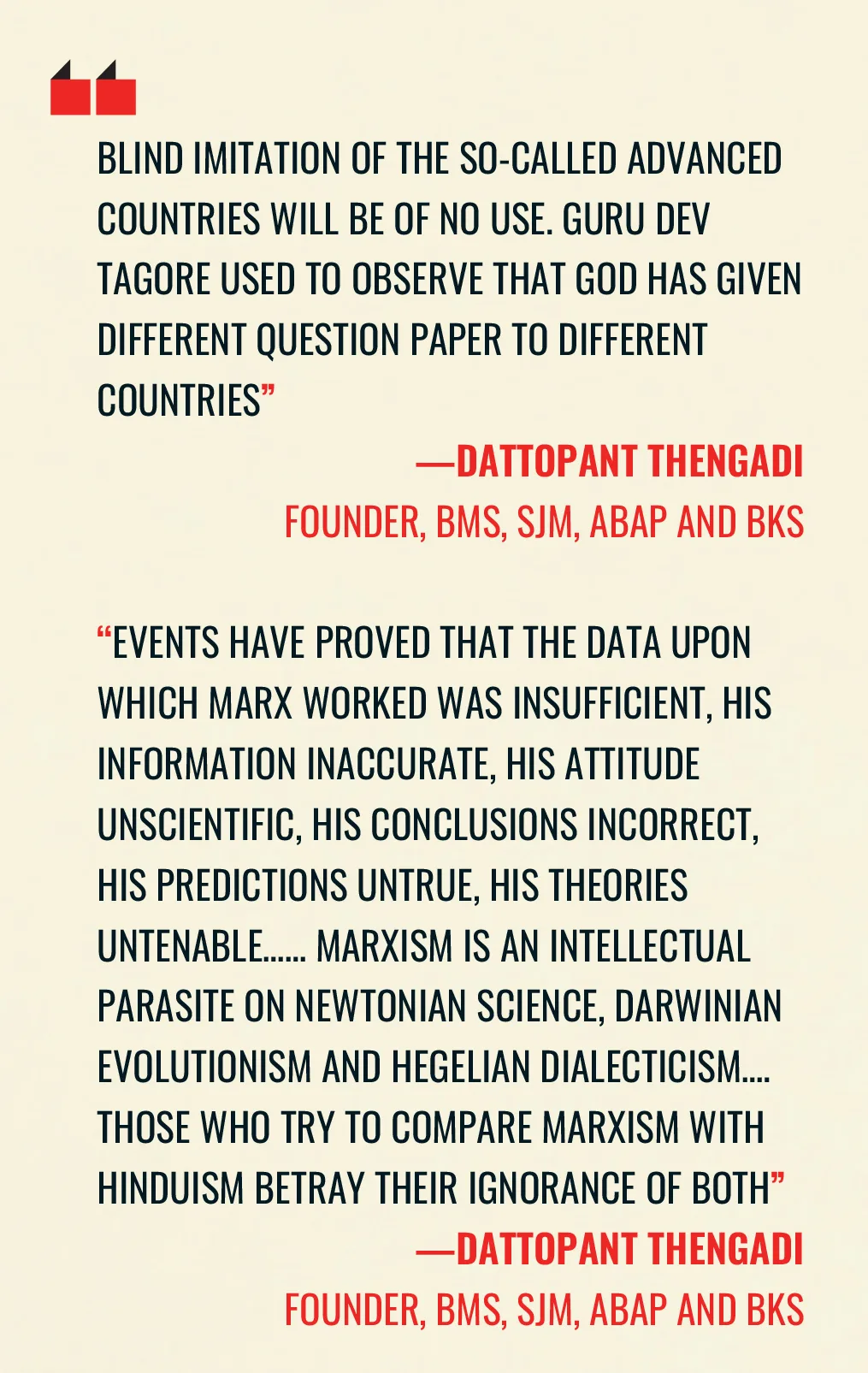
By 1983–84, he began to sense the coming wave of multinational corporations and Western capitalist policies that were starting to dominate the world. As a counter-response, he began calling for Swadeshi (self-reliance) through the platforms of BMS, BKS, and Akhil Bharatiya Vidyarthi Parishad to elevate Bharat on the foundation of Bharatiya thought of economy. Finally, on November 22, 1991, in Nagpur, he convened a meeting of economists led by Prof MG Bokare, the then Vice-Chancellor of Nagpur University and author of Hindu Economics, and founded the Swadeshi Jagaran Manch (SJM).
Today, the idea of Swadeshi has gained widespread acceptance. From the common man to the Prime Minister of Bharat, all are talking in favour of Swadeshi. But in 1991, Swadeshi was far from being an accepted idea. The global discourse was entirely centered on globalisation, dominated by the US and Western economies through the Dunkel Draft, GATT negotiations, and the creation of the WTO.
“Bharat should not rush to join the World Trade Organization. Instead, Bharat must build its economy on Bharatiya model of development,” called Thengadi Ji many times from the stage of SJM. When the whole world was running after globalisation and capitalist models, Thengadi Ji stood alone, firmly rooted in the ideology of Swadeshi.
Now, in 2025, we can see that what he had said 30–35 years ago is proving to be true. The very governments that once rejected his ideas are now embracing them.
From the US to Bharat, world leaders are echoing the call for Swadeshi.
The Philosopher In Him
Dattopant Thengadi Ji was a philosopher. He gave a contemporary interpretation of Deendayal Upadhyaya’s Ekatma Manav Darshan (Integral Humanism). In his speeches, he could simultaneously quote Omar Khayyam’s rubaiyat and Walter’s aphorisms, compare the organisational genius of Prophet Muhammad with that of an RSS pracharak, and cite Jesus Christ’s teachings alongside verses from Shri Krishna’s Gita. He could discuss the global economic future with deep insight and, at the same time, eloquently guide the karyakartas on the subtleties of building strong organisations.
In his book Karyakarta, while explaining the qualities of a true karyakarta, he quotes the Bhagavad Gita (18.26): “Muktasangonahamvadi dhrutyutsaahasamanvitah…” meaning — a true worker should rise above attachment of mine and yours, discrimination of high and low, and the dualities of success and failure, and remain steadfast in his duty. Only such a worker is truly sattvic (pure).
An Impeccable Foresight
In the 1990s, America—the loudest advocate of globalisation and liberalisation—created the World Trade Organisation (WTO). Yet today, the same America imposes tariffs on the world according to its will and as per their statements and lectures, expects the world economy to work in tandem. Thengadi Ji’s idea of Swadeshi is the Brahmastra (divine weapon) that can effectively get rid of this Western economic web. He assures us that Bharat can stand firmly on its own roots—its own resources, population strength, and indigenous technologies.
Bharat has now begun to rise rapidly. With a $4.2 trillion economy, it is the world’s fourth-largest economy, advancing swiftly in infrastructure, technology, and capital formation. Bharatiya railways, airports, ports, shipping, and especially the UPI digital payments system are being admired worldwide.Bharat possesses immense talent and the world’s largest demographic dividend—a population of 1.45 billion, which will remain a major strength for the next two decades. Bharat has to harness that Swadeshi strength to its maximum. This is the time to realise what Thengadi Ji envisioned since 1985. The Western philosopher Victor Hugo once said, “Nothing can stop an idea whose time has come.” In that spirit, we can say: “The time for Swadeshi has come in Bharat — and the time for Bharat has come in the world.”
On the 105th birth anniversary of Dattopant Thengadi Ji (November 10, 1920 –October 14, 2004), let us resolve to place the nation first, and to rebuild our economy, culture, family values, education, and social systems based on the principles of Swadeshi. By doing so, when Bharat celebrates 100 years of Independence in 2047, it will have become a prosperous and great nation—not only the world’s leading economy, but also a moral, familial and cultural guide for humanity.
At the foundation of that future Bharat will stand the philosophy of Pandit Deendayal Upadhyaya’s Integral Humanism, enriched and interpreted for our age by revered Dattopant Thengadi Ji. On his 105th Jayanti, the greatest tribute we can offer is to transform his vision of Swadeshi Bharat into a powerful national movement. Jai Swadeshi, Jai Bharat.

















Comments