





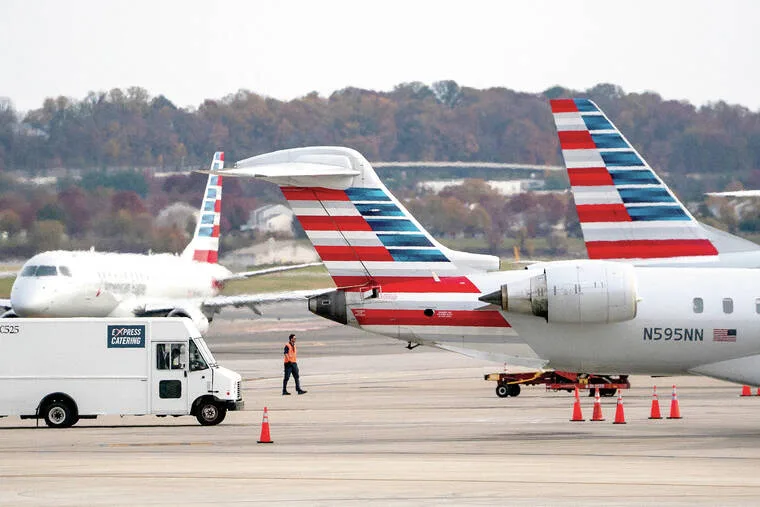
NEW YORK: More than 1,400 flights to, from, or within the United States were cancelled on November 8, after airlines were instructed earlier this week to curb traffic due to the ongoing federal government shutdown. Nearly 6,000 flights were delayed, a slight drop from the more than 7,000 delays recorded on November 7, data from FlightAware showed.
The Federal Aviation Administration (FAA) announced that it would be scaling back air travel capacity by up to 10 percent at 40 of the country’s busiest airports. The agency said air traffic controllers, who are compelled to work without pay throughout the shutdown, are reporting severe fatigue, absenteeism, and rising stress levels, raising concerns over aviation safety. Controllers are legally classified as essential workers and cannot stop reporting for duty, but many have reportedly fallen ill or taken second jobs simply to manage household expenses.
The shutdown began on 1 October and has now stretched into its 39th day, making it the longest in US history. Congress remains hopelessly divided, with Republicans and Democrats locked in a standoff over funding legislation to reopen the government. Senators remained in Washington through the weekend for bipartisan negotiations, but there was no immediate sign of a breakthrough. Meanwhile, the fallout is spreading across the country, from frozen public services to delayed food assistance payments and now crippling aviation disruptions. American Airlines issued a formal appeal urging lawmakers to resolve the crisis swiftly and restore normal operations. The airline said the shutdown was inflicting unnecessary damage on the nation’s transport infrastructure and its travelling public.
🚨 UPDATE: Over 800 flights already canceled today, major hubs & regional routes hit hard. @Delta over 170 flights cancelled @AmericanAir over 200 flights cancelled@united canceling up to 200 flights
3hr check-in delays due to unavailable TSA agents, controllers stretched… pic.twitter.com/WPa2xLnMAd
— Comfortably Broke (@MrMakinMoves) November 7, 2025
New Jersey’s Newark Liberty International Airport faced some of the most severe impacts. By Saturday afternoon, the FAA reported that inbound flights to Newark were arriving more than four hours behind schedule, while departures were delayed by an average of one-and-a-half hours. The situation was repeated across the US aviation system, turning terminals into crowded holding zones as passengers waited for aircraft and crew that never arrived. Charlotte Douglas International, Newark Liberty International, and Chicago O’Hare International recorded the highest number of cancelled flights on Saturday, according to FlightAware tracking. Delays also mounted at major hubs that departures to John F Kennedy International Airport were delayed nearly three hours on average, flights bound for Hartsfield-Jackson Atlanta International faced more than two-and-a-half-hour backlogs, and journeys to LaGuardia were running nearly an hour late.
The crisis is unfolding just weeks before the Thanksgiving holiday on November 27, traditionally one of the busiest travel periods in the United States. With millions of passengers expected to fly, both airlines and passengers fear that traffic restrictions, staff shortages, and weather uncertainties could push the system into chaos. The restrictions are not limited to commercial carriers. The FAA has also curbed private jet operations at high-traffic airports in an effort to prioritise essential passenger services. Officials said private aircraft can use smaller airfields so that strained air traffic control teams can focus on larger commercial aviation networks. The FAA indicated this was an unavoidable step given the limited workforce and rising fatigue among controllers.
Federal workforce crisis triggers security and safety fears at airports
And the situation is expected to deteriorate further. The FAA announced that flight capacity cuts would increase step by step throughout the coming week, up to 4 percent on Friday, rising to 6 percent by 11 November, 8 percent by 13 November, and finally reaching a full 10 percent reduction on 14 November. The agency stressed that these reductions are necessary to maintain aviation safety at a time when the workforce is stretched to its limit. Unions representing air traffic controllers have raised alarms that many employees are exhausted, financially strained, or unable to report to work. Controllers are not alone. Around 1.4 million federal workers are either reporting to duty without pay or have been placed on indefinite leave. The Transportation Security Administration (TSA) is among the hardest hit. The majority of its 64,000 agents are working without salaries, leading to concerns that security lines will lengthen dramatically and airport checkpoints may close. During the 2018 shutdown under President Donald Trump, nearly 10 percent of TSA staff chose to remain at home rather than continue working for free. Aviation experts warn that the current shutdown may create similar or even worse shortages.
As the funding stalemate drags on, the consequences have become a daily reality for ordinary Americans, from cancelled flights and airport gridlock to shrinking government services. With negotiations in Congress still stalled, the United States’ aviation network, once considered a model of global efficiency, is now showing alarming signs of strain. The country enters another week of uncertainty, while travellers, airlines, and federal employees brace for deeper disruption.











Comments