





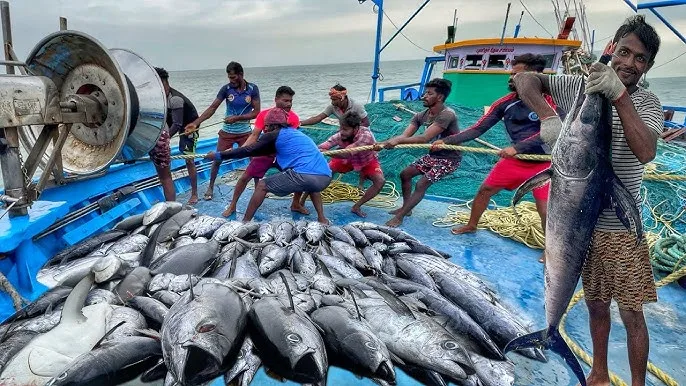
To strengthen India’s marine economy and protect its oceanic resources, the Government of India has notified the “Sustainable Harnessing of Fisheries in the Exclusive Economic Zone (EEZ) Rules, 2025”, aimed at promoting responsible deep-sea fishing, empowering coastal communities, and aligning India’s fisheries governance with global best practices. The rules, notified by the Ministry of Fisheries, Animal Husbandry & Dairying, mark a transformative step in the realisation of Prime Minister Narendra Modi’s vision of a prosperous and inclusive Blue Economy, announced in the Union Budget 2025–26.
The notification sets the stage for a comprehensive overhaul of India’s deep-sea fishing operations, with a focus on sustainable resource use, livelihood generation, technological modernisation, and national security.
Empowering small fishers and coastal cooperatives
At the heart of the new framework lies the government’s commitment to empowering small fishers, cooperatives, and Fish Farmer Producer Organisations (FFPOs). The rules ensure priority access to deep-sea fishing operations for these groups, giving them a level playing field against large commercial operators.
To enhance capacity and competitiveness, the Ministry will provide training, global exposure visits, and affordable credit facilities under flagship schemes such as the Pradhan Mantri Matsya Sampada Yojana (PMMSY) and the Fisheries and Aquaculture Infrastructure Development Fund (FIDF).
According to the Ministry, the reform will help integrate small fishers into value chains and encourage entrepreneurship within coastal communities. “These rules will not only help in sustainable exploitation of marine resources but also ensure that the benefits of deep-sea fishing reach the grassroots,” the Ministry noted.
Modernising India’s marine fisheries sector
The EEZ Rules 2025 are designed to modernise India’s marine fisheries through an integrated framework covering value addition, certification, and traceability. A central feature of this modernisation is the introduction of the “mother-and-child” vessel model, which enables mid-sea transhipment under Reserve Bank of India (RBI) regulations.
This model allows smaller fishing vessels (the “child” units) to transfer their catch to larger processing vessels (the “mother ships”) without returning to shore, reducing fuel costs, extending fishing duration, and improving efficiency.
Furthermore, the rules emphasise the development of fisheries management plans and species-specific legal minimum sizes to prevent overfishing and preserve biodiversity.
Focus on Islands and coastal ecosystems
The notification places a special emphasis on the Andaman & Nicobar and Lakshadweep Islands, which together account for nearly half of India’s EEZ area. These regions will be developed as strategic hubs for sustainable mariculture, seaweed cultivation, and sea-cage farming, creating new livelihood avenues for island communities.
By promoting ecosystem-based fisheries management, the rules aim to conserve marine biodiversity while generating green employment opportunities in coastal belts.
Ban on destructive fishing practices
Taking a firm stance on environmental protection, the government has banned destructive and non-selective fishing practices, including LED light fishing, pair trawling, and bull trawling. These methods, known for their adverse impact on juvenile fish populations and coral ecosystems, have long been under criticism from marine conservationists.
Instead, the new policy framework encourages eco-friendly mariculture activities such as sea-cage farming, mussel and oyster cultivation, and seaweed farming, which contribute to both nutritional security and coastal ecosystem balance.
Digital transformation through ReALCRaft Portal
In line with the government’s “Digital India” initiative, the EEZ Rules 2025 introduce a fully digital “Access Pass” system for mechanised and large motorised fishing vessels through the ReALCRaft portal. This digitised system will streamline licensing, tracking, and compliance while enhancing transparency in marine operations.
Importantly, traditional and small-scale fishers using motorised or non-motorised crafts have been exempted from the access pass requirement to prevent bureaucratic hurdles and safeguard their traditional fishing rights.
The portal has also been integrated with the Nabhmitra Application, developed by the Indian Space Research Organisation (ISRO), for real-time vessel tracking and communication — a feature that significantly enhances maritime safety and coordination between agencies such as the Indian Coast Guard and the Indian Navy.
Crackdown on illegal, unreported, and unregulated (IUU) fishing
One of the most crucial provisions under the new rules is the framing of a National Plan of Action to curb Illegal, Unreported, and Unregulated (IUU) Fishing. This initiative aims to combat transnational fishing crimes that threaten India’s maritime sovereignty, harm local livelihoods, and deplete fish stocks.
Under the new regime, foreign fishing vessels are completely prohibited from operating within India’s EEZ under any arrangement, closing loopholes that previously allowed foreign collaborations or joint ventures to exploit Indian waters.
The plan also envisions enhanced coordination between coastal states, the Coast Guard, and intelligence agencies to monitor suspicious maritime activity and protect India’s marine wealth.
To improve safety and security along India’s vast coastline, the rules mandate the use of transponders and QR-coded ID cards for both vessels and fishers. These security measures will help track vessel movement, assist in distress communication, and prevent cross-border infiltration under the guise of fishing activity.
Moreover, every catch will now be digitally traceable from net to market, ensuring transparency in the supply chain. The Ministry believes this traceability system will not only strengthen food safety and export credibility but also enhance India’s position in global seafood markets that increasingly demand sustainability certifications.
‘Indian-Origin’ recognition for EEZ catches
Addressing a long-standing demand from the fishing industry, the new notification clarifies that fish caught in India’s EEZ beyond the contiguous zone will now be recognised as “Indian origin” under customs norms. This means such catches will no longer be treated as imports when landed at Indian ports, reducing procedural delays and improving export competitiveness.
This clarification is expected to boost India’s seafood exports, which currently stand at over Rs 60,000 crore annually, by making deep-sea operations more profitable and globally compliant.
The notification of the EEZ Rules 2025 marks a significant step in India’s journey toward a sustainable and inclusive Blue Economy, a vision articulated by Prime Minister Modi as part of India’s long-term maritime strategy.
By integrating technology, community participation, and environmental responsibility, the reforms are expected to reshape the future of India’s fisheries sector, which supports over 50 lakh fishers and fish farmers across coastal states.
The Ministry emphasised that the initiative is not merely regulatory but developmental in nature, combining livelihood enhancement with ecological protection. “The rules will act as a bridge between tradition and technology, ensuring that India’s coastal communities thrive while marine resources remain sustainable for generations to come,” the statement said.
Balancing prosperity and sustainability
The Sustainable Harnessing of Fisheries in the EEZ Rules, 2025 are a comprehensive attempt to balance economic development with environmental conservation. With an integrated digital framework, strict surveillance against illegal fishing, and a strong focus on empowering small fishers, India is positioning itself as a responsible maritime nation.
By unlocking the vast potential of its Exclusive Economic Zone, which spans over 2 million square kilometres, India aims not only to boost seafood exports but also to lead the global conversation on sustainable ocean governance.













Comments