





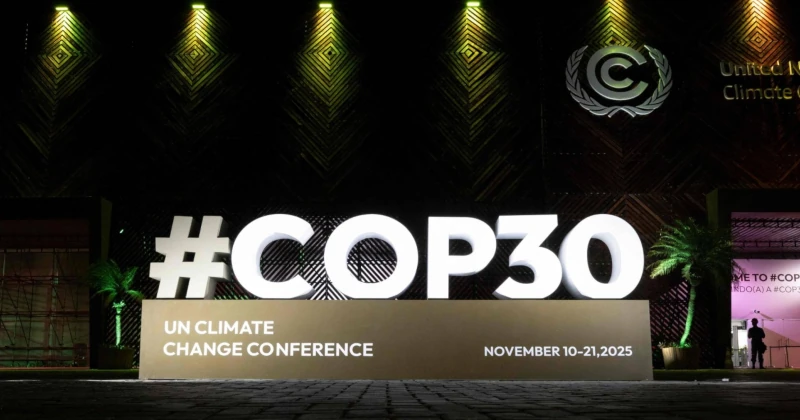
As the world prepares for the 30th Conference of Parties (COP30) to the United Nations Framework Convention on Climate Change (UNFCCC) in Belém, Brazil, the stage is set not merely for another climate summit but for a reckoning. For the first time, a COP will unfold deep in the Amazon, a living symbol of both the Earth’s resilience and its fragility. Ten years since the Paris Agreement, the moral and political contradictions of the global climate regime stand starker than ever.
Brazil, the host and the world’s fifth-largest emitter, has achieved its sharpest fall in greenhouse gas emissions in 16 years, a 17 per cent drop in 2024, thanks largely to reduced deforestation in the Amazon and Cerrado. Yet, in the same breath, it has expanded its oil frontiers. The paradox is emblematic of the global climate challenge: we celebrate reductions in emissions even as we perpetuate the systems that generate them.
The Disappointing Legacy of COP29
The last summit in Baku, Azerbaijan — COP29 — ended as many feared: high on rhetoric, low on resolve. Negotiations over the New Collective Quantified Goal (NCQG) on climate finance stumbled amid disagreements on what constitutes “new and additional” funding. Developed countries once again avoided concrete commitments, while the adaptation agenda, crucial for vulnerable nations, remained mired in technicalities.
For the developing world, this pattern of procrastination is becoming intolerable. Climate justice, promised in Paris, remains hostage to accounting tricks and shifting baselines. The $ 100 billion annual pledge by developed nations, due since 2020, has neither been met in full nor delivered transparently. Instead, loans masquerade as aid, and offsets replace genuine reductions in emissions.
Tropical Forests, Ethical Stocktakes, and the Mirage of Equity
Brazil’s flagship proposal the Tropical Forest Forever Fund aims to reward countries that preserve their tropical forests, creating a permanent multilateral facility rather than relying on short-term pledges. On paper, it’s an idea worth endorsing. But as environmental groups have cautioned, this commitment rings hollow if fossil expansion continues unabated.
Brazil’s own oil exports hit a record 85 million tonnes in 2024. The emissions from that oil released abroad are conveniently omitted from its national inventories. This selective accounting mirrors a larger hypocrisy in the global climate architecture: developing nations are asked to report, regulate, and reform, while the industrialised world continues to externalise its historical emissions.
India’s Moment in Belém: From Participant to Protagonist
For India, COP30 is not merely a forum; it’s a frontline. As one of the most vocal defenders of the Global South’s cause, India’s stance is rooted in principle common but differentiated responsibilities must not be reduced to mere rhetoric.
New Delhi supports Brazil’s push for long-term, predictable finance for forest-rich developing nations but with clarity: conservation cannot come at the cost of sovereignty, and climate responsibility cannot be divorced from equity. “Indicators and funding mechanisms must not penalise developing countries,” a senior Indian negotiator recently noted. “They should reflect national realities, capacity, and access to technology.”
India’s position at COP30 will centre on three fronts:
- Adaptation indicators: Opposing one-size-fits-all global metrics and pushing for flexibility, data sovereignty, and nationally determined parameters.
- Climate finance: Insisting on transparent, non-debt-creating, and predictable mechanisms under the NCQG framework.
- Technology access: Advocating for a global implementation programme that truly enables low-carbon transitions in the developing world.
- The American Contradiction: A Superpower in Denial
No discussion on global climate credibility is complete without examining the role and regression of the United States. Despite its technological prowess and rhetorical leadership, the U.S. continues to be a peculiar case of climate contradiction. Successive administrations have oscillated between bold pledges and policy backtracking, leaving the world uncertain about their intentions.
Domestically, fossil fuel subsidies remain among the highest in the OECD, while crude exports and new drilling permits have surged to record highs. Internationally, its resistance to making climate finance legally binding despite championing “global ambition” exposes a moral void in its leadership.
At a time when the world needs climate cohesion, America’s inward-looking energy policy and selective compliance have effectively stalled progress that took decades to negotiate. The world’s largest economy risks becoming the single greatest obstacle to the very multilateralism it once inspired.
Where Science Meets Ethics
Interestingly, Brazil’s idea of a Global Ethical Stocktake blending scientific review with moral reflection resonates strongly with India’s Mission LiFE (Lifestyle for Environment). Both initiatives aim to humanise climate discourse by grounding it in values, rather than just numbers. In essence, they remind the world that climate action is not only a policy choice but also a civilisational responsibility.
“This is where science meets ethics, and spirituality meets action,” as an Indian official aptly put it. The shared vision between India and Brazil could yet offer the world a new climate grammar one rooted in responsibility, restraint, and renewal.
A Decade Since Paris: The Implementation Reckoning
Ten years on, the Paris Agreement is facing its most severe test implementation. India has expanded its renewable energy capacity from 81 GW in 2014 to 236 GW today, despite limited finance and high technology costs. Brazil, despite achieving impressive emission reductions, remains off track to meet its 2025 Nationally Determined Contribution (NDC) target.
The larger lesson is clear: climate ambition without equitable implementation is a hollow pursuit. The Global South can no longer afford to be a laboratory for others’ climate experiments.
The Deepening Rift Between Developed and Developing Worlds
COP30 will likely reopen old wounds. Developed nations, led by the EU and the U.S., continue to frame the narrative around net-zero pathways and carbon markets. But for much of the developing world, these frameworks threaten to entrench economic dependency rather than liberate it.
The carbon market, touted as a win-win, often allows rich nations to buy their way out of responsibility. Adaptation funds, meanwhile, trickle down through intermediaries, bypassing those most affected. The problem is not the absence of mechanisms but the absence of justice within them.
Developed countries, having industrialised through fossil fuels for two centuries, now dictate decarbonisation targets to those still struggling to eradicate poverty. This hypocrisy is not just historical; it is structural. For many in the Global South, the green transition cannot come at the cost of growth, livelihoods, and developmental aspirations.
India’s Balancing Act: Pragmatism with Principle
India’s challenge at COP30 will be to balance pragmatism with principle to continue leading on renewables and sustainable lifestyles while upholding equity and differentiated responsibility. Its climate diplomacy must highlight that adaptation and resilience not just mitigation deserve equal attention and resources.
Moreover, India must push for reformed global climate accounting that includes consumption-based emissions, not just territorial ones. The developed world’s consumption patterns not merely its production are responsible for much of the atmospheric burden. A truly fair climate regime would account for that imbalance.
A Call for Climate Realism
As the Amazon readies to host the world’s climate negotiators, one question looms large: will COP30 deliver a credible roadmap for fair and inclusive implementation, or will it mark another chapter in the long chronicle of unmet promises?
If the developed world truly seeks to restore trust, it must start by acknowledging that sustainability cannot be outsourced. Equity is not a concession it is the cornerstone of climate success.
For India, the path is clear. It must continue to assert the moral and practical realities of the developing world, reminding the global community that climate justice is not charity, but the fulfilment of a long-overdue debt. Only when fairness becomes the foundation of climate action can the world move from rhetoric to redemption.













Comments