





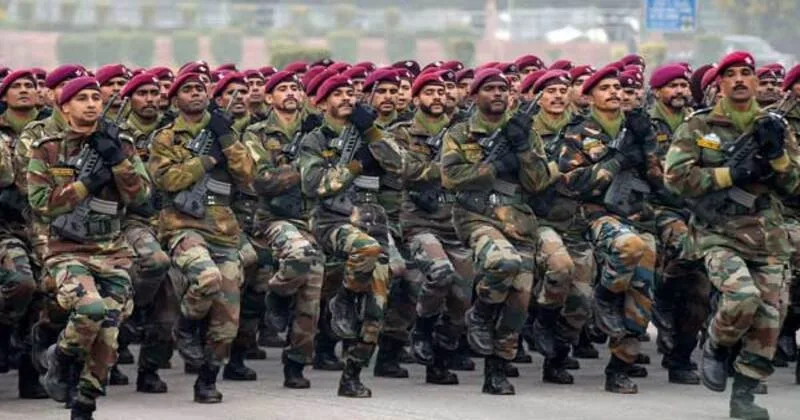
Rahul Gandhi, the leader of opposition (LOP) in Lok Sabha has made a disturbing remark during election campaign in Bihar claiming that country’s 10 per cent (referring to the upper castes) “hold control over the Army”. This statement is disgraceful and has dangerous portends to divide the Indian Army on caste lines. Indian Army prides itself to be totally apolitical and above the caste, which respects only the merit in a soldier and an officer. Having done two tenures in the Military Secretary Branch as also one tenure in Adjutant General Branch of the Army Headquarters, I will explain the intake, posting and promotion policy in the Indian Army.
Indian Army follows a most stringent intake process, be it for soldiers through Agnipath Scheme or the officer cadre, based on written examination, physical tests and medical checkup. Indian Army has a Recruiting Directorate which ensures that the intake in the Army is purely on merit. There is no quota for a particular caste. The intake is open to all able-bodied Indians and the intake process is most rigourous, fair and timebound. Lakhs of candidates apply and only those found meeting the laid down criteria are selected. The candidates who join have the sole passion to serve the motherland and nothing else matters to them. As Commandant of Officers Training Academy, Chennai from 2020-2022, I found cadets, both male and female, who continued to pursue selection for a career in the Army, even after more than 10 attempts. Surely, the remarks of the LOP are going to hurt the sentiments of such committed soldiers and officers.
The service career of a soldier offers an insight into the beauty of India that is Unity in Diversity. Each battalion or equivalent has soldiers and officers from all parts of the country. They pledge to serve the country as per the laid down constitutional duty. Once again, caste is taboo and only your professional skills take you to the next rank. In case of officers, the promotion structure is most fair where only the best rise, irrespective of their caste. In my service career, I have dealt with posting and promotion of officers and not even once there was a mention of a word called caste. It is not surprising therefore that officers of all communities including minorities have occupied senior leadership position in the Indian Army, purely on their professional competence.
Among all battle winning factors, leadership at the cutting edge remains the most important even today. Among the soldiers, a Havildar or equivalent commands a Section of 10 soldiers. A Junior Commissioned Officer (JCO) commands a Platoon of 30 soldiers. In many a battle, one Section or a Platoon or a Battalion has turned the tide with their sheer bravery and brought victory to the Indian Army. Once again, a Havildar or a JCO or an Officer commands respect of his subordinates because he leads from the front, many times making the supreme sacrifice in the cause of the nation. A battalion or equivalent remains a cohesive unit because all soldiers know that the best among them are leading them in the war and conflicts. Thus, meritocracy remains the sole criteria for the leadership role in the Indian Army.
The career progression of an officer in the Indian Army possibly is the toughest in India. Indian Army at present has approximately 42,000 commissioned officers against a sanctioned strength of approximately 50,000. This deficiency is because the recruitment process is so strict that the Army is ready to bear the deficiency, rather than select a wrong candidate. Each officer after commission joins a military unit and thereafter is put through varied tenures of combat experience in mountains, jungles, deserts etc. The officer cadre is assessed every year through a very detailed Annual Confidential Report (ACR). The officers also undergo specialised professional training and are once again evaluated by the watchful eyes of their trainers.
The officers face the promotion boards at Army Headquarters from the rank of Colonel upwards. The promotion boards in the Army Headquarters are an extensive exercise headed by the senior leadership of the Army. The promotion boards maintain highest transparency by ensuring that identity of an officer is not revealed to the board members and the board has to make a quantified decision purely based on the professional record of the officer. Indian Army has less than 100 Lieutenant Generals, a three-star rank and only the very best make it to the top. There is only one four-star rank of General (Chief of the Army Staff) and that vacancy comes up only every third year. I consider myself proud of this most fair organisation called the Indian Army which considered me suitable for the three-star rank.
As an aside, let me say this. My surname is Das and till date, having served with me for decades, many still do not know where do I belong to. Some of my seniors, contemporaries and even juniors think that I am from West Bengal, Odisha, Bihar, Jammu & Kashmir or even Kerela. I enjoy such confusion because my compatriots only saw my professional side and did not bother to know my caste or origin. I will suggest that please have a look at the Honours and Awards list of the Indian Army, published every Republic Day and Independence Day. Once glance at the list would show that so many soldiers and officers from all corners of the country have made the supreme sacrifice or have snatched victory from the jaws of defeat through sheer bravery. Sorry Rahul Gandhi, the Indian Army has no caste, upper, middle or lower. All soldiers and officers are patriotic Indians who live and die for the cause of the nation. Jai Bharat!








Comments