





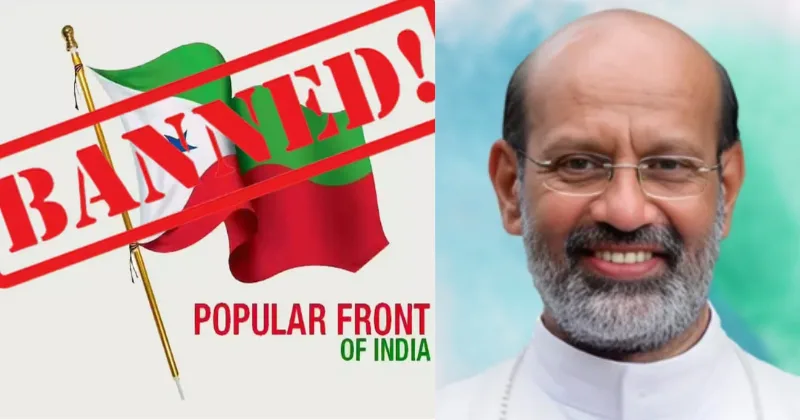
The Popular Front of India (PFI), despite being banned on 27 September 2022 by the Union Home Ministry, continues to operate in different forms across Kerala. The organisation finds a fertile ground in the state due to the political dynamics between the ruling CPM-led Left Democratic Front (LDF) and the opposition Congress-led United Democratic Front (UDF).
Both fronts have made electoral adjustments with the Social Democratic Party of India (SDPI), the political wing of the banned PFI, ranging from local body elections to Lok Sabha polls. Although the PFI was banned under the Unlawful Activities (Prevention) Act (UAPA) for proven terror activities, it now carries on under different guises, particularly through SDPI and other front organisations.
Death threat to Bishop reinforces security concerns
On October 31, Tamarasserry Bishop Remigiose Injaniyel received a death threat from an organisation calling itself the Islamic Defence Forces of India (IDFI), which claims to be the successor of PFI. This threat underscores fears of the banned outfit’s ongoing influence.
The similarity between the names PFI and IDFI is too close to ignore, reinforcing suspicions that former PFI cadres continue their operations under new identities. The SDPI, linked to the PFI, was also accused of instigating the hijab controversy at St. Rita’s Public School in Kochi.
Old terror roots and evolving avatars
Many Islamic extremist organisations trace their roots to the banned Student Islamic Movement of India (SIMI), the student wing of Jamaat-e-Islami, which was outlawed on 26 September 2001 by the Atal Bihari Vajpayee government. Following SIMI’s ban, its members regrouped under the National Democratic Front (NDF), which carried out several murders before evolving into the Popular Front of India.
The PFI gained notoriety for brutal acts such as the hand-chopping of a college professor in Thodupuzha, leading to its eventual proscription.
After the PFI ban, many of its members infiltrated mainstream political parties under both LDF and UDF banners. The Indian Union Muslim League (IUML), the second-largest constituent of the UDF, has been accused of providing direct and indirect support to these elements. Some IUML leaders are even reported to use language sympathetic to extremists.
When the PFI was banned, its cadres launched statewide violence. The police, rather than suppressing the unrest, allegedly remained passive — indirectly enabling the rioters.
Reports suggest that Islamic radicals from other Indian states and abroad have entered Kerala disguised as labourers. They are believed to be trained to spark riots at short notice. Past incidents support these claims.
Merely banning the PFI is not enough. Stronger measures are required to prevent its operatives from regrouping under different banners. This calls for robust action from the Union Government, thorough intelligence investigations, and vigilant public awareness.
The century-long shadow of political Islam
In Bharat, political Islam has played a divisive role for over a century. The All India Muslim League (AIML), formed in 1906, prioritised Muslim interests over national unity and ran politics parallel to the British-founded Congress Party (1885).
This divisive agenda ultimately led to the 1947 Partition. In 1948, the Indian Union Muslim League (IUML) was established with similar objectives — safeguarding Muslim interests even above national priorities. Since then, Kerala has remained its stronghold.
When political Islam lost electoral traction, it turned to violence. Organisations such as Jamaat-e-Islami Hind, SIMI, and PFI evolved with the same ideological objective: establishing religious supremacy and Islamising Bharat. The PFI itself declared a goal to convert India into an Islamic nation by 2047 — directly contrasting the national vision of a Viksit Bharat by 2047.
Kerala has a long history of political Islam intertwined with violence — from the 1921 Khilafat uprising to recent arrests of Islamic State (ISIS) operatives and open expressions of support for Hamas in Palestine. These developments have raised serious concerns about attempts to turn Kerala into a Sharia-influenced enclave within Bharat.












Comments