





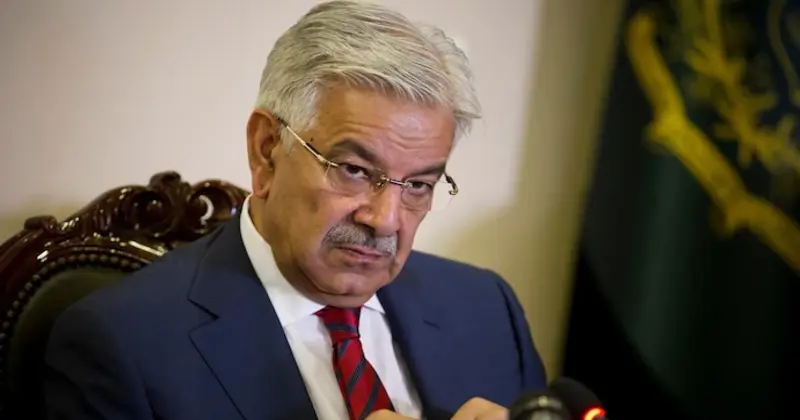
Pakistan Defence Minister Khawaja Asif has said that India wanted to keep Pakistan bogged down on both the eastern and western fronts amid tensions with Kabul and New Delhi. He said that Pakistan and Afghanistan have agreed to continue a ceasefire for now. Incidentally, there was rapid deterioration in bilateral relations and a brief conflict along their shared border in October. It was after intervention from Saudi Arabia, Turkiye and some other nations that the two countries had agreed on a ceasefire after talks in Istanbul.
These talks had followed a sharp escalation in tensions that saw Pakistan launch air strikes on alleged Tehrik Taliban Pakistan (TTP) sanctuaries in Afghanistan on October 9. This had triggered violent border clashes on October 11 that continued for days before a ceasefire was formalised in Doha on October 18-19. The Istanbul agreement came after days of deadlock that nearly brought the process to a halt, with mediators pulling both delegations back to the table even as Pakistan’s team had already begun preparations to return home, according to a Dawn report.
Meanwhile, an uneasy peace persists between Pakistan and India after their May conflict earlier this year. This means that Pakistan is facing a double jeopardy, with hostile neighbours on its eastern as also western borders. Incidentally, for a long time Pakistan treated Afghanistan as if it were a vassal state, treating its top leaders with scant regard. On August 25, 2021, when Taliban swept to power in Kabul, then Pakistan Prime Minister Imran Khan was jubilant. However, after four years, the Taliban leaders are out to prove that they have a mind of their own and will not bow to Pakistan.
Pakistan’s hostility towards poor Afghans and its decision to expel lakhs of such undocumented people may have permanently damaged its relationship with the Taliban regime. The rulers of Afghanistan have interpreted these actions as pressure tactics meant to bring them on their knees. However, they have refused to give in before Pakistan’s harsh actions of air bombardments and other actions attempted to choke their regime.
Amid it all, one of the most important actions that Afghanistan has initiated can lead to the loss of substantial water to Pakistan from Kunar river. Incidentally, Kunar river runs its course for about 480 km through Afghanistan and Pakistan territory before merging in the Kabul river. Angered by Pakistan’s recalcitrant behaviour, Taliban supremo Habitullah Akhundaza has announced that Afghanistan will build a dam on Kunar river for harnessing it for the benefit of Afghan people “as soon as possible”.
Akhundaza has said that the dam will be built by Afghan firms and seek to irrigate large tracts of land as also produce hydropower from the impounded water. It may be mentioned here that Afghanistan has no bilateral water-sharing agreement with Pakistan. So far, the country’s poverty has meant that no dams have been built to harness its rivers and water flows to downstream Pakistan unimpeded. This may be set to change in the coming months and years.
Since May conflict, Indian political and military leadership, including chiefs of the military branches, have made several statements, repeating terrorism allegations that Pakistan has always refuted. The Indian political and military leadership has also warned of changing history as also “geography” in the course of any future conflict. “If there is a need for evidence, then we have it, about what involvement India has in terrorism [in Pakistan] and how it wants to keep us busy on two fronts: the eastern and western”, Khwaja Asif said in a programme on Geo News.
He claimed that Prime Minister Narendra Modi was “silenced” after the defeat dealt to India during the May conflict. He expressed hope that talks with Afghanistan would reach a reasonable conclusion. “Everyone is on board — politicians, the establishment and the Pakistani nation — that an immediate solution to the Afghanistan issue is very necessary, which is that terrorism from Afghan soil should be completely stopped”, said the minister in reference to the country’s western neighbour. Asif said the preferable solution would be for both states to maintain a civilised relationship.
The second round of negotiations with Afghanistan produced a three-point understanding — the continuation of the ceasefire, the establishment of a monitoring and verification mechanism to ensure peace, and penalties for violations. The operational details of that mechanism are expected to be finalised when the “principals”, senior representatives from both sides, meet again in Istanbul.
In a related development, Pakista Information Minister Attaullah Tarar said that a fisherman from Pakistan was arrested by the Indian Coast Guard and was coerced into carrying out tasks for the neighbouring country’s intelligence agency. A few days ago, Asif had stated that India was waging a “low-intensity” war against Pakistan from Afghanistan, adding that New Delhi was trying to “settle the score” after facing defeat in the four-day conflict with Islamabad in May.
Separately, the information ministry rubbished remarks by Afghan Taliban spokesperson Zabihullah Mujahid about details of a prisoner exchange scheme in the Istanbul talks. Ariana News reported that he claimed Pakistani was informed in the talks that the Islamic Emirates of Afghanistan was willing to “deport people Islamabad considered a security threat” but Pakistan did not accept the offer. It added that he said that Pakistan requested the Afghan side to control such people within Afghanistan instead of deporting them.
Responding to the development, the information ministry said it “rejects deliberate twisting of facts” by Mujahid. Pakistan had demanded that terrorists in Afghanistan posing a threat to Pakistan be controlled or arrested. When the Afghan side said that they were Pakistani nationals, Pakistan immediately proposed that they be handed over through designated border posts, consistent with Pakistan’s long-standing position.
















Comments