





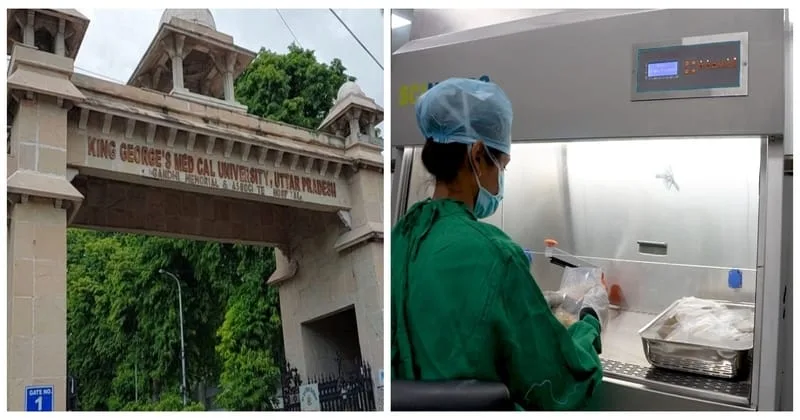
In a historic step for Uttar Pradesh’s healthcare sector, King George’s Medical University (KGMU), Lucknow, has established the state’s first Bone Bank. This has marked a new era of advancement in reconstructive and orthopedic surgeries. This facility will enable surgeons to use preserved bones from donors for various surgical procedures, an innovation that will significantly reduce dependence on autografts and make bone transplantation easier, safer, and more accessible.
The initiative marks a major breakthrough for patients who are suffering from bone loss due to accidents, cancer, infections, or congenital deformities. It goes well with Chief Minister Yogi Adityanath’s broader vision of a “Naye Bharat Ka Naya UP”, a technologically advanced and medically empowered Uttar Pradesh.
The Bone Bank will function much like an organ bank, but specifically for bones and bone tissues. Donated bones will be collected from deceased individuals who have pledged for organ or body donation. After necessary medical examinations, the bones will be processed, sterilised, and stored under ultra-cold temperatures, typically around -80°C, to preserve them for future use in surgeries. This scientific process ensures that the bones remain sterile, safe, and structurally intact for several years. They can then be used in orthopaedic procedures such as bone grafting, spine surgeries, limb reconstructions, and tumour resections.
According to Dr A.N. Agarwal, Senior Orthopedic Specialist at KGMU, this innovation will revolutionise bone surgeries. “Until now, for reconstructive or replacement procedures, we had to extract bone segments from the patient’s own body, which caused additional pain and prolonged recovery. With this Bone Bank, that need is eliminated. Surgeons can now use pre-preserved donor bones, ensuring faster, safer, and more comfortable recovery for patients,” he said.
Every year, thousands of patients in Uttar Pradesh suffer from severe bone loss caused by road accidents, bone cancer, and infections such as osteomyelitis. Many of these patients require bone grafts to restore normal function. However, the lack of an organised bone preservation facility often delayed or limited surgical treatment. With this new Bone Bank, patients across Uttar Pradesh will have access to ready-to-use bone grafts, saving crucial time in emergency and trauma cases. The facility is also expected to significantly reduce costs associated with importing bone grafts or using synthetic materials.
Dr Agarwal added that the Bone Bank would play a vital role in joint replacement, spinal reconstruction, and orthopedic oncology surgeries, particularly for cancer patients who lose bone during tumour removal.
Scientific process behind bone preservation
The process of creating a bone bank involves multiple stages of testing and preservation:
Collection: Bones are retrieved from deceased donors after obtaining consent from their families.
Screening: Samples are tested for infections like HIV, Hepatitis B and C, and bacterial contamination.
Processing: Bones are cleaned, shaped, and sterilised using gamma irradiation.
Storage: The bones are then stored in special freezers at extremely low temperatures (–80°C).
Usage: When required, they are thawed, re-sterilised, and used in surgeries as per patient compatibility.
This meticulous process ensures that every bone graft remains biologically safe and structurally strong for transplantation.
The newly developed facility at KGMU follows the model of AIIMS Delhi, PGIMER Chandigarh, and CMC Vellore, which are among the few medical institutions in India equipped with bone banks. By following these models, KGMU’s Bone Bank is set to become a regional centre of excellence, catering to patients not just from Uttar Pradesh but from neighbouring states as well.
Medical experts believe that the establishment of a Bone Bank will also promote the culture of organ and tissue donation in the state. Bones, unlike organs, can be preserved for a longer period and used in multiple surgeries, making them invaluable for medical use.
The hospital plans to raise public awareness about bone and tissue donation and encourage people to register as donors. “Many people are unaware that their bone donation can give someone a second chance to walk, work, and live normally. We want to change that mindset,” a senior KGMU official stated.
After receiving final clearance from the appropriate medical regulatory authorities, the facility is expected to become fully operational soon. Once functional, it will serve as a vital resource for teaching, research, and patient care, marking a new chapter in Uttar Pradesh’s medical history.
With the establishment of Uttar Pradesh’s first Bone Bank, KGMU has set a new standard for healthcare innovation in the state. The initiative not only strengthens the medical ecosystem but also embodies a compassionate vision where science and service meet to restore hope, mobility, and dignity to countless lives.













Comments