





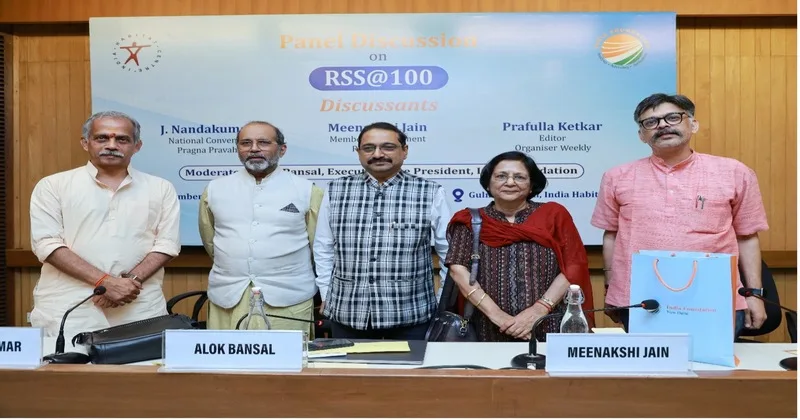
The India Foundation, in collaboration with the India Habitat Centre, organised a panel discussion on ‘RSS@100’ at Gulmohar Hall, India Habitat Centre, New Delhi, on November 3, 2025. The panel comprised J. Nandakumar, National Convenor of Pragna Pravah, RSS; Dr Meenakshi Jain, Member of Parliament, Rajya Sabha; and Prafulla Ketkar, Editor of Organiser Weekly.
The session was moderated by Capt. Alok Bansal, Executive Vice President, India Foundation. Capt. Bansal, in his initial remarks, highlighted the glorious journey of the RSS as a unique and one of the longest-serving organisations, and how the RSS has consistently contributed to society over the last 100 years. He also emphasises the insider-outsider view of organisation and organisation’s contribution in society and the nation-building process. Emphasising that the speech given by Param Pujyneeya Sar-Sangh Chalak ji served as a reference point for the discussion, Capt. Bansal set the tone and agenda for the discussants to present their views before the audience.
Prafulla Ketkar highlighted the reference points in the journey of the RSS and gave credit to the first Sarsanghchalak of the RSS, Shri K.B. Hedgewar, and V D Savarkar for the initial ideological background of the RSS. He emphasised the difference between the RSS and other organisations, pointing out the inclusive idea of Hindutva that the RSS espouses. Moreover, he explained this argument through the examples of some members of RSS, who joined various organisations to serve the country, and concluded how inclusiveness is an interesting working style of RSS, both as an organisation and a movement. During the explanation of the uniqueness of the organisation, he highlighted that the RSS joined the nationalist movement in a different way and worked as a dynamic organisation, citing his book, The RSS: 100 Years of Service, Dedication, and Nation Building.
Prof. Meenakshi Jain further provided details about the history of reforms in the 19th century and how the RSS was somehow related to those reform movements, but also made a distinct contribution. The trajectory of the RSS is aligned with some of the reform movements from Bengal and Maharashtra, but the RSS was not only a reformist movement but also played a major role in rebuilding the nation and its markers. Prof. Jain specifically talked about the Ram Janmbhoomi movement, which was essentially a mark of nation-building and highlighted the crucial contribution of the RSS members in collecting the evidence, even from the colonial times and archives (where it was mentioned as Janmsthan) for the court case and street narratives. She explicitly highlighted the pain of the members who sacrificed selflessly for the Temple cause.
J. Nandakumar highlighted the understanding and perception in poetic terms of different regions in India, where he highlighted the meaning of RSS as swa-ras, meaning self-taste. Nandkumar also explained the multi-dimensional vision of the RSS towards the nation and society, both during the colonial period and in the freedom movement, as well as in the process of nation-building. Furthermore, he explained the different phases of the RSS journey and pointed out that, in all these phases, one of the most important binding glues was its Shakha, which gave importance and continuity to the service for the nation.











Comments