





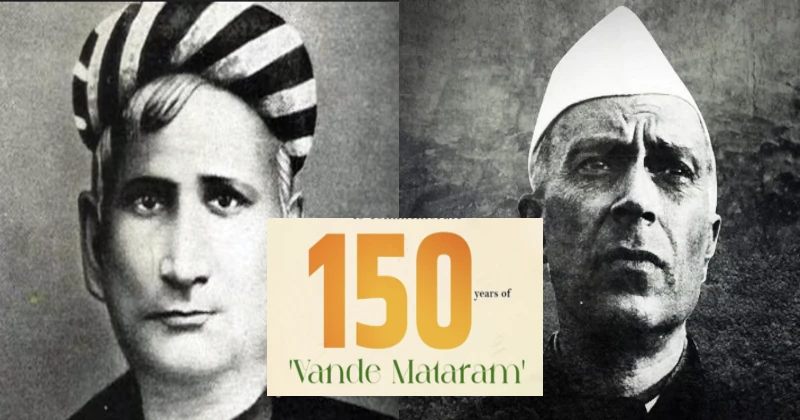
On the 150th anniversary of Vande Mataram, the song that once made British rulers tremble and inspired countless freedom fighters a storm of historical truth has resurfaced. What was once outlawed by the British for uniting Indians in revolt was later mutilated by India’s own leaders in the name of “secularism.”
At the centre of this controversy stands Jawaharlal Nehru, India’s first Prime Minister, whose correspondence with Mohammad Ali Jinnah, Subhas Chandra Bose, and poet Sardar Jafri reveals a disturbing pattern one of appeasement, compromise, and deliberate dilution of India’s civilisational spirit.
As Prime Minister Narendra Modi led the Vande Mataram@150 campaign calling for the collective singing of the entire version of the song across the nation he reminded the country that the real censorship of Vande Mataram was not done by colonial masters, but by Congress leaders themselves.
Few Indians today know that in a letter dated October 25, 1937, Jawaharlal Nehru personally wrote to Mohammad Ali Jinnah, explaining that only the first two verses of Vande Mataram would be used publicly because “the later portions contain certain allusions which might offend the susceptibilities of our Muslim friends.”
Why were paragraphs omitted from Vande Mataram?
Because Jawaharlal Nehru himself explained to Jinnah that certain stanzas were “objectionable to Muslims.”
In a letter to Jinnah dated 25 October 1937, Nehru wrote that only the first two verses of Vande Mataram would be used… pic.twitter.com/10Bz4XTDeV
— Amit Malviya (@amitmalviya) November 7, 2025
That one sentence marked the beginning of the political sanitisation of India’s national song. Even more revealing was Nehru’s October 20, 1937, letter to Subhas Chandra Bose, in which he admitted that the “background of Vande Mataram could offend Muslims,” and conceded that there was “some substance” in their objections.
Bose, a staunch nationalist, had strongly defended the complete song, arguing that it represented Bharat Mata, the motherland itself, not a sectarian deity. Yet Nehru, driven by political calculation, chose surrender over conviction.
Later, in a letter to Urdu poet Sardar Jafri, Nehru continued to defend the truncation of the song, saying that while Vande Mataram had “played a magnificent role in our national struggle,” its full version contained imagery that could “create difficulties.” Hence, only the first two stanzas were considered fit for public rendition.
At the Faizpur Session of the Congress in 1937, Nehru then the party’s president took the unprecedented step of formally adopting the truncated version of Vande Mataram as the Congress anthem.
This version excluded verses that invoked Durga the embodiment of Shakti and the personification of Bharat Mata’s strength. According to BJP IT Cell head Amit Malviya, this was not an act of inclusivity but a deliberate distortion of Bharat’s cultural identity.
He revealed that in a letter dated September 1, 1937, Nehru expressed outright disdain for the song’s spiritual tone, writing that including any reference to the goddess was “foolishness” and that Vande Mataram was “not suitable as a national anthem.”
यह ज़रूरी है कि हमारी नई पीढ़ी जाने कि किस तरह कांग्रेस पार्टी ने पंडित नेहरू की अध्यक्षता में अपने मज़हबी एजेंडे को बढ़ावा देते हुए 1937 के फ़ैज़पुर अधिवेशन में केवल कटा-छँटा ‘वंदे मातरम्’ को ही पार्टी का राष्ट्रगीत बनाया था।
आज जब प्रधानमंत्री नरेंद्र मोदी जी ‘वंदे मातरम्’ के… pic.twitter.com/usZMjYqzIT
— Amit Malviya (@amitmalviya) November 7, 2025
Amit Malviya called this “the first official act of cultural vandalism committed by Congress in independent India’s formative years.”
“The British banned Vande Mataram because it united Indians for freedom. The Congress censored it because it united Hindus in pride,” he asserted.
Fast forward to 2024, nearly nine decades later and the same anti-Hindu strain runs through Congress’s politics. Rahul Gandhi’s statement during the Bharat Jodo Nyay Yatra that “we are fighting against Shakti” was not a political slip; it was the echo of Nehruvian disdain for India’s spiritual power.
Amit Malviya drew this parallel sharply, saying, “When Nehru erased Durga from Vande Mataram, Rahul Gandhi erased faith from politics.”
This ideological contempt, he added, explains why Rahul Gandhi recently mocked the sacred Chhath Puja as “drama,” hurting the sentiments of millions of devotees. From Nehru’s dismissal of Durga to Rahul’s mockery of Chhath, Congress has consistently derided symbols of Hindu faith masking it under the guise of “secularism.”
At the Vande Mataram@150 celebrations, Prime Minister Narendra Modi launched a powerful counter-narrative. He said the removal of significant verses from Vande Mataram “sowed the seeds of partition,” as it represented the first instance where India’s cultural unity was sacrificed at the altar of vote-bank politics.
“The Congress didn’t just drop stanzas they dropped the idea of Bharat Mata,” PM Modi declared.
“Vande Mataram united us in the freedom struggle; Congress divided it for political convenience.”
PM Modi exposes Congress’s communal politics over Vande Mataram 🇮🇳
On the 150th anniversary of Vande Mataram, Prime Minister Modi reminded the nation how Congress leaders — from Nehru to their present heirs — diluted and disrespected the very song that inspired India’s freedom… pic.twitter.com/47WAeZ5YDT
— Amit Malviya (@amitmalviya) November 7, 2025
For PM Modi, restoring the full rendition is not merely about music or poetry it is about restoring the soul of the nation, one that recognizes Shakti, Maa Bharti, and the sacred bond between motherland and patriot.
In the early 1900s, Vande Mataram was the heartbeat of India’s freedom struggle. From Bipin Chandra Pal and Sri Aurobindo to Tilak and Netaji Bose, the song was the anthem of resistance. The British outlawed it, fearing its power to unite a colonised people. But after independence, the same song was deemed too Hindu by Congress leaders who feared losing minority support.
Today, as PM Modi calls upon citizens to sing the full version of Vande Mataram, the movement carries symbolic weight far beyond cultural celebration. It is a national correction of historical wrongs a reminder that Bharat’s unity cannot be built by erasing its roots.
Amit Malviya’s concluded that, “Vande Mataram is not just a song. It is the living soul of Bharat which Congress tried to suppress, and which Prime Minister Modi is now resurrecting for the new generation.”











Comments