





Lives of great men all remind us
We can make our lives sublime,
And, departing Leave behind us
Foot prints on the sands of time
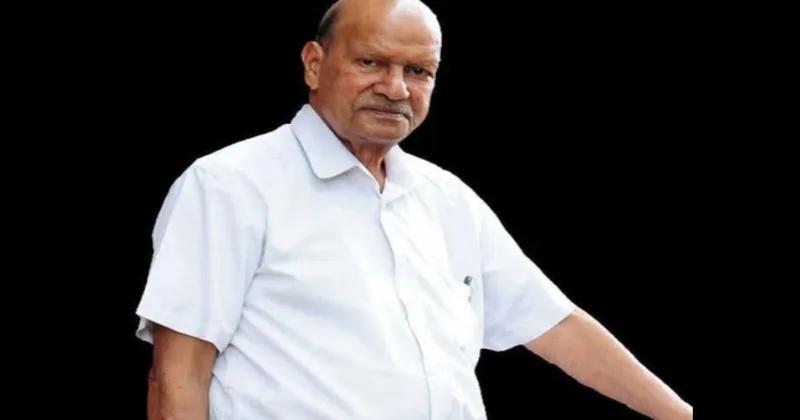
Prof. K. Narahari, a senior karyakarta of the Rashtriya Swayamsevak Sangh, has left us. The Sangh was the base line of his life, the Sangh was the top line also. Born in 1932 in Bengaluru, Prof. Narahari passed away on October 8, 2025, after leading a devoted Sangh life spanning 80 years. In his life as a karyakarta of the Sangh, a professor, a legislator and a leader of various social organizations, the qualities that stood out in Narahari were his national consciousness, social concern, devotion and allegiance to the Sangh, efficiency in work and kind-hearted nature.
Sangh Work as His Daily Routine
Narahari became a Swayamsevak of the Rashtriya Swayamsevak Sangh during his student days and was among the first Swayamsevaks in Bengaluru. His entire household was a Sangh home. His elder brother, Sri Suryanarayana Rao (Suru), was a pracharak who expanded Sangh work across South India and served as an Akhila Bharatiya Seva Pramukh. As a college student, Narahari already carried Sangh responsibilities. Sangh work was always his top priority and he remained continuously active from 6:30 in the morning. His day took him from the shakha to college, then to Sampark, followed by the night Baithak, returning home late, sometimes as late as midnight. The six chapatis prepared by his mother were his breakfast, lunch and dinner. While he always prioritized the work of the Sangh, he successfully earned his B.Sc. and B.E. degrees. Later, in 1959, he worked as the jilla pracharak in Kodagu district. In times when Sangh work was considered challenging, he sowed the seeds of its growth.
His Journey as a Lecturer
Later, he joined BMS College of Engineering as a lecturer in Mechanical Engineering and eventually became a professor. He studied the subject matter thoroughly, to ensure that his students fully understood each lesson. He was always punctual for his classes and sought to instill in his students the values he embodied as a swayamsevak: putting the nation first, social responsibility, discipline, self-restraint, honesty and meticulousness in their work.
In class, he wrote on the blackboard in clear, straight lines. About ten minutes before the end of the class period, he would neatly clean the board himself so that it was ready for the next class/lecturer. One of his former students, who later became a Vice-Chancellor, remarked that he brought a sense of spirituality and national consciousness into the teaching of Mechanical Engineering. While teaching entropy in thermodynamics, he would explain that in every system in the world, there will be a state of disorder and to restore order, energy must be brought in from outside. Human life reflects the same principle, for it to be balanced and righteous, national consciousness must be nurtured, and spirituality must be imbued. About ten years after Narahari voluntarily retired from the college, a young scholar in the Department of Mechanical Engineering made the remark. ‘Even after Ten years he was a legend in our college’.
Service in the Legislature
Narahari was elected three times as an MLC from the teachers’ constituency. He never aspired for the position. He remained distant from the legislature and indifferent to power. However, the Sangh directed him to contest the elections and he agreed without hesitation, as the Sangh’s directives were always binding on him. As an MLC, he was ajatashatru, a friend to all and earned the respect of members from all other political parties. He also respected other political leaders and maintained close rapport with everyone. Regardless of which party was in power, education ministers and officials sought his guidance and opinions on educational matters. Yet, Narahari never compromised on the national interest, social welfare, or the ideological principles of the Sangh.
He held the responsibility of leading numerous social organizations and institutions and worked as their head at the All-India level. He worked in such a way that each organization and institution functioned according to its original goals and objectives and progressed step by step. The thought of being the head of an organization never entered his mind and it was never reflected in his behavior. He remained a humble servant of the organization. He was member of management committee of 115-year-old renowned organization, The Mythic Society in Bangalore, for 50 years and also held the position of its president. During challenging times, he was the backbone of the Mythic Society. He had deep affection for the Janaseva Trust and the educational institutions in Channenahalli. During his tenure as an MLC from 1984 to 2002, he donated his entire salaryand, later, his pension to the Janaseva Trust. The government had allotted him a plot of land in Bangalore, which he sold and donated the proceeds to the Janaseva Trust. He often said, “I became a legislator because of the Rashtriya Swayamsevak Sangh and the Sangh’s samskar and therefore, all the remuneration I received as an MLC was meant for the service of society.”
Role During the Emergency
During the Emergency, he successfully undertook and guided numerous challenging and complex tasks in Karnataka as a leader of the underground movement.
Narahari’s physical body has returned to the five elements, but his spirit endures forever in the students he taught, the dedicated swayamsevaks he guided and the organisations and institutions he led.













Comments